You know those characters that are constantly referred to so smart or so capable or so sensitive (etc. etc.) by other characters or in the narration? And every time it comes up you find yourself shaking your head or rolling your eyes because the character in question either is as bland as boiled potatoes or constantly acts in ways that contradict those claims without explanation?
That’s what is commonly called an “informed trait”. You’re told the character is a certain way (or has a certain ability), but there is more or less nothing in the text to back that up.
It goes the other way around, too, with informed flaws that are supposed to make a character more relatable or interesting – think almost every romantic comedy leading lady who is supposedly “shy” and “clumsy”, but in a cute, endearing way that only ever comes up when the plot asks for it.
It’s frustrating, distracting, incredibly dull and at times downright insulting to the reader to encounter a story where one or more characters have a bad case of this, but unfortunately, it’s a pretty common weakness even in otherwise strong, well-written stories with interesting and complex character concepts.
Since characters and how the reader feels about them (whether they are supposed to relate to them, look up to them or feel repulsed by them) can really make or break a story, informed traits are an easy trap to fall into and many a writer’s Achilles heel.
So, how to avoid them?
This is where the trusty old “Show, don’t tell” comes in. You have most likely been told before that it’s usually better to go for subtlety and leave something to the reader’s imagination than to spell it out, and that is true.
It’s challenging to imply something without outright saying it. You have to get creative with the details you want to put into your story to get a point across by relying on your audience’s ability to read between the lines, and while it’s absolutely worth it to go the extra mile, you also run the risk of making your narrative too stilted and contrived instead.
However, there is a fairly simple trick to make your characterization feel more natural and insert it into the story smoothly:
Stop thinking of your characters as possessing certain traits and start thinking of their personalities as a collection of habits, preferences and specific abilities.
It might not sound like that big of a difference, but it will make translating your character traits into text much, much easier and save you a lot of trouble while editing.
Some examples:
A “smart” character
This can mean a lot of things. You could have a character who is booksmart, learns quickly, reads a lot, can retain information easily and access it when needed, but has trouble applying theoretical knowledge in real life, someone who entertains their friends by telling them about weird facts and trivia, someone who can still recite poems they had to learn by heart when they were ten, someone with a tendency to talk in such complex run-on sentences they frequently forget what they were talking about half-way through. Or you could have a character who is good at problem-solving instead, who likes puzzles and riddles, who gleefully obsesses over odd problems to find even odder solutions, but thinks so far out of the box in order to remain engaged in their current task they often miss the forest for the trees.
A “brave” character
Try to instead make a character who can never resist a challenge, who is a thrill-seeker and went bungee jumping about a dozen times already, who enjoys dragging their friends on the most dangerous looking rides in an amusement park and endlessly teases them about how pale they went afterwards. Make someone who simply cannot stand by when they see someone else get bullied, someone with a collection of scars they wear proudly and a story to tell about each one.
A “shy” character
Forget about characters who blush prettily when spoken to and that’s it. Instead, write about a character who can’t make eye contact without forcing themselves to, who stumbles over their own words when talking to strangers, who is afraid of wearing bright colours because it might draw attention to them, someone who is humble and polite, but distant and comes across as cold or uncaring because they have tendency to hide their insecurity by retreating into themselves, even though seeming rude is the last thing on their mind.
Insert these habits into the story wherever they fit best. Be consistent in the portrayal of your character’s behaviour, even as character development kicks in. Adjust deliberately, but reasonably. After all, old habits die hard, so having your character break with one, however minor, can be a powerful moment with just as much emotional resonance as a flashy, dramatic scene meant to convey the same sentiment, and any “big” scenes will likely feel more organic if the reader has already seen traces of the necessary character changes before.
“Stop thinking of your characters as possessing certain traits and start thinking of their personalities as a collection of habits, preferences and specific abilities.”
Ironically, I’m dealing with a character right now who falls under #2, and that section is actually a perfect match.
hot take: if the only people who can understand your writing are a select few pretentious jerkoffs like yourself, maybe the problem isn’t that you’re just too fucking smart to communicate to the uneducated masses. maybe you’re like. a bad writer lol
like uhhh not be controversial but if the point of academic writing is to share information and 75% of your readers have no fucking clue what you’re saying around that thesaurus you’re deepthroating then uhhh maybe you’re a shit academic and also a lot less intelligent than you think you are. just a concept
Are you really…. not supposed to…. describe what your characters are wearing….
I think there’s a great deal of misinformation on this topic.
I believe it’s fine to describe what your characters are wearing. However, like all things, it should serve some kind of purpose.
For instance, describing winter clothes helps impart to the reader a sense of how cold it is. Describing summer clothes helps explain how warm it is.
Describing an outfit before a social event gives a window onto the character’s sense of fashion, or explains their reverence (or lack) for the event; for example a character can wear a black suit to a funeral, or watch from a distance while wearing a t-shirt and jeans. These impart a different attitude.
An outfit may be described purely to give a little more interest to a character; to give the reader a bit more insight into who they are, through the way they present themselves. It may have no greater significance to the wider story but this is still a reason to do it.
So the “purpose” doesn’t need to be super-vital to the story. It can be just because “describing this to the reader helps them appreciate the character or scene”, but that’s still a purpose.
I like that last comment because I think it can apply to a lot of things in storytelling! Anything that shows some element of your character has a purpose to the story even if it doesn’t exactly advance the plot.
it really is next to impossible to write realistic sibling dialogue, I just passed my brother on the stairs and instead of greeting each other like human beings I said ‘born survivor’ and he said ‘youtube rewind. let’s set it to rewind.’ like you ain’t gonna find that shit in a novel
aw man writing siblings is so wild because sometimes you just can’t portray it
me and my little brother don’t even greet each other – if we pass each other on the stairs or in the corridor, we jump into ridiculous fight stances then feign karate chopping and slapping each other (stopping just before we make contact) whilst making “HIIIYA” and “POW” noises for a solid 30 seconds, then silently walk off and continue what we were doing
and then sometimes he’ll either just do the Had To Do It To ‘Em pose when I enter the room or dab as a greeting
exactly! I have three younger brothers and the original post was just about the oldest, the middle one and me usually do some kind of elaborate dab also, and a lot of the time when I see the youngest I just yell his name like a wrestling commentator…siblings have a different language
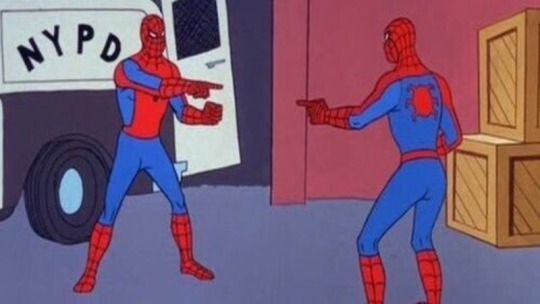
my twin brother and I just point at each other like that spider-man meme if we see each other at school
it really is next to impossible to write realistic sibling dialogue, I just passed my brother on the stairs and instead of greeting each other like human beings I said ‘born survivor’ and he said ‘youtube rewind. let’s set it to rewind.’ like you ain’t gonna find that shit in a novel
Do you know what writers deserve? No matter how many reads or followers?
F E E D B A C K
I agree. But you have to actually take that feedback.
I’ve (constructively) criticized writing and been told, basically, that my criticism was wrong.
So. That’s why I’m scared to give anything less than “it was good” and/or something to the effect of “I enjoyed it”.
And like.. you can say all you want that you won’t bite, but for some people.. that doesn’t matter. Like I’m scared to give my literal best friend actual feedback even though literally nothing bad could possibly come from it. Some people are just.. scared.
I’m all for encouraging people to give people feedback (and reblog art(writing is art too)), but.. yeah.
Satan had gotten tired of forwarding misspelled Christmas letters and decided to go speak with the big man himself. Write about the unlikely friendship spawned between Satan and Santa.
 ifesbob