today i looked up lost words and these are my favorites:
airgonaut n 1784 -1784 one who journeys through the air Balloonists, skydivers and other airgonauts are all a little mad, if you ask me.
alabandical adj 1656 -1775 barbarous; stupefied from drink His behaviour after the party was positively alabandical.
amarulence n 1731 -1755 bitterness; spite After losing her job to a less qualified man, she was full of amarulence.
amorevolous adj 1670 -1670 affectionate; loving Our father, though amorevolous, could be a strict taskmaster at times.
apanthropinization n 1880 -1880 withdrawal from human concerns or the human world His life as a hermit in the woods was characterized by apanthropinization.
aquabib n 1731 -1883 water-drinker I was never much of an aquabib, and always preferred harder libations.
artigrapher n 1753 -1753 writer or composer of a grammar; a grammarian Today’s prescriptivists are no better than the artigraphers of the Renaissance.
boscaresque adj 1734 -1734 picturesque; scenically wooded Despite northern England’s industrial pollution, parts of it remain boscaresque.
crocitation n 1623 -1656 croaking; cawing The crocitation of the gulls meant that I got no sleep last night.
dodrantal adj 1656 -1883 of nine inches in length The male stripper’s dodrantal instrument impressed the ladies greatly.
ephydriad n 1823 -1823 water-nymph The synchronized swimmers were like ephydriads, full of natural grace.
essomenic adj 1771 -1771 showing things as they will be in the future The essomenic properties of crystal balls are very much in dispute.
fabrefaction n 1652 -1678 act of fashioning or making a work of art The sculptor felt that fabrefaction was more important than the end result.
latibule n 1623 -1691 hiding place The girl emerged triumphantly from her latibule, only to find her friends had already left.
lignatile adj 1855 -1855 living or growing on wood She collected lignatile mushrooms on her hike, confident in her identifications.
magastromancy n 1652 -1652 magical astrology Her reliance on magastromancy to decide the students’ grades got her in trouble.
murklins adv 1568 -1674 in the dark She stumbled murklins about the house until she found the light switch.
nepheliad n 1818 -1821 cloud-nymph Like a nepheliad, the skydiver dove gracefully through the clouds.
nerterology n 1800 -1800 learning relating to the dead or the underworld Her inquiries into nerterology were inspired by a youthful visit to a medieval crypt.
quaeritate v 1657 -1657 to question; to inquire If I might quaeritate, why are we headed in the wrong direction on the trail?
scaevity n 1623 -1658 unluckiness; left-handedness She attributed her failure to evil forces, but her family felt it was a matter of scaevity.
scelidate adj 1877 -1877 having legs; legged The legless dragon of Eastern myth contrasts with its scelidate Western counterpart.
senticous adj 1657 -1657 prickly; thorny He pricked himself on a senticous bush as he searched about for his golf ball.
siagonology n 1895 -1895 study of jaw-bones Reliance on siagonology alone led to the proliferation of the Piltdown Man hoax.
sparsile adj 1891 -1891 of a star, not included in any constellation The prevalence of sparsile stars today reflects technical advances in telescopy.
stagma n 1681 -1820 any distilled liquor I will touch neither wine nor stagma, though I do occasionally partake of ale.
supellectile adj 1615 -1843 of the nature of furniture Our apartment is full of knick-knacks, but is lacking in supellectile necessities.
thural adj 1624 -1714 of or pertaining to incense The mysteries of the ancient order involved the burning of thural herbs.
vampirarchy n 1823 -1823 set of rulers comparable to vampires Some believe that we are secretly ruled by the Illuminati or a similar vampirarchy.
venialia n 1654 -1654 minor sins or offences Though he had done nothing heinous, all of his friends had been victims of his venialia.
Why I never mock or even bring attention to mispronunciation in a conversation, and will snap down anyone who tries to
Besides poverty, for many peoplevEnglish is a second (or third+) language and has weird rules too.
Most of the time, even when words are mispronounced, they’re still understandable if you make an effort. Just be patient and don’t look down on people who mispronounce!
how did they learn to translate languages into other languages how did they know which words meant what HOW DID TH
English Person: *Points at an apple* Apple
French Person: Non c’est une fucking pomme
*800 years of war*
Fun fact: There are a lot of rivers in the UK named “avon” because the Romans arrived and asked the Celts what the rivers were called. The Celts answered “avon.”
“Avon” is just the Celtic word for river.
Fan Fact #2: When Spanish conquistadors landed in the Yucatán peninsula, they asked the natives what their land was called and they responded “Yucatán”. In 2015, it was discovered that in those mesoamerican languages, “Yucatán” meant “I don’t understand what you are saying”
W H E E Z E
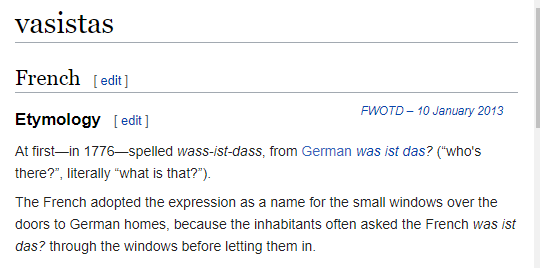
I love entomology so much because so many words kind of happened by accident or by a native speaker trying to say “WTF are you saying?“
hey in case u dont know why “breaking the fourth wall” is called “breaking the fourth wall”:
in traditional stage play sets you only ever saw 3 walls in a room. if there were 4 walls you obviously wouldnt be able to see the actors since they would be blocked from view. that missing wall is removed from the physical set, and instead implied to be there. the characters act as if there is 4 walls completing the room even though there is only 3. however, when the character addresses the audience in some way they are effectively removing that barrier that we placed there, the 4th wall and, thus, “breaking the 4th wall”.
i know it seems pretty obvious when you think about it and im sure plenty of you already put it together in your head, but I didnt think about it for so long and just kinda accepted the phrase to mean “a character talking to the audience” without knowing why it was phrased that way. but now ya know.
one of the things that fucking sucks about being decently versed in online terminology is seeing a joke or particular word usage or reference that immediately pins down exactly what shithead online circle someone’s from
So literally “Bear Bear Bear”. The most bear a bear can be.
So bear. Much roar. Wow.
Also! The Arctic Circle is named for the bears, not the other way ‘round. It’s the Circle With Bears In, and the Antarctic is the Circle (and continent) Away From Bears.
Are you telling us that the poles of our world are Bear Continent and Anti-Bear Continent
im highkey convinced that 99% of americans cant name the 7 continents correctly
Africa, Australia, South America, North America, Antarctica, Asia, Europe (?)
Probably messed that up but eh
australia is not a continent lghjglkhjglk
its oceania which also includes n. zealand, polynesia, etc.
Told you I messed up
If I wasn’t sick rn I might be able to? Idk geography isn’t my strong suit.
Oceania isn’t considered a continent where I live. Its Australia.
Australia is a continent and I have Google backing me up
Do people really not know the seven continents???????
Australia… isn’t… a continent… it’s… Oceania…
A continent’s a big chunk of mass do it’d be australia
OK YALL MOST AMERICAN SCHOOLS CONSIDER AUSTRALIA TO BE A CONTINENT BECAUSE THE SYLLABUS AND WHAT INFORMATION IS TAUGHT VARIES FROM SCHOOL DISTRICT TO SCHOOL DISTRICT
I cant believe this got 97 notes ajfkskd
and a discussion wheter australia is or isnt a continent djgkdn
Yeah i was taught that Australia is a continent and country so
this is weird
wikipedia english calls it australia
while other languages call it oceania
German says Australia
In Croatia it’s Australia. It’s both a country and a continent.
Our books were inconsistent. Half of them said Australia, and the other half said Oceania.
And Indians are just as ridiculously bad at geography as Americans despite having it as a school subject (while Americans do not). One of my classmates thought Czechoslovakia was in Africa…
In Australia we use both….
Australia for the continent.
Australiasia for Australia, New Zealand, and a couple of neighbouring islands, sometimes including Papua.
Oceania as a broader geographic region, also including Melanesia, Polynesia, and Micronesia. Its a large enough geographic region that it also includes the Bonin island (Japanese), Hawaii, Juan Fernandez Islands (Chilean), and the Cocos Keeling Islands (Australian, but closer to Java than Australia…).
And if you want to play plate tectonics, it’s called the Australian plate. The current position seems to be that it broke from the Indo-Australian plate (again). Much of what is included in Oceania is not on the Australian plate, nor any where close to it.
sjdkak i almost forgot of this post
thanks for your input
In Canada we were mostly taught Australia (Australia is a continent, country, and an island! Wow so cool), but we have some books that say Oceania and that’s what I always went by. Bottom line is it’s sort of a grey area and no one’s really right or wrong.


 ifesbob