This suggests that Maximum Overdrive was Jurassic Park for motor vehicles.
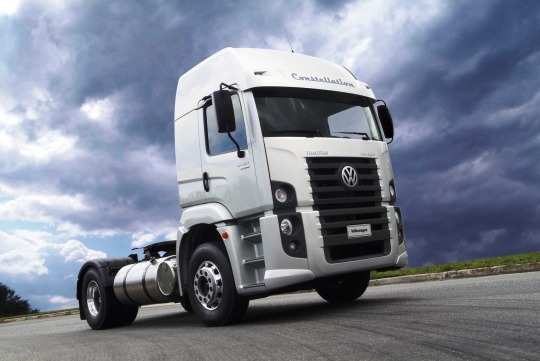
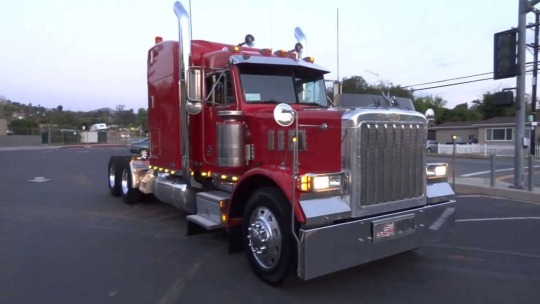
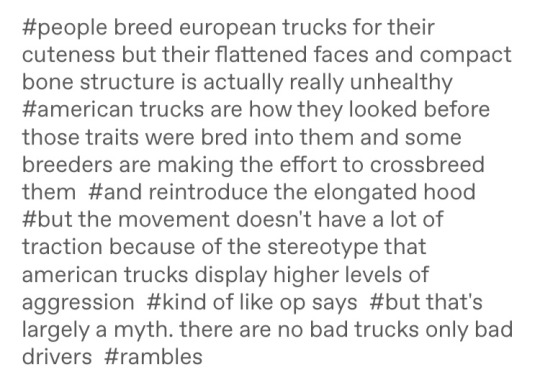
I’m sorry, but that is misleading as hell. American and European trucks are bred for different purposes.
American trucks are bred for long hauls on largely straight roads. They can go for hours without a break. A European truck needs more breaks and a lighter load, and they would indeed take great internal damage if they tried to keep up with the Longsnout.
The European Shortsnout is not bred for looks, but for agility! They navigate the windy roads of Europe in a way that would be way too risky for the powerful, but more clumsy American truck. It is true that the European overheats faster at high speeds, that is the very reason that breaks every 4,5 hours are mandatory for both the truck and the handler and a day of driving can never be longer then 9 hours.
So, all in all, appreciate all of our trucks and our shared history, and be the responsible owner that gets the right breed for the right job.
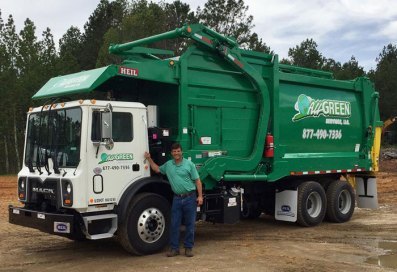
To be fair, the US does have shortnose trucks as well, they’re just a breed kept mainly for very local work where, like the above says, they are working in places with lots of turns, shorter drives, and plenty of stops. I see them used for garbage pickup a lot, where a longnosed Mack wouldn’t be able to fit much less maneuver, and the short nose prevents them from getting rubs (raw skin or even open sores) on their snouts.
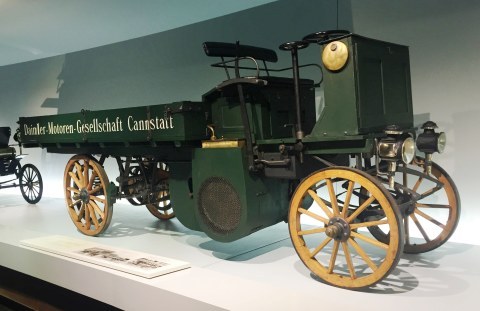
I would also like to point out that the tags have got it backwards. The wild trucks (which I’m pretty sure are extinct in the wild now) that all modern breeds stemmed from were shortnose trucks. We had known about automobiles and domesticated several species, but the truck species was not discovered until close to the start of the 1900’s, in Germany, which I BELIEVE was the first country to breed them in captivity, although England was the first country to really start using them for work. I managed to find a photo of taxidermied specimen
As you can see, it resembles both long and short nosed breeds, as well as the far more common house truck used by individuals instead of for commercial work.
As to the aggression, while the mack longnose LOOKS aggressive, they’re generally gentle giants (although please do give them space on the road! not seeing you in their blind spot is NOT the same as aggression!), it is actually the smaller house truck that is often trained by their handler to be aggressive: the keyword being TRAINED, they are also not naturally aggressive. The only time I have seen a mack be commonly aggressive is when they are pulling 2 gravel trailers, and I would be cranky if I was being overworked, too. If you see them hauling that kind of load, just give them space, and you’ll be fine.
I feel like somebody should add something about the Australian variants.
From my understanding of Australian wildlife:
Does anyone know if/how American School Busses are related to trucks?
Pics for reference:
The classic long-nose schoolbus
But short-nose varieties exist, I remember when they first started appearing in my district!
@dreorzen While school buses ARE in the automobile order, they are actually part of the Van family, not the Truck family, due to their passenger capacity. As you can see in the photos, they have no cargo bed or hookup, and are not really built for object transport. But they DO excel at carrying passengers, particularly children (although certainly not limited to just children)
They’re known to be exceptionally protective of any passengers, and if you look closely on that second image you can actually see a specialized appendage that is (I think) unique to school buses- a small, red, octagonal fan, which they extend when there are small creatures around them that they are acquiring or releasing. Much like an angler fish’s bioluminescent bulb appendage, this fan (along with several bioluminescent patches on top of their faces and on their hindquarters) works to mesmerize any other vehicles in close proximity, to where those vehicles will cease movement until the bus lowers the fan. It’s super fascinating behavior, and little wonder why we trust our children to these gentle, protective giants.
Man this post gets better every time I see it xD
The fact that this is all objectively correct information delivered as if trucks are sentient animals is just…
This wind powered cargo ship is set to change the way we ship the goods across oceans. The model is very practical and is looking at a possible launch in 2024. https://ift.tt/2MKA9Pb
Wind powered ships!? What a time to be alive!
we really are in the future
ok i did have a good laugh but the more i think about it the more awesome this is?
i mean, the reason we quit using sail power wasn’t because it didn’t provide good propulsion. it was because sails were fragile, labor-intensive, and subject to the whims of the weather. from an industrial revolution era perspective, being able to know that your cargo is going to be chugging across the atlantic at a constant 10 knots and arrive friday after next at the latest was HUGE. it’s no wonder we never went back, even after fossil fuels became not only gross but expensive.
this design? using aerofoils like plane wings, with full rotation ability and telescoping height, controlled by computer from the wheelhouse? all the problems with sail power are suddenly over, except the ‘how much wind is there’ one. and that one is significantly reduced by modern weather data gathering systems.
i love the age of sail as a fiction setting because sailing tall ships was so fraught and busy and stressful. the captain or bosun was shouting out orders based on what he could see and feel and guess in that very moment, and maybe some clues like the movement of fog or birds in the distance, and a bunch of underfed guys with crippling ptsd would go rushing up and down an enormous jungle gym with no safety equipment, quite often coated with ice or in the pitch dark, and if they screwed up they died. amazing drama.
but for real life oceangoing experiences, give me this. a ship so big it feels solid as a rock, sails like skyscrapers, no mechanical sounds but the occasional hum of servos adjusting their angle, gliding serene across the water like a reflection of the moon. yeah. give me that.








 ifesbob