you are missing something! although those are the boots of the apollo 11 suits, they’re not what was worn on the moon. neil armstrong, not content with wearing just one pair of shoes, demanded nasa make him another, larger and cooler pair of boots just for walking on the moon.
you can see them here, to the right of the suit’s built-in boots.
photos of armstrong on the moon prominently feature the boots!
although i couldn’t find any official nasa photos of the bottoms of the boots, i could find something even more interesting! an x-ray of the boots “taken as a last minute check to see if there were any foreign objects that could compromise the integrity of the spacesuit during the mission, such as broken off tips of needles that were used in the stitching process”
the thick vertical lines are the treads at the bottoms of the boots
on a more pragmatic note: if nasa was faking a moon landing with a $150 billion+ budget, do you really think they’d mess up something as simple as a boot print?
“The important thing to understand here is that all that the calculations can tell is the mass of Planet Nine, not its composition,” Batygin told Astronomy. “So, in principle, Planet Nine can be a planet, a potato, a black hole, a hamburger, etc., as long as its orbital parameters are right.”
the short answer is no! there are many different types of stars.
the long answer is that I used that wording because I didn’t want to bring up the term ‘main sequence star’ in a short blurb, but here goes- a main sequence star is any celestial body that gives off light and heat by fusing hydrogen atoms together to form helium! these stars have a specific color/size range and a definitive life cycle.
most of the lights and named stars you see in the night sky are actually main sequence stars, but not ALL of them. there are also weirder bodies lurking out there in the dark like pulsars, neutron stars, red giants, and red, brown, or white dwarfs! none of those objects fuse hydrogen and thus they aren’t main sequence stars.
but both our own sun and 51 Pegasi are main sequence stars, making Pegasi 51b the very first exoplanet discovered orbiting a stellar body comparable to our own.
(they had found exoplanets before that but they were orbiting a pulsar for some reason? maybe they were lost.)
Star science is so cool. Plus, the phrase G2V Sol (our Sun!) is a neat thing.
This is really quite a big deal. A tremendous amount of modern research ends up being sold to journals which require unreasonable payments to access it and only pay the original authors a pittance. It’s nice to see an agency like NASA deliberately widebanding its findings.
Not sure if people fully realize just how big of a deal this is.
THIS is how science is advanced. Not through biased corporate research, business secrets, marketing, paywalls and patent wars. But through open, uncensored and unrestricted public access to knowledge.
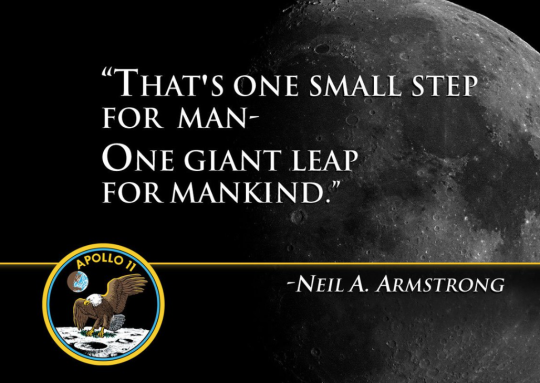
also according to michael collins when the three of them were discussing what neil armstrong should say when he first stepped on the moon, collins suggested armstrong say “Oh, my God, what is that thing?” and then scream and cut out his mic.
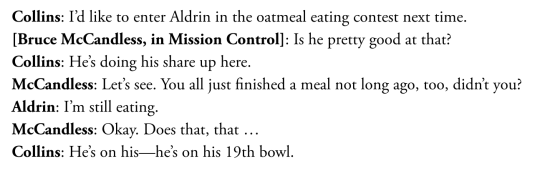
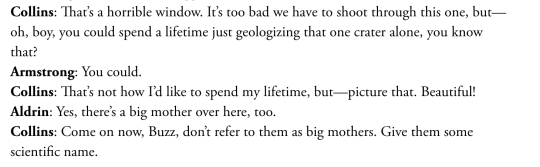
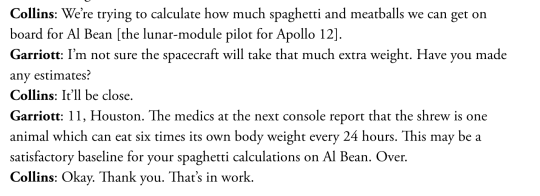
all you’ve done is convince me that michael collins was one of the funniest men alive tbh



 ifesbob