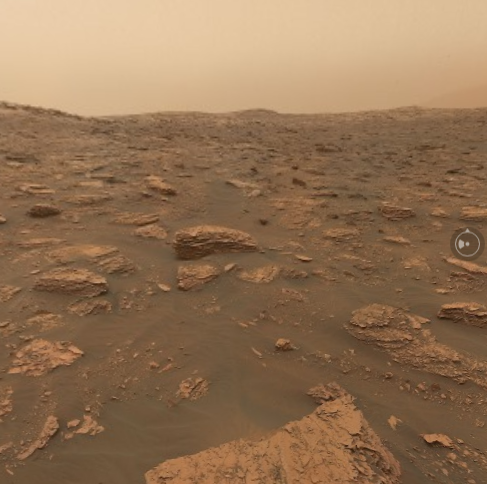
dude seeing these Mega high quality images of the surface of mars that we now have has me fucked up. Like. Mars is a place. mars is a real actual place where one could hypothetically stand. It is a physical place in the universe. ITS JUST OUT THERE LOOKING LIKE UH IDK A REGULAR OLD DESERT WITH LOTS OF ROCKS BUT ITS A WHOLE OTHER PLANET?
LIKE THIS JUST LOOKS LIKE IT COULD BE A PERSON’S BACKYARD. LIKE YEA A LITTLE DUSTY MAYBE THERE WAS A SANDSTORM BUT THAT’S COOL I’M JUST GONNA WALK DOWN TO THE STORE P S Y C H YOU’RE ON MARS BICH!
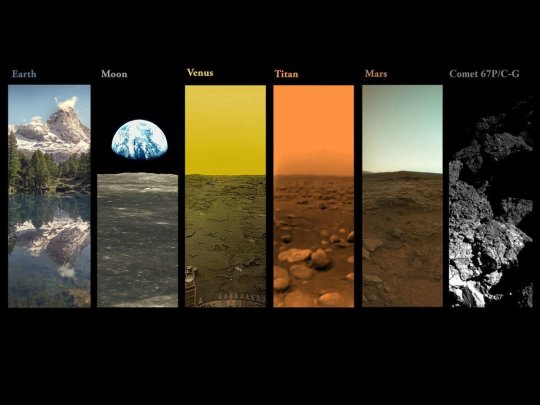
i hate to be rude and intrude on this post but we have decent pictures of the surface Venus too!
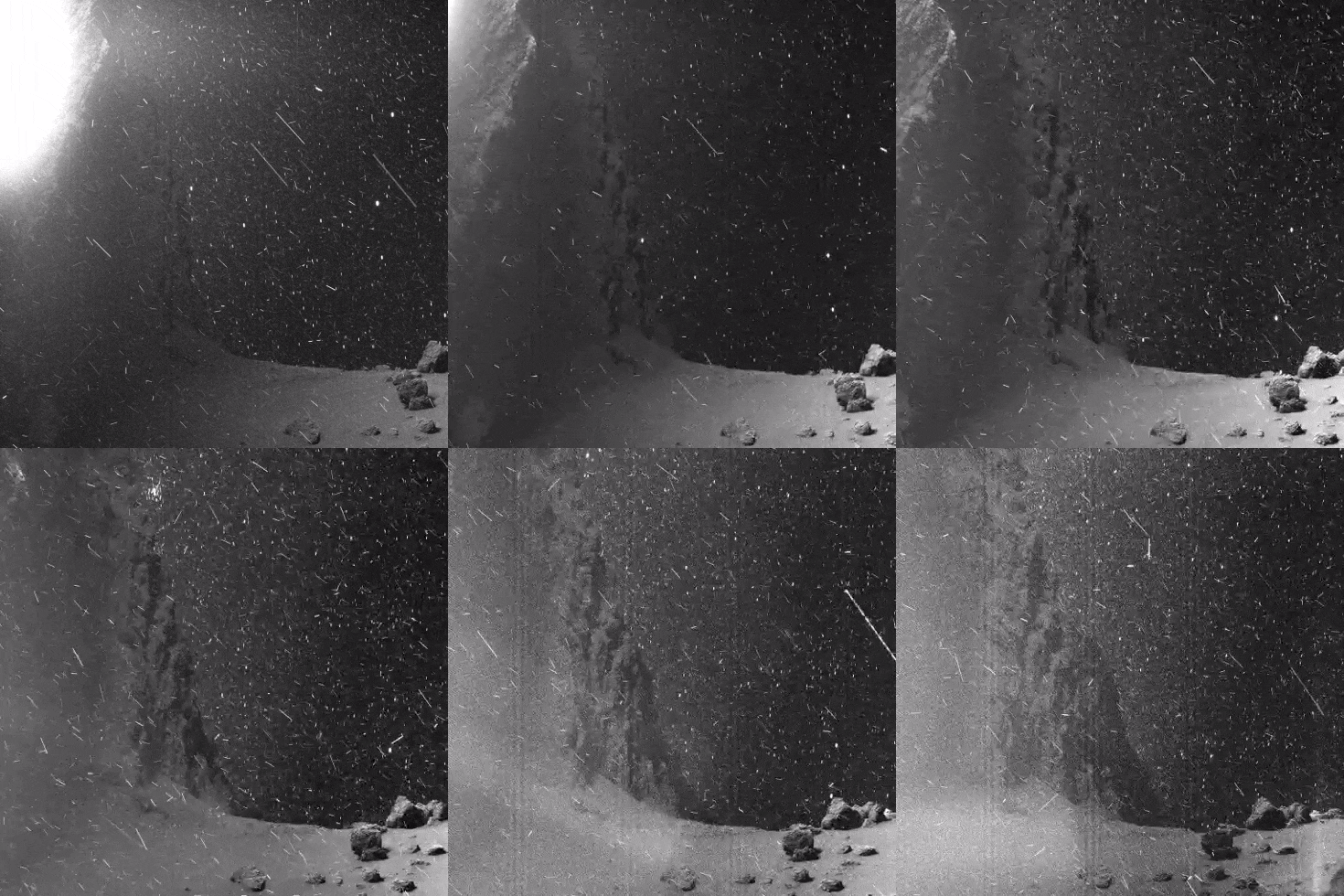
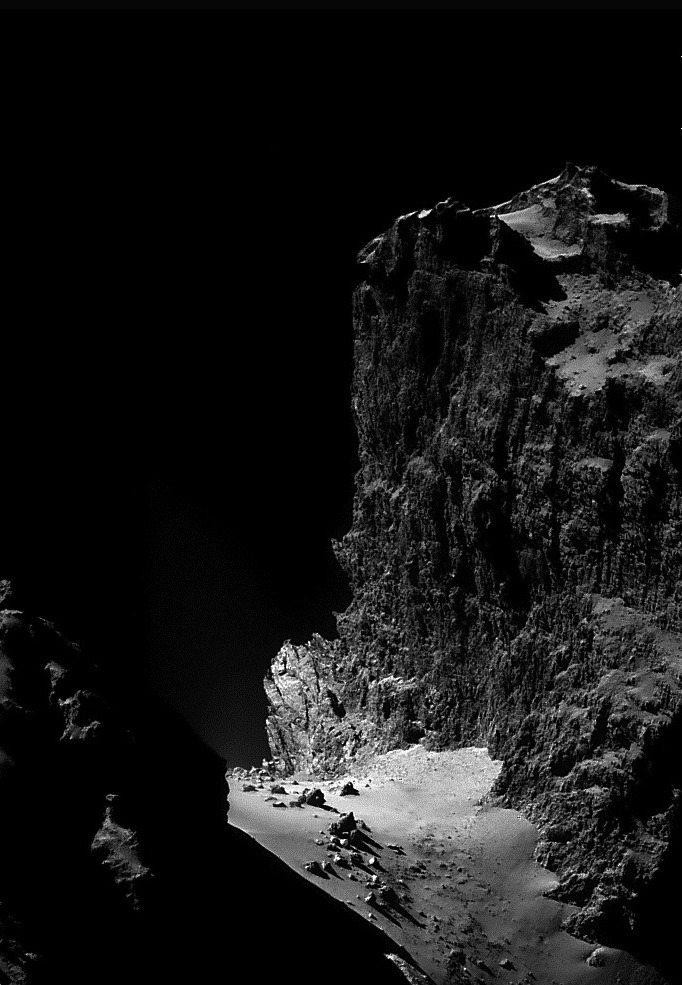
So it’s not quite snowing on Churyumov–Gerasimenko, unfortunately; the white specks are artifacts of cosmic rays impinging on the CCDs in the camera, as well as a rotating starfield in the background (since the comet is spinning). A few specks could be dust. But, holy shit, that’s the surface of a comet. That’s a spot you could in theory cling to for dear life sit down on. The Cliffs of Comet 76pare a place.
If that isn’t the neatest shit I don’t know what is.
the space race may be the funniest point in history period and i’ll stand by that. the US is like “yes whoever gets into space first will prove once and for all that our economic model is superior and that we are, in general, the superior country of superior and smarter people.” then the soviets just went and did it and the US freaked out and needed to cover their ass so were like “WE MEAN THE MOON, WE MEAN THE FIRST TO LAND ON THE MOON.”
yeah its cus walking on the moon was cool as hell and all this other boring shit sucked ass
When I was a freshman in a red-state college, I had a professor who taught Newtonian physics with a super thick Russian accent. The student body was unusually conservative for a state college, so there was a sort of general bemusement about learning physics from a Russian, but even back then the Cold War was far enough in the past that not even the red tribe was inclined to stir up trouble about it.
He was aware enough of this to get off on trolling the class, though. Whenever some force diagram in a homework assignment needed to be weightless, instead of being some generic spacecraft it would be “Mir” specifically. And he’d always use ‘cosmonaut’ instead of ‘astronaut’, that kind of thing.
One day about halfway through the semester, he’s doing this with in-class examples on the board, and one of the students finally gets up the guts to troll back a little. So this kid shouts from the back of the auditorium, “Hey professor, what’s the difference between a cosmonaut and an astronaut?”
And this beautiful man spins around on one heel to face the class, whiteboard marker triumphantly over his head, clearly having been waiting for this moment the entire semester:
@riotbrrrd “I can’t cry but if you want I can ramble about the stat of venus in litterature for 20 minutes. If that would make you happy”
are you kidding that would make me very happy
It’s why I love reading old fashioned science-fiction, not only is it super cute to really see what they didn’t know yet, it’s also extremely cute to see what they thought would be possible soon, and what they hoped and dreamed about. And the Venus situation is one of my favourite examples of that
Because you see, in the early days of spatial exploration and science-fiction, the general idea was that Venus would be the easiest planet to colonize. It’s roughly the same size as Earth, days and years are roughly as long, so people just sort of assumed that it would have a breathable atmosphere and water and plants and everything that would be needed to sustain life. So a lot of sci-fi writers from the 1920s to the 1950s told stories happening there. Easiest example is Heinlein’s Future History which is a gigantic collection of short stories extrapolating on scientific progress, but I found out recently that Ray Bradbury also had written some shorts about it (found them in The Illustrated Man, and while it’s not quite the subject, please read The Illustrated Man, it’s so fucking good, anyway back on tracks) and even Lovecraft had a fun one about a labyrinth made of glass and lizard aliens.
And then the space program happened and the US started sending probes in the general direction of Venus and tURNS OUT VENUS IS A DEATH TRAP. Its atmosphere is almost exclusively carbon dyoxide, days are insanely hot, nights are insanely cold, volcanoes throw acid around, it has a very very weak magnetic field which means there’s no protection against cosmic radiations, also one of the last probes that was sent into its atmosphere ended up crushed by atmospheric pressure before it hit the ground. So in pretty much a decade or less, everyone went nope! not sending people there!
And what I find absolutely delightful is that every sci-fic writer out there just turned around and started writing stories about the moon and Mars instead, and nobody, ever, came back to talking about Venus ever since. And yet, as soon as the 60s and 70s, we had authors who started looking further away than Mars – sometimes way further, sending their characters to planets that don’t even exist, imagining spaceships cruising so far away in space that they were certain never to return. The question of scientific accuracy became less and less important in favour of pretending that, in the future, we’ll have the technology. And sure, in epic sagas of worlds so removed from ours they enter the realm of fantasy, Venus would become a footnote, not worth mentioning. But even in more recent sci-fi sagas that very much try to pretend like the superpowers of their characters come from transhumanism rather than magic, the stories are the same. People in Becky Chamber’s Wayfarers series live on giant space stations or on weird, hostile asteroids inhabited with dangerous insects, but not on Venus. Martha Wells sends her Murderbot on planets where people can be eaten by giant worms, but not on Venus. John Varley’s The Golden Globe suggests that the entire solar system has been colonized, and violently so – there’s an amazing section of the book where he explains how corporations are mining the entirety of Uranus’ moon to build another, entirely artificial moon on the same orbit, so like, the realistic aspects of terraforming are definitely the least of his worries, and yet? Still No Mention Of Venus.
It’s like. As soon as our eyes turned to Mars everyone felt that loneliness that Bradbury describes at the beginning of his Chronicles, and desperately tried to fill in the void that expands beyond Pluto, and never came back. And it’s absolutely fascinating to me, that Venus is right here, and we could have had our revenge on the disappointment a hundred times already, but no! We prefer it the unknown void. We prefer it the potential. If this planet can’t fit our fantasies of starting anew on another ground, we’ll just make up a million other planets, somewhere.
well first let me thank you for this gift, also your rants are very sexy.
So, in a way, we could compare the treatment of Venus in literature with the Moon conquest ? We went to the Moon, it was great, we done did it and then we just… stopped. We immediately started dreaming bigger and better and further. I feel what you mean with the potential. We know Venus is not life-friendly, or at least we think so (or maybe we hope so, how different would a creature need to be to live on Venus ? How far removed from our concept of life ?). It’s a question that has been answered, and there’s so many questions left !
Maybe it has to do with the fact that Venus is our closest neighbor ? In today’s society, where people are growing more and more isolated, trying to write about what it means to be human in a community is easier when throwing your hero so far away that number loose their meaning ? Or maybe we know enough than living on Venus is more fiction, living on Mars is more science, and everything else is in that sweet sweet spot of the Unknown.
Now I desperately want a book about living on Venus
I think both points sort of tie into each other.
There’s definitely a good amount of “not cool enough anymore” going on, the main difference with the Moon is that we did very much walk on the Moon and the possibility of a colony on the Moon has been actually considered. And in most of the examples I pointed out, it is admitted that there are or were people on the Moon, it’s just that humanity used it as a starting point towards further exploration. No other planet really had the “oops, my bad!” treatment that Venus had. Even planets that truly, for sure, absolutely could not sustain life, sometimes get the right to be the cool place where people live – Neptune in, again, John Varley’s books, Mercury in Kim Stanley Robinson’s 2312, and, remember Jupiter Ascending? But Venus is too old fashioned now, so it would stand out in any story. Fun fact! That’s actually how I started thinking about this – when I played Destiny and the game sent me on Venus, my firs thought was “wait, why does that surprise me?”
It is a valid point also that a lot of stories are more interested in “the clash of cultures” with aliens, and that requires settings to move further and further away because, now we have HD pictures of Pluto, so we know nobody lives on the dark side of the planets close to us. And, I think it’s in that Houellebecq biography of Lovecraft that I read it? that in general spatial exploration started getting big once we had explored all of the places on earth: Lovecraft actually placed his fallen civilizations in Antartica, which was still being explored at the time, and in archaeological sites in Egypt, which has also stayed a ~place of mystery~ longer than others, and really it’s his legacy that pushed his great old ones back in the stars where they belong, because we know now that there are no giant, abandoned cities at the mountains of madness, and that no pyramid houses the crystal skull of some otherwordly entity. So the only place left to house all our horrible nightmares and all the amazing wonders we can think of is the immensity of space – and the great thing about it is that we’re never gonna run out of it!
And so, yeah, it doesn’t matter that nobody cares about Venus because indeed, we don’t need to inhabit it, just to know enough about it to satisfy our curiosity. But that’s also still why I find its treatment amazing: it forces me to think about why, and about what really matters in the stories I read, and what they have in common or not – and also it’s just incredibly funny to me that it could be the perfect setting for horrible, horrible creatures to live extremely close to us, and we’re sleeping on it because it’s not trendy anymore! Human brains are extremely smart and also extremely dumb at the same time, and I love it
The concept of a planet being “not cool enough anymore” bogles me, now that you’ve forced me to think about it. But no planet could ever be as alien and terrifying than the whole vastness of space. Monsters are immediately less scary when they have a home planet ? May they be Great Old Ones, or adorable Space Whales, a creature that does not need soil to stand on and a fixed point to call home is actually unnerving to me.
One of my absolute favorite things that I would like to see one day is a space version of Charybdis and Scylla – monstrous creatures that are also locations, gigantic phenomenons that we don’t understand.
oooooh yes that’s an amazing idea !! I immediately though about Knowhere from Guardians of the Galaxy, the decapitated head of a long dead celestial creature that is now a mining colony. A creature so big you could live on it. But that’s a monster that became a location, so not the same at all, really



 ifesbob