The Ganges shark has a dangerous reputation, likely due to confusion with the bull shark, which is known to inhabit the same areas. The teeth of the Ganges shark are better designed for impaling fish then taking apart mammalian prey, like the teeth of the bull shark.
This is probably investigatory behavior! As we talked about a couple years ago on the blog, sharks have lots of little sensory organs around their nose and mouth called Ampullae of Lorenzini.
They’re basically little gel-filled pores that sense electric current, and they’re why sharks investigate everything with their faces. Sharks bump things with their nose to put their ampullae near them in an attempt to learn about them – like finding out if you’re animal, vegetable or mineral, and if you could potentially be edible.
From the video linked, we can see the shark is swimming around checking out the divers (who appear to be hanging out at a decompression stop), before coming over closer to the guy who is filming. This isn’t aggressive behavior – it looks like simply curiosity. It’s not a shark kiss, it’s a shark question: what are you?
Another example of why sharks don’t deserve bad media representation…
They are not the only animals to use their faces and mouths to explore and understand the world. Yes, they have sharp teeth. And yes, there have been cases where sharks attack people. But most of the time, sharks just want to be allowed to do what it is sharks do. They’re clever and curious, and we go into their world–so of course they want to investigate.
I’m not saying that you shouldn’t have a healthy fear of sharks. They’ve been around for millions of years because they’re excellent predators, and they can definitely cause a lot of harm. So yes, respect the fact that there are many sharks out there capable of doing serious damage to you.
But don’t think of sharks as mindless, evil killing machines. There is so much more to sharks than their teeth.
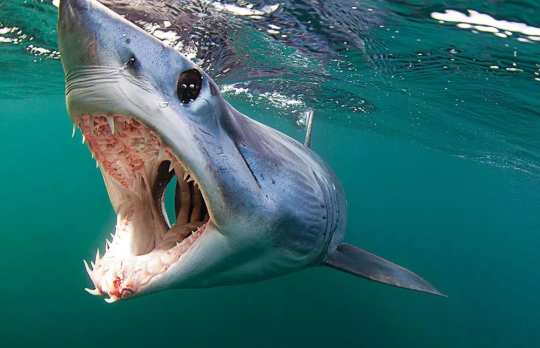
Mako sharks adapt very poorly to captivity, with the current record for length of survival being only five days.
But why, @sharkfactoftheday ? I’ve heard something similar for great whites, and if I’m not mistaken it’s because they refuse to eat in captivity. In what way do makos not adapt? And do most shark species in general not adapt to captivity?
Great question! Most pelagic sharks do not adapt well. The record survival time for great whites is a little over 2 weeks, to give another example.
Refusing to eat seems to be the main cause, the reason for it likely having to do with restricted freedom. Pelagic sharks are accustomed to being able to swim in essentially any direction for miles, and therefore don’t react well to walls. Here is a source about makos in captivity (specifically the record-holder mentioned above). That mako did refuse to eat and was observed to have difficulty “pulling away” from the walls.
It’s generally considered inhumane to keep pelagic sharks in captivity; however, there are several other shark species that adapt much better. Small sharks, like horn sharks, houndsharks, and catsharks are often much more successful. They’re smaller and tend to stay closer to a specific area, so the tanks that are suffocating to larger, more migratory sharks are safe for them.
Other species that have thrived in captivity include nurse sharks, bull sharks, zebra sharks, and sandtigers- although depending on exactly what care and habitat they are provided, this can change. Sandtigers, for example, are prone to spinal deformities, which are hypothesized to be the result of tank size and shape.
So to address your last question, it’s hard to say. Some species don’t adapt at all, while others adapt very easily. And those numbers are hard to find- if we assume all catsharks adapt well, for example, which is not necessarily true, that’s around 160 species-whereas mako sharks are only 2. And there are many, many species that there isn’t much information on how they would fare.
This gets into the whole topic of the morality of zoos/aquaria, which is not something I feel qualified to discuss, given the unprofessional nature of my interest in sharks and the large audience of this blog. Successful adaptation depends on a lot of factors, and it’s probably better to consider on a case-by-case basis, either with individual species or small groups of similar species.
[Apologies for any typos / incoherencies, it is late and I am tired. Also, periodic reminder @ everyone to feel free to correct me if my information is inaccurate or incomplete, I’ll try my best to fix things ]
Bony fish and sharks both generally have five pairs of gill slits, with some exceptions. The big difference is not the number of gills, but the presence or absence of the operculum, which is a bony covering of the gills in bony fish. This is the structure that allows bony fish to breathe without moving; it gives them more control over water flowing past their gills.
Also if you’re looking to learn more about sharks, I’d recommend starting with something like Sharkopedia, which can get you some basic information about various species, and then if something interests you, try searching for that specifically. It can be hard to figure out how to learn about something completely on your own, but I think that’s a decent jumping-off point. Alternatively, googling “shark facts” can be a good start.




 ifesbob