fire cannot have a shadow because it is a source of light jesus christ i hate this website
This is the same website that believed you could have unlimited chocolate if you cut it the right way.
These people are our future
Okay so I really really want to know how you trumpet fellating douchefucks managed to spring fully formed into the world, knowing every single little thing that has ever existed ever?
Because shit, that would be some groundbreaking scientific and theological wetdream.
OP is basically going “wow, this is a cool thing. Who else never really considered why this cool science thing does this cool science thing” and eventually some assholes turn up and go; ” i hate this website”, to “THESE people are our future”?
What the frickity frick you fun sucking vampiric pisslords.
Shit son, you are literally the perfect example of why kids go “science is hard and boring”. Because instead of going “Heck yeah! This weird thing happens because gases! Because flames! Because light! Because the world is weird and fun and dude if you think this thing this is cool check out this and this and this!”
Because instead of going “Yeah, not everyone knows as much as science about me. Everyone has to learn things somewhere; come on friend have I got so much to show you.”
You went; “I’m self absorbed as heckle and I think that everyone MUST know or they’re just silly ignorant peasants aha lol im smart. Screw this website and the kids on it.”
I could go on all day, but you know what friend? We all have to start somewhere, because education in a single county district can be as unequal and bollocked up as heck, let alone between countries, between ages, between classes, between days and I have so much to show you.
Let’s start here;
Good luck.
i’ve never seen this version yelling at the science hipsters before, good addition
i’m all for encouraging girls to pursue STEM fields but can we stop acting like talent/passion for the arts is inherently less valuable than talent/passion for maths and science thanks
Fun story: One of the first things I was taught as an astronomy student is that, if you want to be a dick to someone giving a presentation, ask them “and how do the magnetic fields play into this?” and they will invariably say “fuck you I don’t know” because no one understands magnetic fields they are black magic.
Pure utter bullshit. Electromagnetic forces somehow outstrip gravitic forces in strength by an obscene factor, for no reason I can comprehend and it bothers me.
I love magnets
One, that gif showing the Curie temperature is really cool.
Two, you don’t understand, magnetic fields are the bane of my existance and I have a masters dissertation about them. I studied how magnetic fields develop in low mass stars and every single meeting with my supervisor ended in some conversation about how stupid magnetism is.
“Oh yeah and this is effected by the magnetic field strength…”
“But why?”
“God knows, I don’t have a clue.”
Was literally said to me by a professor who has spent 20 years of his life looking at magnetism in stars.
ALSO:
“Don’t ask why, we don’t know. Maybe magnetism? Who knows anything about magnetism.” – My Stellar Physics professor when asked about certain processes in stellar formation, something he has been studying for 10 years.
Like we know so little about that it’s actually funny.
While physics can show us amazing things about our universe, it doesn’t always agree with how we think things should work. Sometimes, physics can be very counter-intuitive, and often unsettling. So, here’s my list of physics facts that can be a bit unnerving.
10: Weight doesn’t matter
If it wasn’t for air resistance, everything would fall at exactly the same rate. If you let go of a hammer and a feather
from the same height
at the same time on the Moon, they would hit the ground simultaneously.
9: Gyroscopic precession
It doesn’t matter how much you know about physics; gyroscopes are weird. The way they seem to defy gravity makes you rethink everything you know about physics, despite being fairly simple toys. Still, it’s all just Newton’s laws of motion.
8: Neutrinos and dark matter
We like to think that we can interact with most of the world around us, but this couldn’t be further from the truth. Neutrinos and dark matter are passing through your body right now, as if you weren’t even there. The fact that 65 billion neutrinos pass through each square centimeter of your body every second is weird enough, who knows what we’ll learn about dark matter.
7: Photons are particles
Light travels like a wave, but can only interact like a particle. It can interfere and have a frequency, but it can only take and give energy in discrete quantities. It behaves like nothing else in our macroscopic world, and can be very difficult to imagine.
6: Electrons are waves
We’ve established how photons act like waves and particles, but surely massive particles act normally. Nope! Even electrons have wave-like properties. In fact, everything acts like a wave! Except these waves come in discrete quantities, which we’ll call particles. This won’t get confusing.
5: E=mc^2
Einstein’s most famous contribution to physics
states that matter is simply another form of energy, which has very
profound consequences. A wound-up Jack-in-a-box would weigh ever so
slightly more than a released Jack-in-a-box, due to the potential energy
stored within.
4: Time is relative
The core of special relativity states that time passes differently for different observers. If you took a trip to Alpha Centauri at 99% the speed of light, everyone on Earth would see the trip take 4.4 years, while you would only experience 7.5 months. Time travel is real!
3: The (not so empty) vacuum
Something can be created from nothing, as long as it goes right back to being nothing quickly. In seemingly empty space, particles pop in and out of existence all the time as a result of the uncertainty principle. Not to mention, space is inflating at an accelerated rate due to “dark energy”. To the vacuum, the law of conservation of energy is more of a suggestion.
2: c is the fastest speed
Another important point in special relativity is that nothing could ever go faster than light. This doesn’t sit well with a lot of people, but the math doesn’t lie. To even get something with mass to travel at the speed of light would require infinite energy. Even if you somehow get around this, there are just too many mathematical problems with superluminal travel. Like it or not, the universe has a speed limit.
1: The cat is dead and alive
How could it not be this? The nature of quantum mechanics allows for objects to take on two seemingly contradictory states in a ‘superposition’. An electron can be in two places at once, or in a more extreme example, a cat can be both dead and alive. Of course, this weird property goes away once someone makes an observation. It’s as if there are tiny physics trolls messing with nature whenever we’re not looking.
Of course, there’s plenty more unsettling physics facts, like the space-bending nature of general relativity, or the “spooky action at a distance” that is quantum entanglement, but these are my top 10. I’d like to hear any unsettling physics facts you think I’ve missed, though!
While physics can show us amazing things about our universe, it doesn’t always agree with how we think things should work. Sometimes, physics can be very counter-intuitive, and often unsettling. So, here’s my list of physics facts that can be a bit unnerving.
10: Weight doesn’t matter
If it wasn’t for air resistance, everything would fall at exactly the same rate. If you let go of a hammer and a feather
from the same height
at the same time on the Moon, they would hit the ground simultaneously.
9: Gyroscopic precession
It doesn’t matter how much you know about physics; gyroscopes are weird. The way they seem to defy gravity makes you rethink everything you know about physics, despite being fairly simple toys. Still, it’s all just Newton’s laws of motion.
8: Neutrinos and dark matter
We like to think that we can interact with most of the world around us, but this couldn’t be further from the truth. Neutrinos and dark matter are passing through your body right now, as if you weren’t even there. The fact that 65 billion neutrinos pass through each square centimeter of your body every second is weird enough, who knows what we’ll learn about dark matter.
7: Photons are particles
Light travels like a wave, but can only interact like a particle. It can interfere and have a frequency, but it can only take and give energy in discrete quantities. It behaves like nothing else in our macroscopic world, and can be very difficult to imagine.
6: Electrons are waves
We’ve established how photons act like waves and particles, but surely massive particles act normally. Nope! Even electrons have wave-like properties. In fact, everything acts like a wave! Except these waves come in discrete quantities, which we’ll call particles. This won’t get confusing.
5: E=mc^2
Einstein’s most famous contribution to physics
states that matter is simply another form of energy, which has very
profound consequences. A wound-up Jack-in-a-box would weigh ever so
slightly more than a released Jack-in-a-box, due to the potential energy
stored within.
4: Time is relative
The core of special relativity states that time passes differently for different observers. If you took a trip to Alpha Centauri at 99% the speed of light, everyone on Earth would see the trip take 4.4 years, while you would only experience 7.5 months. Time travel is real!
3: The (not so empty) vacuum
Something can be created from nothing, as long as it goes right back to being nothing quickly. In seemingly empty space, particles pop in and out of existence all the time as a result of the uncertainty principle. Not to mention, space is inflating at an accelerated rate due to “dark energy”. To the vacuum, the law of conservation of energy is more of a suggestion.
2: c is the fastest speed
Another important point in special relativity is that nothing could ever go faster than light. This doesn’t sit well with a lot of people, but the math doesn’t lie. To even get something with mass to travel at the speed of light would require infinite energy. Even if you somehow get around this, there are just too many mathematical problems with superluminal travel. Like it or not, the universe has a speed limit.
1: The cat is dead and alive
How could it not be this? The nature of quantum mechanics allows for objects to take on two seemingly contradictory states in a ‘superposition’. An electron can be in two places at once, or in a more extreme example, a cat can be both dead and alive. Of course, this weird property goes away once someone makes an observation. It’s as if there are tiny physics trolls messing with nature whenever we’re not looking.
Of course, there’s plenty more unsettling physics facts, like the space-bending nature of general relativity, or the “spooky action at a distance” that is quantum entanglement, but these are my top 10. I’d like to hear any unsettling physics facts you think I’ve missed, though!
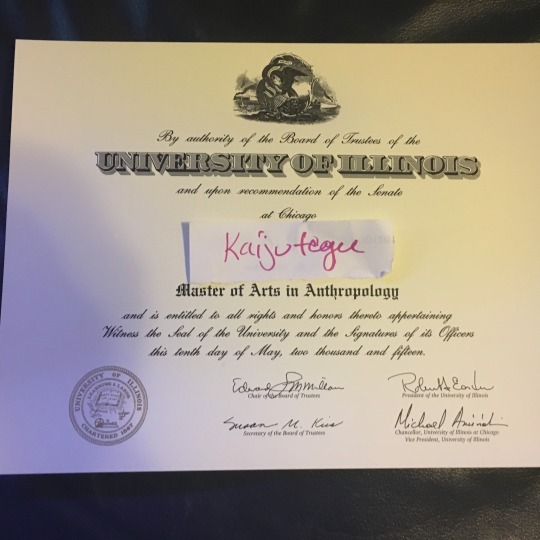
This is my masters’ degree in anthropology. I’d show you my BA, but it’s at my parents’ house. I’m three and a half years into a PhD in physical anthropology. I’ve been employed to do physical anthropology at one of the world’s best natural history museums. My area of study? Teeth and diets. I’m not here to argue veganism or vegetarianism, I’m here to tell you, point by point, why you’re devastatingly misinformed about our place in the primate family tree, along with my peer-reviewed sources behind the jump. I know we live in a “post-truth” society so maybe being presented with the overwhelming consensus of the scientists who currently work with this material is meaningless to you, and honestly, this probably isn’t going to make a bit of difference for you, but I can’t let this slide. Not in this house built on blood and honor. And teeth.
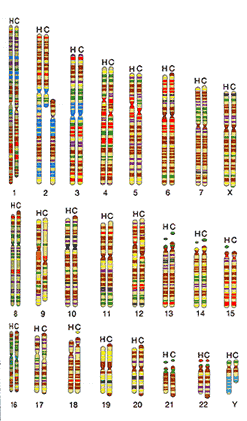
1. The evidence for being closely related to chimpanzees is vast and well-understood thanks to advances in DNA analysis. We share a huge amount of DNA with them, and not just repeating patterns in non-coding DNA. We have numerous genes that are identical and likely diverged around 7 million years ago, when Sahelanthropus tschadensis was roaming the earth. S. tschadensis was a woodland species with basal ape and basal human-line traits. The most notable was the positioning of the foramen magnum towards the central base of the skull and not emerging from the back suggests bipedality. This, along with other traits such as small canines worn at the tip, which implies a reduced or absent C/P3 honing complex (the diastema), suggests that this is actually a basal trait and the pronounced diastema we see in other species was a trait that came later. But more on that later- back to chimps and what we mean by sharing DNA. Our chromosomes and chimp chromosomes are structured far more like each other than other mammals. Furthermore, the genes located on these chromosomes are very similar. Chromosome 2, for instance, is nearly identical to two chimpanzee chromosomes. (Chromosome 2 in humans, Neanderthals, and Denisovans is different from Chromosome 2 found in apes and is actually the remnant of an ancient mutation where Chromosome 2 and 3 merged- you can see that from its vestigial centromeres and the genes found on it. We can’t get DNA from fossil material, but Neanderthal and Denisovan subfossils have demonstrated that this reduced chromosome count- we have one fewer pair than apes- is a typical trait of the Homo genus). Here’s a side by side comparison of Human and chimpanzee chromosomes.
Gene coding regions are colored- bands at the same place mean that there’s two identical genes at that locus. Our similarities to lemurs, on the other hand, aren’t on homologous chromosomes. We have similar coding around the centromeres but the genes express themselves differently. The structure of non-ape primate genes is also significantly different; when the first chromosomal comparisons were done between humans and lemurs back in the 1990s, it was discovered that lemurs have much more highly-concentrated heterochromatin at their centromeres, whereas the structure of human and chimpanzee centromeres is similar. The major differences in chimp and human DNA are in the noncoding regions; most of our genes have identical structures.
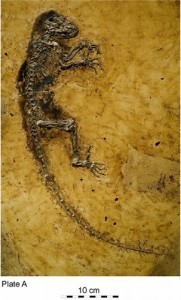
2. All primates evolved from a lemur-like organism, not just humans. Here’s one of them. I’ve seen her in person. Pretty cool, huh?
Her name is Ida and she’s a member of the genus Darwinius. But that’s just like saying all primates evolved from something that was basically a tree shrew- which is also true. See, one of the main points of evolution is that organisms are continually changing throughout time. We didn’t jump from lemur-like organism to human; changes were slow and gradual and the lineage isn’t really a straight tree. The fossil species we have and know lead to different lines branching out. Some things died off, some things flourished. Heck, look at the Miocene- twelve million years ago, there were hundreds of ape species. Now there’s twenty-three. (Sixteen gibbons, two chimp species, two gorilla species, two orangutan species, and one human species. There’s also some subspecies of gorilla and gibbon, but I’m only counting the primary species.) It’s hard to trace things back, but saying that we evolved from lemur-like species is obtuse and obfuscates the real point, which is that Homo and Pan descended from a relatively recent-in-the-grand-scheme-of-things common ancestor.
3. Our dentition is unique to the extant primates, but not australopithecines. Our teeth look very much like other members of the genus Homo, the extinct ones, as well as many of the australopithecines. We also have very similar enamel proportions to gracile australopithecines; apes have much thinner enamel overall.
But what did australopithecines eat?
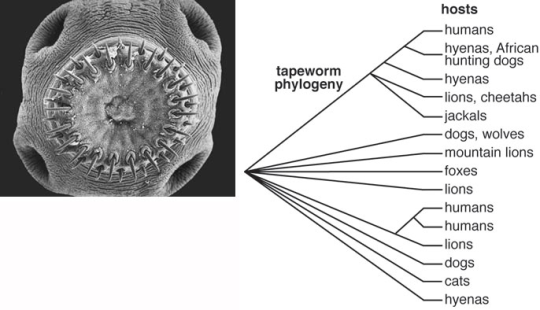
Everything. We know they were eating fruits and nuts based on microwear analysis and strontium analysis, but we also know they were eating meat- and in pretty decent quantity, too. We’ve found all kinds of butchering sites dating back millions of years and in association with Australopithecus garhi, the earliest tool user, but we can also see this in tapeworm evolution. There’s many, many species of tapeworm in several genera. But three of them, in the genus Taenia, are only found in humans. And these species diverged from… carnivore tapeworms. Their closest relatives infect African carnivores like hyenas and wild dogs.
Tapeworms that are adapted to the specific gut of their host species need a certain environment, as well as a specific cycle of infection so that it can reproduce. A tapeworm that infects hyenas is going to be less successful if it somehow makes the jump to a horse. But if the hyena tapeworm was able to adapt to our gut, that suggests that our stomach was hospitable enough for them chemically to survive- which brings me to the intestines.
4. Our intestines are also unique. Yes, we have longer intestines than carnivores, but we also don’t have cecums like herbivores. We are omnivores and that means we still needed to retain the ability to digest plants.
The key to being omnivores is omni. All. I’m not saying we should only be eating meat, I’m saying our ancestors ate a varied diet that included all kinds of things. If we weren’t omnivores, why would we have lost the cecum’s function? Why is the human appendix only a reservoir for the lymphatic system, as it is in carnivores? The cecum is an extremely important organ in herbivores, as it houses the bacteria needed to break down cellulose and fully utilize fiber from leaves. But we don’t have that. Instead, we compensate with a long gut. Our ancestors absolutely did eat fruits and nuts and berries, but they also ate other stuff. Like scavenged carcasses and bugs and probably anything they could fit in their mouths. Which- actually, primate mouths are interesting. Humans and chimpanzees have enclosed oral cavities, thick tongues, and jaw angles much more like herbivores than carnivores- suggesting a herbivorous ancestor. That’s not something I’m arguing against at all. But again, we have adaptations for eating meat and processing animal protein because we are an extremely opportunistic species.
5. Our canines are true canines. First, semantics: having a diastema does not canine teeth make. We refer to the canine teeth by position- even herbivores, like horses, have them. They’re the teeth that come right after the incisors. All heterodonts have the potential same basic tooth types- incisors, canines, premolars, molars- in various combinations and arrangements. Some species don’t have one type of teeth, others don’t have any- but it’s silly to say that the canine teeth aren’t canine teeth just because they don’t serve the same function as a gorilla’s or a bear’s or some other animal’s. It’s basic derived versus primitive characteristics.
Now that we’ve got semantics out of the way, let’s talk about that diastema. The lost diastema is a derived trait, which means that our ancestors had it and we lost it over time. All other extant non-Homo primates have a canine diastema. All of them. However, when you look at australopithecines, we see that many of them either don’t have it or have it in a reduced capacity. At the earliest known hominin site, Lukeino, we see Orrorin tugenensis with reduced canines compared to ape fossils and modern apes- and… you do know that apes don’t use their canines for eating meat, right? Like, primate canines serve a very different purpose than carnivorans’ canines. It’s suggested that the large canines are for social display moreso than anything dietary- bigger, more threatening teeth are useful if you’re a gorilla or chimpanzee fighting to the top of your group’s social structure.
I’m going to refer you to a blog post written by Dr. John Hawks, a good friend of my advisor and generally a pretty cool guy. He’s got a nice writeup on the evolution of hominin teeth and how the human line’s teeth have changed through time.
Also, of course our teeth are going to be smaller. When we compare archaic Homo sapiens fossils to modern skeletons, their teeth and jaws are much more robust. This is likely related to the introduction of soft foods- and by soft, I mean cooked grain mush- to the diet around the time of domestication, right before the population explosion that happened about 10k years ago. In general, post-domestication human jaws are much smaller and more crowded than any other humans and hominins that came before.
6: Neanderthals did die out, but not in a catastrophic event like we think of with dinosaurs. While there are no living Neanderthals today that we would classify as Homo neanderthalensis, there is plenty of evidence that we interbred and likely outcompeted them as a species due to our overwhelmingly large population size (hypothesized based on number and locations of remains found). While there’s only a small percentage of Neanderthal mitochondrial DNA lines in human populations today, it’s quite likely we lost a lot of that due to genetic drift and population migration- Neanderthals, after all, had a much more limited range than Homo sapiens sapiens. Their eventual extinction is a mosaic of events- outcompetition plus assimilation. The line between Homo sapiens sapiens and Homo neanderthalensis/Homo sapiens neanderthalensis is blurry- there’s some physical anthropologists who actually think we should be including them within our species as a subspecies- but they are extinct in that the specific subset of hominins with distinct karyotypes and potential phenotypes no longer exists.
A new study
gives an unprecedented peek into the early life of two Neanderthal
youngsters who lived some 250,000 years ago in what is now southeastern
France.
it’s facial reconstructions of prehistoric humans!!
like, look at this part-homo sapiens, part-neandertal man from well over 30,000 years ago:
doesn’t he just look like a dude you’d wanna hang out with? like he probably washes dishes in the kitchen with you, and has excellent weed
what a charming fellow. what stories he probably has to tell. i’d definitely go shoot the shit with him on Contemplation Rock after i’d finished my day’s work carving a bone flute for the autumn hunting ceremony, or whatever
people have been people ever since people first became people, i tell you what
they all had lives and histories and families and friends and dumb gossip and games they played and total bullshit in which they believed wholeheartedly
they all argued about the nature of the world, and of themselves
they all sang songs
they all drew pictures
they all buried their dead in graves, and they buried their dead in graves well before they did a lot of that other stuff. they buried their dead with flowers, with panther claws, with the bones of animals they’d killed, with the bones of family members who had died at the same time or earlier. they buried their dead with their arms folded across their chests
they fell in love
they took care of their old and their sick and their disabled, even when it cost them
they made new things, and worried about what the new things meant for people everywhere, as a whole
Oh I like him he looks like he would appreciate my jokes
This dude would have great stories at a get-together and would bring some really great homemade dip.
I feel like he really digs Lo-Fi Music
This guy was sculpted by Alfons and Adrie Kennis, and their Neanderthal reconstructions are all delightful.
I love the kid in the last picture a lot- they look like a kid, just a little kid who’s done some mischief and is trying not to laugh about it.
I also adore their Lucy- they’ve struck a wonderful balance between the falling angel and the rising ape.
And their Turkana boy- there’s something precious and wistful in those eyes.
But my favorite has got to be their reconstruction of H. floresiensis.
Just look at her. That’s a face of someone who’s lived and seen a lot, but also a face that’s known love and joy and laughter. That’s a face with a soul.




 ifesbob