Gather around, children. I’m about to tell you a story of ye olde fandom. (Real life fandom friends, I’m sorry. You’ve heard this story a thousand times, I know.)
Long before Disney bought Star Wars, long before the new trilogy, before even the prequels, and themselves predating the “remastered” versions of the original trilogy, Star Wars experienced it’s second renaissance in novel form. And comic book form. Skim the pages of the dozens upon dozens of Expanded Universe (”EU”) novels and you’ll find lots of foundations for the things you see on screen these days. Ben Solo, for sure, has his origins there.
But it was also a different era for the fandom. The 90′s saw the transition from fanzine culture to online fan fiction archives. The programming ability and computing power you needed to make a fan fiction archive that the authors could edit themselves did not yet exist in an accessible way. Series based archives popped up, mostly hand curated by webmasters posting .txt files of chapters and stories that they’d received from authors via email. Or usenet. Or mailinglists. I spent many of my teen years on Gossamer, the X-Files archive, and Fanfix.com, my favorite Star Wars archive. I remember haunting a Babylon 5 archive at the time, too, but it’s lost to history.
I read everything. Everything. But, by far my favorite fan fiction of all time was, and I will always remember this, “As Simple and as Complicated as All That” by Xia Sang Li. It was epic. Four novels. NOVELS. Dozens of chapters. Hundreds and hundreds of pages. It follows Luke Skywalker’s decision to finally throw caution to the wind and fall into bed, and in love, with Mara Jade. Written in the sweet spot after her character was introduced and explored, but before permission was given to the licensed authors to marry Luke off, it was an amazing indulgence. And, it was epic in scale and scope. The great plot twist in book one was that, spoiler alert, when Gaeriel Captison died, leaving Luke to look after her orphaned daughter, she didn’t tell the whole story. You see, Luke and Mara had indulged each other before, had a secret love child, and this brief period of time was erased or minimized in their memories. Slowly, the two come to realize, through their haze of lust and passion, that something is conspiring to keep them apart, and that this little girl isn’t who she seemed. Themes of family, and duty, and passion, and trauma. Force visions, original characters, and sex sex sex. It was amazing.
Epic right??? Right?? Wanna read it??
It’s impossible. The Fanfix.com archive zipped the textfiles, so the Wayback Machine hasn’t archived them. The Geocities page went down before the Geocities archive was published after its closure. And, the original author’s blog, not updated in a decade, features only a few chapters of a rewrite, an AU of her original epic.
But it’s not dead.
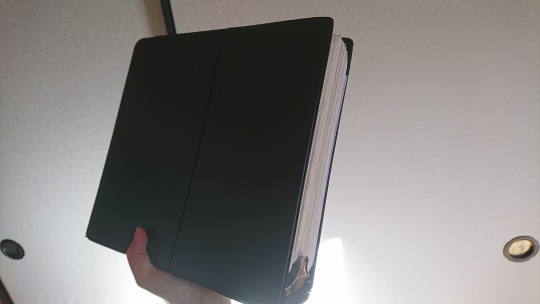
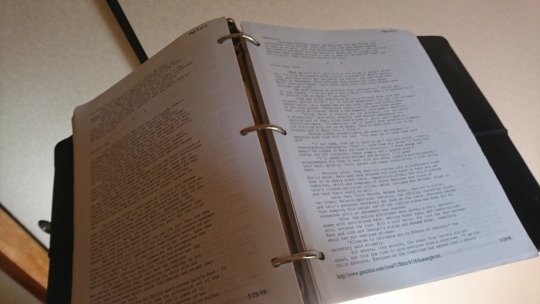
Starting in 1998, my teenage self printed the whole fucking epic. I did one chapter at a time. It took more than a year. I had it all saved, too, on a 3 ½ inch floppy that got destroyed. Beyond the author’s own hard drive somewhere on this green earth, I think this might be the only copy.
Every few years, when nostalgia overtakes me, I reread it, from front to back. The gender politics are very different. The interpretation of Luke, too, vastly different from modern fandom’s take. Sometimes I wish I could find the author, buy her dinner, and tell her how important her work was to me. But, that’s probably impossible. Sometimes I think about re-digitizing it and, like a different kind of pirate, putting it back into circulation. But, that’s just a wish. A whimsical dream. The notebook is at least 3 inches thick, with front to back printed pages of text. It would take… years. Certainly it took years to write. But, it was part of the floating world of fandom. And, it faded away. Stuff like this should never fade away.
Fan fic authors… I implore you. Never delete your work.
You can’t know the impact you make. You might think it not good, embarrassing, or irrelevant. It’s not. Not to someone. Not to me.
Seriously. You have no idea how many fanfics I had wanted to print and bind just so that I can keep it in my personal library to read. Some fics are so damn GOOD that they deserve to exist binded as a physical copy. Save them please!!! All fics matter to someone
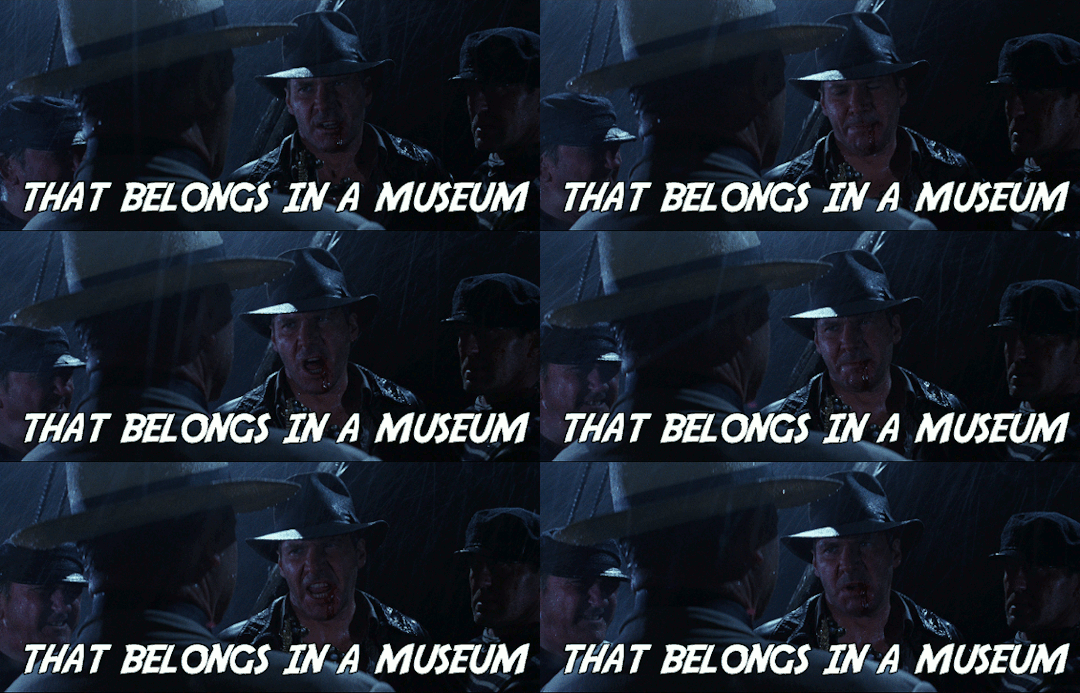
PUT THAT BOOK IN A SAFE BOX OR A MUSEUM (is there a fandom museum? we should make one)
It’s not quite a museum, but there is the Fan Culture Preservation Project, which is a join venture between the OTW and the Special Collections department at the University of Iowa Libraries. It’s a place to preserve hard copies of fanworks and fandom memorabilia.
(Though it seems likely that @mizunocaitlin would like to keep a beloved fanfic.)
Dear fic readers: Save it before you lose it!
authors have pleanty of reason to delete their shit, sad as it is, but you can still have it!! do what that person did, use https://www.lulu.com/ like i did for my faves stuff (tho already archived on gdrive by someone else), but find a way to PRINT IT OUT if you love it so much. dont just rely on digital copies because shit happens.
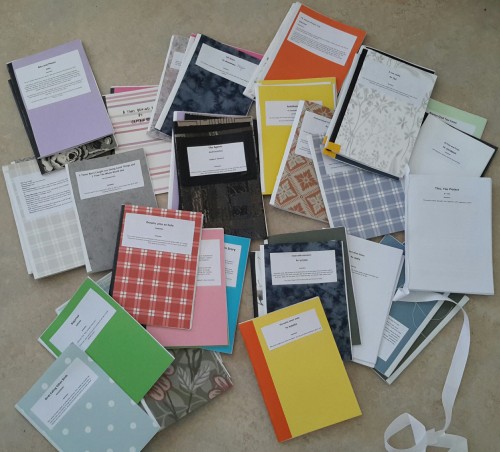
This is my current printed library of fanfics. This way works best for fanfics up to 20000 words, but I’m learning basic bookbinding for the longer ones (an experiment of that can be seen in the right side of the picture – “This, You Protect” by Owlet), because I LOVE HOLDING THEM WHEN I READ THEM and also, what will I read if the power goes down? Exactly.
If someone could tag that person who did the gorgeous binding of @senlinyu‘s magnificent Manacled… I mean the book is awesome, and the book binding ? Gives it justice. Also I think that the person who did the binding has made / is making other bindings? Maybe? I can’t quite remember?
I feel so vindicated in seeing this post, and knowing I’m not the only one who has “probably-the-only-extant-copy” fanfics from the late 90s in binders.
I took probably the most ridiculous and difficult route, hand bookbinding. Here’s an example of an earlier-era fic I’ve bound for archival purposes.
And some Bookbinding resources if anyone wants to join in the efforts! Rock on, fanfic hamsters!
as an archivist (a real one!) and a fanfic author, this post speaks so hard to me. SAVE YOUR STUFF, AUTHORS
In high school my best friend and I were known as the book printers. At the time neither of us had access to the internet beyond school so we did the only thing that made sense, printed everything. We would spend as much time as we could after school, usually on fridays, huddled around the library computers printing fics we wanted to read. The librarians didn’t mind, one of them actually thought it was charming and christened us her book printers.
I owe so much to authors, the early ones who showed me that it was ok to think up grand worlds and fill them with my favorite characters as well as characters of my own creation, and especially the new authors who quickly became my found family and have taught me that finding yourself through your writing is perfectly acceptable, and losing yourself to an indulgent plot line is fine too.
If I’ve learned anything in the decades since I offered to pay the school for the gross amount of paper we used, it’s that you should never forget your roots, and always remember you might just be the one creating fertile grounds for others to put down roots of their own.
If you ever have the chance, do it, print the pages and bind them. The story already holds a special place in your heart, isn’t it only fair that you hold it close as well?
i’m pretty sure most people know of all this, but there’s probably the odd thing that people don’t know about!
Thought I’d post this again.
AS A SPRITE ARTIST LEARNING TO DO THIS SHIT I CANNOT THANK ANYONE WHO REBLOGS THIS ENOUGH
I don’t know if there’s a low-fi appeal to using MS Paint, but if you want a free graphical image manipulation program, you should meander on over to gimp.org. It’s an Open-Source program and free to use forever! Also, layers are a wonderful thing.
Texturing is a technique that involves
adding local shading and details on surfaces to better represent the
material of an object.
This technique is of course closely linked to shading in general. This is usually applied after defining a global shading.
From left to right :
Lineart
Global shading
Completed sprite
One of the big differences between global and local shading is homogeneity. The
very principle of global shading is to give a sufficiently contrasting
effect between the shaded and lit areas to bring out volume and depth.
Conversely,
a texture must be as homogeneous as possible. It must be able to be
applied on large, uniform surfaces, without making it look bad.
2. Applying a texture
A
texture being homogeneous in terms of its luminosity/contrast, if it is
applied to an object without taking into account the global shading, we
will lose any effect of volume and depth.
A texture applied to a sphere without shading. Only the deformation of the texture can give us a clue on the shape of the object, but it is still difficult to discern.
Homogeneous contrast
When applying a texture to an object, shadows must also be taken into account. It
is therefore important to maintain a uniform contrast between colours. A
dark line separating a light zone from a dark zone should not keep the
same colour between these two zones.
The color of the line will be lighter on the lighter side and darker on
the darker side to preserve its contrast with the background.
In
the same way it is possible to apply a texture or pattern on a shaded
object, by proceeding to a simple color shifting in our palette.
Combination of a texture (left) and an object that is not textured but shaded (middle).
3. Local shading
Since shading is used to highlight the bumps, there are generally two possible cases:
A groove
A bump
Each of these cases can be more or less accentuated by playing on the colors, the intensity of shadows and lights.
On the upper line, troughs ranging from the weakest to the strongest bumps. On the second line, these are bumps that stand out.
The
mastery of these light bumps is very important, it is the basis of the
textures, and will make it possible to manage all the simple cases, such
as wood or matte plastic.
Example of application on a simple object:
4. Reflections
The application of a reflection is done in a
simple way, by applying diagonal strips of light of varying
thicknesses, and following a few rules.
A trough or bump will create an offset at the reflection level (proportional to the height change). As
for the shadows, there is no absolute, depending on the palette or the
material represented, it is possible to lighten or not the area at the
reflection level. It is also important not to have parallel light bands on faces that are not oriented in the same direction, as on this cube:
Concrete example of the application of a gold texture on our drawers:
Or, added reflections on our previous crate:
5. Dithering and granularity
Dithering consists in
creating a new false color from a checkerboard or other regular pattern
of two colors close enough to give an illusion of mixing. The closer
the colours are, the stronger the illusion will be. The more the colours
are contrasted, the stronger the granularity effect will be.
Dithering is basically used to obtain fake intermediate shades on
limited palettes, but it is also very useful for making complex and
rough textures.
Example of complex dithering separating 3 colors over a wide area.
The nature of the pattern totally changes the roughness aspect.
Example of the application of a sandy rock on our drawers:
Or add grain to our crate:
6. The art of destruction
The more complex a texture is, the more it will combine fundamental techniques such as bumpiness, reflections or granularity. However, some materials need to go further, by cutting, slash or breaking the base support.
Cuts It works much like bump, but on a much finer surface. We are subject to the same rules, of which here is a summary image:
From the finest to the most pronounced, on the first line of the cuts, and on the second of the bumps.
A concrete example on our crate:
Exercises
Since nothing beats practice to learn, here is a series of examples from the simplest to the most complicated.
For each exercise resolved, post your results.
Mastering tools
Add
a strong bump on the text of this image, except the ‘x’ which must be a
groove (the center must be dug more strongly than the rest of the ‘x’):
Palette:
Add reflections on the image obtained between the two red lines shown below:
Now cut and break the letter ‘e’ as well as possible.
Add grain to the letter ‘l’.
Finalize a sprite
Texturize/colorize this sprite:
Palette:
Add reflections on the inside of the doors to give the impression that there are windows.
Add damage (cuts etc) on the right side of the wardrobe.
Make a variant of this cabinet by redoing it in gold using the palette of the gold drawers example in the tutorial. Palette:




 ifesbob
