“What about REAL monster girls??? Not just weird humans?? like real huge MONSTERS??
With giant sharp claws and big sharp teeth?? Where are those???”
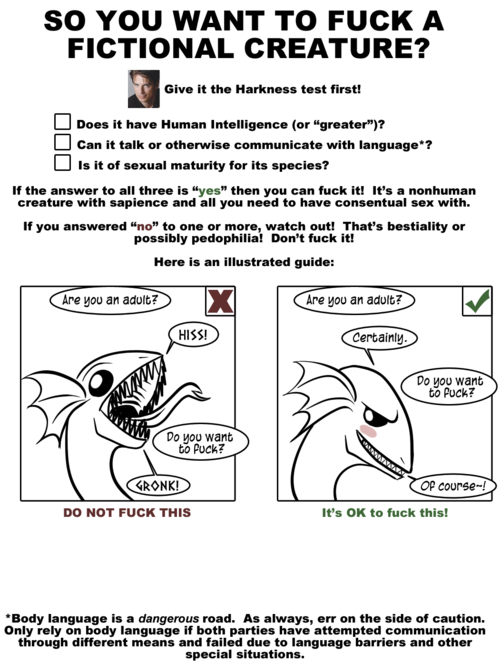
You’re thinking of bestiality. You want to fuck a T-Rex.
If it passes the Harkness Test, I’m down.
For the uninformed:
This isn’t an item or even a game mechanic but I think y’all know you need the Harkness Test at some point or another in most campaigns
here’s my issue with the harkness test
The takeaway here is that Scoobert Doo is a fuckable monster
look, the harkness test isn’t whether a monster is ATTRACTIVE, it’s whether fucking the monster is UNETHICAL. “do I find scooby doo hot?” is a separate question from “IF I find scooby doo hot, would fucking him constitute bestiality?”
holy fuck is right… but… does it work with legs???
yes !!
but how much extend
^^^^^^^^^^
I NEARLY CHOKED
ENJFDFNFATFVFDF
finally. i can be accurate
This is too fucking great to not reblog
I give it MASCLES
BIG MACHO
🤣🤣
LMAOOOOOO
Okay but for anyone who legit wants to know how to calculate it correctly:
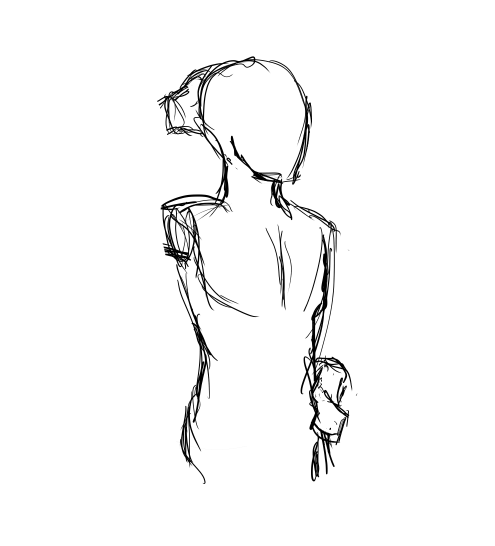
The elbow joint on average rests a couple inches higher than the navel, so if you measure how long the distance is from the middle of the shoulder to that point then you have the length of the upper and fore arms!
So if anyone’s wondering about legs too, the simplest rule of thumb is that the length from the top of the leg to the knee is equal to the distance between the top of the leg and the bottom of the pectorals:
And I wanna stress that when i say “top of the leg” i’m not talking about the crotch (please don’t flag me tumblr it’s an anatomical term) i’m talking about the point where the femur connects to the pelvis, which is higher up on the hips:
It’s easier to see what I’m talking about in this photo of a man squatting:
So yeah if you use that measurement when using this technique you should get fairly realistically proportioned legs:
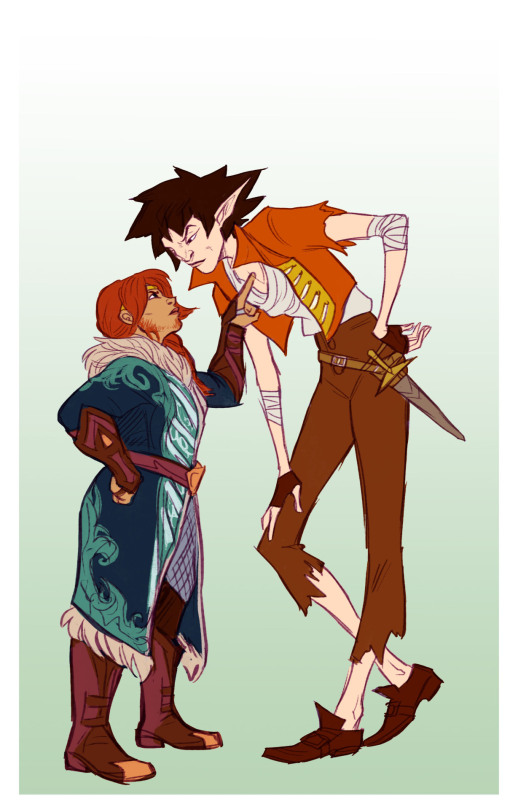
But remember! messing with proportions is an important and fun part of character design! Know the rules first so you can then break them however you please!
HOW THE HELL DID I FIND THIS POST OMG
Licherally in the midst of drawing a guy and crying at how bad the arms are. Thanks Tumbles
I only ever saw the part where people started drawing the limbs outrageously long and genuinely wanted to know how to fix that, so I’m really thankful to see the rest.
Kid Pix just became pubic domain, so the remade (but pretty much exactly the same) version is now available here. It’s uh, wild, highly recommend checking it out not only for the wonderful nostalgia but you can legit make some incredible looking stuff!
Does anyone have any advice on how to keep a cat inside??? My kittys not supposed to be out but she keeps bolting out right as we walk in. My parents have basically given up on keeping her in so she’s got tags on her collar but I still really want to keep her in. The kitty hates me though so it’s not like she’ll come when I call
Here’s some resources that might help! I also had some success keeping treats in my coat pocket and tossing them into the house whenever I left or returned home. My cat ran after the treat instead of outside so I could get through the door without worrying.
i really wish…i can share the warmth i feel when i’m at synagogue with other people at the least i want non-jews to hear our worship and how beautiful it is i think it would change a lot
if you’ve never heard a jewish prayer please just take a little time out of your day to listen:
so i made a post about autistic people having high rates of unemployment, and i noticed that some people in the tags were saying things like “wait does that mean i shouldn’t tell people i’m autistic on job applications?” or “but i have to say i’m autistic in job interviews” and i just want to say that no. you absolutely should not mention your autism (or any other neurodivergence) on job applications or during job interviews. it’s ok if you didn’t know this, but a lot of application questions are meant to screen out neurodivergent people. yes, it’s absolutely illegal, but companies do it anyway. so don’t give them the information they need to discriminate against you. if you can pass for neurotypical for the duration of a job interview, please, don’t let them know you’re autistic.
if you need accommodations, make your case for them after you’ve already got the job
Outcomes of scientific studies such as Marks-Block’s often affirm what Native people already know from tradition and experience, but that doesn’t mean the studies aren’t useful, Tripp says.
“We knew what the outcome was going to be,” he says. “But nobody listens if it isn’t written down like that.”
Being able to cite scientific literature may be especially important as Indigenous groups push for more rights, especially on “ceded territories” they still claim but no longer own. For example, Karuks want more burning rights on Forest Service land, while neighboring Yuroks are pushing to co-manage and conduct controlled burns in Redwood National Park.
FTA: “After more than a century on their own, Indigenous-created forest gardens of the Pacific Northwest support more pollinators, more seed-eating animals and more plant species than the supposedly “natural” conifer forests surrounding them.
“When we look at forest gardens, they’re actually enhancing what nature does, making it much more resilient, much more biodiverse—and, oh yeah, they feed people too,” says Armstrong.
The paper may be the first to quantify how Indigenous land stewardship can enhance what ecologists call functional diversity—a measure of how many goods an ecosystem provides. It joins a growing scientific literature revealing that Indigenous people—both historically and today—often outperform government agencies and conservation organizations at supporting biodiversity, sequestering carbon, and generating other ecological benefits on their land. Leaving nature alone is not always the right course, scientists are finding—and the original land stewards often do it best.”
…
“
“Western science for too long has embraced the idea of primordial wilderness,” says Jesse Miller, an ecologist at Stanford and Armstrong’s coauthor. “We’re seeing this paradigm shift to recognizing how much of what was thought of as primordial wilderness were actually landscapes shaped by humans.”
The forest gardens Armstrong studied once supplied Indigenous villages with food and medicine, including plants that had been imported from elsewhere. “Historically it was really important to have all the resources here,” says Willie Charlie, a former chief and current employee of the Sts’ailes Nation of the Coast Salish people. “If you had all that in your family, you were pretty self-sustaining.”
“People outside the tribal community tend to … think a lot of our positions are culturally based. But I would argue they tend to align much more with science than the non-tribal worldview,” says Peter David, a wildlife biologist for the Great Lakes Indian Fish and Wildlife Commission, which represents 11 Midwestern Ojibwe tribes.
Peter David, a wildlife biologist with the Great Lakes Indian Fish and Wildlife Commission, hanging out with some wild rice
“The tribal worldview says wolves ought to be able to establish their own population levels, and they do that at very low levels…it aligns much better with the science.”
Despite an increasing convergence between science and Indigenous knowledge, the academy still has work to do, too, says Waller. “I would like to see forestry schools routinely sending forestry students, for example, to Menominee Tribal Enterprises,” he says. “I would like to see ecologists have an option to take an ethnobotany or traditional ecological knowledge course.”“









 ifesbob