✔ they have far stronger senses than you and the world is super stimulating
They are NOT being:
❌ stubborn
❌ malicious
❌ “dominating”
Things you can do to enforce leash etiquette:
✔ utilise treats and life rewards
✔ tire your dog out prior to their walk by playing tug, fetch, etc.
✔ utilise mini-commands (sit at road, “this way”, etc)
✔ freeze or U-turn when your dog pulls
Rather than:
❌ choke chains/prong collars
❌ yelling/shouting
❌ yanking the leash
❌ “dragging” the dog (collar grabs, pushing down their butt to sit, pinning them between your legs, etc.)
We all want good leash etiquette, but there is no good reason to actively punish your dog for being excited about an exciting environment. Your own impatience and frustration (with a dog who is still learning) is not an excuse.
Hello friends! I’ve been asked how long do some insects live! This is an important factor when choosing a pet arthropod. They require as much commitment as a cat or a dog and you should not get a pet that you can’t see yourself caring for after a year.
Please note that these are average numbers. Some species have sub species that can live longer or shorter lifespans. Obviously I cannot list every single subspecies, so it’s still up to you to look up the particular bug. I am giving out average estimates so you can make a decision if you are willing to spend that much time caring for a bug.
Remember, females tend to live longer than males.
SO! Let’s start off!
Short Lifespans
These species have rather short lifespans compared to other animals, rarely lasting a season or two. With care however, they can live a few months longer.
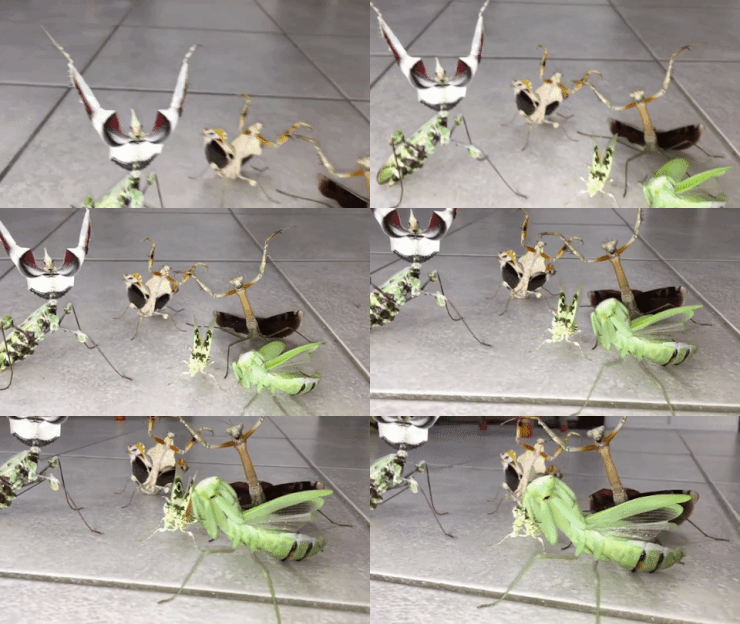
Mantids. – 9-12 months
Stick insects and Leaf insects – 1year
Jumping spiders – 10-12 months
Camel Spiders (Solifugae) – 3 months (estimated)
Eastern Hercules beetle (adults) – 3 – 4 months
Please note that with Camel Spiders, it is currently unknown just how long they actually live for. This species does badly in captivity, and it’s unknown if they require some sort of unknown mineral or conditions required to have them thrive. They are perhaps one of the most sensitive species in the pet trade.
Intermediate Lifespans
These are arthropods that live a few years, much like pet mice and rats. In the wild they may only last a season or two, but in captivity with proper care, they can live well on an extra year or so.
Whip spiders – 2 – 3 years.
Spiders – 1-3 years
Caterpillars/Moths/Butterflies – 1 year as larvae / 6 months -1 year as adults.
Hellgrammites/Dobsonfly larvae – 2-5 years as larvae / 1-2 weeks as adults
Assassin bugs – 1-2 years
Long Lifespans
These are species that live well up to a decade, which is quite old for little buggies. These are definitely insects that you must consider carefully before owning one, they require as much dedication as a rabbit.
Millipedes – 7-10 years
Blue Death Feigning Beetles – 7-8 years
Centipedes – 5-10 years
Ancient Lifespans
These species live well over a decade and beyond! Consider these like getting a dog or a cat!
Mealworms/Darkling beetles – 15 years
Female tarantulas – 20-40 years
Vinegaroon – Males – 10 years/Females – 20 years.
Arizona Desert hairy scorpion – 20 – 25 years
Helix pomatia snails – 15 – 25 years
Colony Lifespans
Colony insects thrive together and can reproduce like crazy. As long as you have the space and the food, the colonies can keep going for years and years. These are just the ages of how long an individual lives. Some of these species, like cockroaches, need buddies!
Ant Queens – 30 years / Workers – 1-3 years
Hissing cockroaches – 2-5 years
Death’s Head Cockroach – 1 year
Slugs – 1 – 3 years
Isopods/pill bugs/rolly pollies – 2-5 years
Honey Queen Bee – 2-4 years / Workers – weeks to months depending on climate.
I hope this helps you guys decide on what is the best bug for you! :3
You have probably read the tweet from a pet owner saying her vet told her that “… 90% of owners don’t actually want to be in
the room when he injects them so the animal’s last moments are usually
them frantically looking around for their owners &tbh that broke me” or another post allegedly written by a vet stating if you leave your pet during euthanasia you are a “coward”.
First of all, I cannot imagine any veterinarian saying any of those things. It is my belief that a lay person wrote those things and simply claimed the vet said them, but I could be wrong. Regardless, those posts are absolutely incorrect and those people should be ashamed of themselves. I also think that number is hugely exaggerated. Maybe 10% of owners don’t want to be present, and you know what, that is ok.
Euthanasia is a very personal thing and people have all kinds of reasons for not wanting to be present. Simply making the decision to have your pet put to sleep shows that you are compassionate and unselfish. Euthanasia is the ultimate act of love for your pet because it is completely about them- the owners get nothing out of it. The owners love their pet so much that they would rather be without them than keep them and have them suffer.
Your pet is not going to look around desperately for you or feel abandoned. Shame on those “vets” for putting out that misinformation and shame on them if they had a scared pet and they did nothing. Your vet can give your pet sedatives and other medications so they are relaxed and comfortable, I have NEVER allowed a pet to be scared or anxious before a euthanasia and the vast majority of vets will not either.
Please do not feel ashamed or upset if you choose not to be with your pet for euthanasia. I promise that the veterinarian and staff will comfort her just like she was their own and make sure she is relaxed and at peace throughout.
You have probably read the tweet from a pet owner saying her vet told her that “… 90% of owners don’t actually want to be in
the room when he injects them so the animal’s last moments are usually
them frantically looking around for their owners &tbh that broke me” or another post allegedly written by a vet stating if you leave your pet during euthanasia you are a “coward”.
First of all, I cannot imagine any veterinarian saying any of those things. It is my belief that a lay person wrote those things and simply claimed the vet said them, but I could be wrong. Regardless, those posts are absolutely incorrect and those people should be ashamed of themselves. I also think that number is hugely exaggerated. Maybe 10% of owners don’t want to be present, and you know what, that is ok.
Euthanasia is a very personal thing and people have all kinds of reasons for not wanting to be present. Simply making the decision to have your pet put to sleep shows that you are compassionate and unselfish. Euthanasia is the ultimate act of love for your pet because it is completely about them- the owners get nothing out of it. The owners love their pet so much that they would rather be without them than keep them and have them suffer.
Your pet is not going to look around desperately for you or feel abandoned. Shame on those “vets” for putting out that misinformation and shame on them if they had a scared pet and they did nothing. Your vet can give your pet sedatives and other medications so they are relaxed and comfortable, I have NEVER allowed a pet to be scared or anxious before a euthanasia and the vast majority of vets will not either.
Please do not feel ashamed or upset if you choose not to be with your pet for euthanasia. I promise that the veterinarian and staff will comfort her just like she was their own and make sure she is relaxed and at peace throughout.
This goes for any animal from a fish to a horse. Don’t do it if you don’t have the appropriate space, veterinarians or resources for care to them. It’s cruel.
As you probably have figured, leopard geckos normal behavior can vary widely between individuals. So some part of knowing this will be up to observation of your reptile. This will go over common behaviors that are normal, and cover some of the not so good behaviors.
That’s the accepted minimum standard, so I highly encourage you to get bigger if you can. Your gecko is going to spend pretty much its entire life in this enclosure; make it the best you can. c:
One of the things I hear a lot is, “oh, that’s too big/a big tank will stress a gecko out”. This is NOT accurate. Geckos get stressed out by a lot of blank space in their enclosures because they feel insecure and open to attack. This is easily mitigated by putting in more hides, plants, corkbark, decor… just anything to fill the space.
If you can’t get a bigger tank, don’t worry; you can still give your gecko a good home by making use of vertical space. Using turtle ramps can give your gecko more room to roam.
Oh thank you for the answer! I just got pretty worried because I had heard you’re supposed to use a bigger tank, and I really can’t afford one at the moment (once I get a decent job I’m going to try to get a bigger one!)
I’m going to do my best to make the enclosure the most natural looking I can with my current budget, and I might have to add stuff after a while since I don’t have a job at the moment, but hearing that the tank is big enough really made my anxiety about this better, so again thank you!
You’re welcome! Here are some extra ways to save on tank decor that your gecko will love:
Shop for fake plants at dollar stores. So long as the plants aren’t covered in glitter or perfume, they’re safe. Plastic ones are really easy to disinfect using a 10% bleach solution. Just let them soak overnight and wash them off in the morning really well. Fabric ones should be washed in hot water and soap. Watch out for dye running! If the dye runs, it’s not safe for geckos.
Toilet paper or paper towel tubes are excellent hides. honestly one of my gecko loves these more than any proper hide I get for her.
Kleenex boxes and even small cereal boxes are great.
find a cool rock outside? n i c e. Put it in the freezer for 24-36 hours to disinfect and it can be used as decor (once it’s no longer freezing, i mean). i’ve even used bricks in the past and it was fine.
Grapewood and corkbark are both cheap as HECK and very nice in gecko homes. You can freeze them for 24-36 hours to disinfect, if you want.
Oh thank you for the tips! Those will come in very handy! If you don’t mind me asking, do you know if having a lightbulb hanging inside the tank is safe? I have a hole in the top of the tank (the top is made out of a metal net) that is there so a bulb can hang inside it, and I just want to make sure it won’t hurt the gecko!
That carries a heavy risk of hurting the geck, unfortunately. It’d be really hard for the gecko to get away from the light, so there’s a risk of overheating and getting burned, as well as possible eye injuries.
I really recommend checking out this care sheet. It’s very informative.
The thing about the petsmart/petco debate that people don’t seem to understand is that it’s a lot like animal conservation. It would be physically impossible to save every animal. It only benefits one animal and the entire cooperation that sells these animals.
It’s hard to see an animal suffering. Trust me, I know. But in the long run, nothing will change if you continue to buy them. Nothing will change if you still stay silent.
Look at that snake you see in petsmart’s window and walk away. You want to know what you can do to help? Complain to management, talk to the cooperations, demand change and don’t give them profit.
and yes, I put as much effort educating people in their futile efforts to save a single snake (that will be replaced by another within a week) as I do fighting the cooperations that sell these animals.
Sometimes a veterinarian has a client who is suicidal.
They don’t really ever tell you this directly, but it happens. While our main duty of care is to our animal patients, we can’t discount the need to be there for our clients in a professional setting. You have to look out for them when you can, and in light of those atrocious, guilt-tripping posts going viral about being in the room for euthanasia, I wanted to share this story with you.
No cute pictures or gifs on this one. I’m serious.
As a veterinarian you don’t remember every euthanasia you perform. You hold the recent ones in your heart and mind for a while, but you certainly lose count as the years go by. These moments were intense for the pet owners, but you have to let them wash over you or you end up going mad with the grief and pain. But some you always remember.
My very second euthanasia was a little terrier called Roxie. And Roxie had congestive heart failure.
You can manage congestive heart failure for a while, and we’d been doing so, bu tit’s only managed, not cured. There’s no new heart transplant waiting for that dog, only a controlled death when the time comes.
Roxie’s owner was never… well, there was always something odd about him in those months of her treatment. Something intense that I couldn’t quite explain. A little odd for sure, but I was working in a new town far from home, where everybody seemed a little odd, in their own way. I was a newly graduated veterinarian and pretty green, everything was on the brink of overwhelming all the time and I probably missed warning signs.
But the day finally came when Roxie needed to be put to sleep. She was suffering, and not breathing all that well. And honestly, even with the best medicine available at the time, we’d run out of ways to make her comfortable. She couldn’t have a new heart, all we could offer was a smooth, peaceful death.
We always gave people the option: they could chose to stay for the euthanasia if they wanted to, for as much as they wanted to, or we could take the pet out the back.
He’d already made up his mind.
He chose not to stay with her, to let us take her out the back.
But he sobbed and wailed and assured the little dog, earnestly, that he would “See her soon. I’ll see you soon.”
And it wasn’t until I had already carried her, gasping, out to the back when those words dawned on me.
He wasn’t burying her at home. She wasn’t to be cremated. He hadn’t wanted to see her peaceful body after she passed.
So when exactly was he going to see her again, ‘soon’?
I didn’t know what to do. I was a new vet, still green and wet behind the ears, and vet school hadn’t prepared me very well for what to do if you think your client is going to kill themselves.
So I told the practice manager, because that’s what a new vet does when they’re stuck. I was scared. This little dog needed death, but she was quite possibly the only thing keeping this human alive, and he was not prepared for her death. Or rather, he was potentially prepared in a very wrong way.
I am eternally grateful that the practice manager went and talked to him. Talked about the dog’s life, talked him into cremation instead so he had to wait at least two weeks for her ashes to be returned, talked about making a space for them at home. Talked him into having someone else pick him up from the clinic.
Quite probably talked him into living.
I often regret that I can’t do more for people’s pain. But on my mind right now is the thought, what if he saw those guilt tripping posts. Those awful, mean-spirited, judgemental, cruel digs at someone’s personal grief.
Would he be able to stand it now, all those years removed?
What if someone else in a similar mindset reads them, with the grief still fresh?
I hope with all my heart that those posts don’t cause someone to come to harm, but I am afraid.
I think its time for another conversation about animal husbandry.
Your pets require a minimum amount of care that it is your duty to provide daily. Your dogs need fresh food, water, and daily exercise. Why have pets if they are locked in crates or in rooms all day? Why have pets if you are just going to let them live in filth?
Your dogs, cats, rodents, whatever you have, have very small lives, they’re experiences and happiness completely revolve around you. By not taking them on walks and offering positive experiences and adventures and love, you make their tiny world an unhappy one.
Things like deprivation of exercise, food, water, and affection, putting our animals in unsafe situations deliberately, physical punishment, not caring for their coat and other grooming needs, working them when they are physically unable, makes for a stressed out and unhappy creatures, ones who have spent their whole life loving and trusting you, and sets them up for major health and behavioral issues and even result in death.
I know we all have tough situations at times, where we can’t meet our pets needs to the full extent every day. I’m right there now. My mental and physical health is in the trash, but my dogs are still fed, watered, medicated and minimally exercised, and if I couldn’t do these things I would be reaching out for help or changing something in my life so that I could meet the needs of my best friends.
My biggest issue is how everyone says one thing and does another. We talk about how slapping around our pets is horrible, about how locking them in crates for 20 hours a day is neglect, how not having food and water for them is abuse, but ultimately when we find out about these things going on we let it slide. We make excuses for people we know. Its at the point where I’m so disappointed with the whole community, because if you know and you do nothing you are just as bad. I mean where exactly do you draw the line friends? None of us are perfect, all of us make mistakes in our husbandry, but our goal as animal lovers and pet owners should always be to do BETTER. When someone brings up a problem with your husbandry, your response shouldn’t be anger and denial but rather taking the criticism, researching it and making changes if necessary. If you need help, then get it. Its one thing not to take care of yourself, but dependents like children and animals have no recourse and are wholly your responsibility no matter what state you are in.
So for the love of god take your pets to yearly exams for blood work and exams, feed and water your pets the correct amount daily, exercise and meet their mental and physical stimulation needs, correct and teach with respect and kindness, react within appropriate bounds to situations involving your pets, keep your pets out of situations that could involve stress and serious injury to them, other people, or other animals, work only dogs sound in mind and body because otherwise it just means pain, injury, and behavioral issues. A little respect for life goes a very long way.
Hold each other responsible. If you see or hear evidence of dangerous and neglectful husbandry, approach the subject with respect, but please bring attention to it. Don’t sweep it under the rug, or tell them its okay, because its not. Honestly if you can’t take the criticism then don’t have an animal in your care. If someone is unwilling to make those changes, why would you want to be friends with someone who has complete disregard for a living thing? I’m not talking about yelling at your dog too loudly once or twice, or overreacting and grabbing your dog when you see them doing something thats dangerous. I’m talking about patterns of behavior, things that happen all the time, things people do or don’t do for their animals that puts their health and wellness at stake and perhaps the saftey of others as well.
Take some goddamn responsibility for your actions and if your friends are guilty of these things do something about it. Who you associate with says a lot about you as a person. If you tolerate racist friends, what else will you allow? If you continue to be friends with abusers? What WON’T you allow?
As someone with 4 high maintenance dogs, one being a very special needs boy, I know that the demands of pet ownership can at times be overwhelming, especially in conjunction with everything that goes on in our lives, but don’t let their care slip by the wayside, make your best friends a priority. Love them the way you want to be loved, care for them the way you’d hope someone would care for you, and if you need help, get it.


 ifesbob