I’m sure that, like me, by this point in the holiday season, you’ve seen about a hundred gift guides for every person or pet on your list, including your cat. You possibly have, also like me, noticed a pattern when it comes to the cat-related guides: they are almost never actually for the cats, but rather for the people. They often contain a number of “cute” or “trendy” cat-related products that, as one guide put it, “look good in your home”, or “care” products that are pretty much 100% for the benefit of the people (like self-cleaning litter boxes, none of which, by the way, would even be remotely large enough for me to even entertain using), but have little or nothing on them that is actually for us cats. I even saw one that recommended VEGAN cat treats as a gift! PLANTS FOR TREATS?! I don’t know about you, but I wouldn’t be caught dead eating those. Anyway, I’ve become more and more disappointed as I’ve looked at these lists, all of which are quite obviously written by people, and have decided to write one of my own as a result.
1. FOOD PUZZLES!!!! I know we cats tend to be a bit picky about when, where, how, and what we eat, but I promise that mixing things up a bit for us will actually help with that (and so much more)! There’s all sorts of puzzles available, now, and though a lot of them are sold as dog toys, we’re a lot smarter than people give us credit for, and are perfectly capable of figuring those ones out, as well (I’m a testament to that). There’s even some for wet food! You don’t have to spend any money on one if you don’t want to, either. You probably have all you need in your home right now to make your very own!
2. Wall and window shelves! This is one where you actually CAN take design into consideration while also looking after the needs of your cat. It’s also another one where you don’t have to spend a lot of money. If you’re going the DIY route, though, make sure you take your cat’s weight into consideration, and build shelves sturdy enough to hold them both when they’re lounging lazily and when they’re literally bouncing off the walls.
3. Cat trees and/or a scratching posts/mats/platforms! If you’re not able to put up wall shelves in your home, you simply aren’t confident enough in your shelf installation skills (my person is definitely not), or you want to provide us with even MORE places to climb, as well as a good place or two to stretch and scratch, nothing beats a good, tall, sturdy cat tree. Taller is always better, of course, but again, make sure it’s going to hold up to us at our rowdiest, and it’s probably best to secure a REALLY tall one to a wall or two. My person found a really good, sturdy one for me at a local, independent pet store, for an even lower price than some of the less sturdy ones at the national chain stores. This is another thing you could possibly make yourself, too, if you have the skills, the tools, and the inclination. Of course, if you think you have enough places for us to climb, we could always use another scratching surface or two. Vertical is often preferred, but a good, horizontal, cardboard scratching platform probably won’t go unused, and those come in some fun shapes that both us and our people can enjoy (plus, you can nap on those ones).
4. Another litter box, a BIGGER litter box, and/or a non-hooded litter box! Look, we know that we can stink, and we know that having a box of poop sitting out in the middle of your home is weird for you people, but it’s very important for us. Not only that, but we often need more options and more space than people know or think to give us. If you’re reluctant to give your cat a present (I guess some people think this is odd) and/or are looking for a super practical gift, possibly consider upgrading our litter box situation.
5. Meat for treats! We don’t really need plant matter in our diet, and all those vegan cat treats are going to do is make YOU feel good, so consider getting us something that makes US feel good. Raw meat is messy, of course, but there are plenty of freeze-dried meat treats out there for us, often with only one or two ingredients to them!
6. Water fountains! Most of us aren’t very good at staying hydrated (much like a lot of our people), but most of us can be persuaded into drinking more by a good, clean source of running water that’s just for us. We’ll still probably drink out of your water cup while you’re not looking, but with a fountain around, that won’t potentially be the ONLY water we drink when you’re not looking.
7. A Cat Charmer! I know this one is oddly specific, but it’s because this is my absolute favorite toy, and it’s my absolute favorite toy because it’s the one that my person uses to play with me every day. Us cats tend to come across as aloof to people, but spending time with OUR people is still VERY important to us, both when it’s nap time AND play time. You don’t have to get this specific toy to play with us, of course, but it’s a very good example of a toy that is 100% designed around OUR needs but that is also still fun for our people (and my person really likes the rainbow one).
8. A good, sturdy, escape-proof harness and leash! It’s important for us indoor cats to stay entertained and occupied when we’re not napping, and nothing does that better than a bit of safe and supervised outdoor time (which also lets us spend some time with our people). I know you’re probably thinking “there’s no WAY my cat will let me put a harness on them”, but I’m a testament to the fact that you can get pretty much any cat to not only tolerate, but ENJOY walking on a leash (and here’s how my person learned to do that).
9. CATIOS!!!! I can attest to the fact that even us indoor cats can’t get enough of the great outdoors, and a good way to let us have plenty of safe, environmentally-friendly outdoor time WITHOUT having to coax us into a harness is to buy (or build) us a catio. This is another one of those where you don’t need to spend a lot of money: all we need is a safe, secure, sturdy enclose where we can lounge and play, and the rest is really up to your imagination (though you should also probably check to make sure you’re not violating any city building codes, while you’re at it).
10. Last, but not least, of course, is a good, solid cardboard box! Yes, that’s right, a cardboard box! It’s important for us to have places to hide in our everyday life, and you should provide us with all sorts of tents, beds, hammocks, tunnels, blanket forts, cubby holes, and hideaways that you possibly can, but nothing really ever beats a good, old cardboard box. They’re good for hiding, napping, playing, and spying, as well as all sorts of other things that people find much more useful than we do (like keeping our toys contained to one spot, though I still don’t understand that particular human need). They also cost next to nothing, for those on a budget, and they’re pretty much endlessly customizable!
There is, of course, nothing wrong with buying your cat a few “cute” or “trendy” gifts during the holidays, but it’s also important to take into consideration what your cat actually WANTS and NEEDS when buying those gifts. It’s my hope that this list will help you understand those wants and need, as well as give you some ideas about what to get them to provide for them, possibly while also getting something that is appealing to you.
No matter what holiday you celebrate during this time of the year, I hope you have a happy one, filled with lots of warmth from both the people and pets in your life!
Toxic for rabbits:
Anise, Clove, Oregano, Tea Tree, Wintergreen
Safe for rabbits:
Lavender, lemon, orange, fennel, eucalyptus and peppermint, all should be diluted with water!
DO
NOT
USE
ESSENTIAL OILS
If you are too stupid to know they are extremely concentrated and their purpose is to highly concentrate (yes I said it twice) active substances. Active substances means that they have an effect AND SIDE EFFECTS
Do you know what you are trying to replace, baaad medicine or baaaad anti-fleas or whatever
ARE MADE OF THE SAME ACTIVE SUBSTANCES EXCEPT THEY HAVE BEEN TESTED AND MADE SAFE FOR YOU OR ANIMALS
effectively trying to and usually succeeding to erase side effects. Sometimes they don’t succeed but most of the time they do. At least they won’t kill your puppy you moron
you don’t want potential side effects? You go take homeopathy and forgo any actual effect. And probably watch your pet/kid die if the thing was too bad.
Stop trying to kill your pets or kids by giving them “natural” shit 2k18
To be honest, I had no idea that some of those essential oils were so bad for pets that even a diffuser could harm them. I think that’s why it’s so important to just always check – the same way you would with a child to make sure nothing is left lying around that could be potentially hazardous (and obviously, not exposing them to things that are dangerous!)
But I do feel bad for the woman with the diffuser. That’s a simple error to make that would have just totally slipped her mind, and people make mistakes. Just so glad the pup is OK!
For those of you who don’t know, I have been working at a raptor center for the last four years, and this is where I learned everything I know about animal training. We use a contemporary, stress-free and force-free method of training that is used by many other professional animal trainers, which follows an “A-B-C” guideline. I’ve gone on to use this method on the lab chickens and turkeys I study as a poultry welfare and behaviour researcher, and I also spend nearly all of my spare time at home training my personal backyard chickens to perform a lot of the same behaviours I’ve trained on other groups like falcons and hawks. This is a very short clip of me training Arty, one of the hens I adopted from my lab to do “hops”, or short, horizontal flights. Here’s how the A-B-C method is broken down:
Antecedents: This is anything and everything that precedes a behaviour. The most obvious example in here is the double-tap I do on my forearm, which I shaped Arty to respond to in less than a day. Before she learned this “cue”, however, the antecedent was me waving a treat, or reinforcer, above my forearm. Eventually, I was able to incorporate the double-tap, and fade out having the reinforcer in plain view. There are many other different types of antecedents, though, and some may cause a behaviour that you don’t desire/intend to train. For example, any disturbance like a loud noise or a more dominant hen pushing Arty out of the way would have been antecedents for a different behaviour, such as walking or flying away from me. When training an animal, it’s important to be aware of all possible antecedents, and “arrange” them in a way that sets the animal up for success.
Bridge: This is a signal, such as a click, whistle, “good boy/girl”, etc., that acts as a line of communication with the animal, letting it know that he/she has successfully done the behaviour you asked for, and that a nice treat is coming. Timing is very important here, as you want to make sure that you are reinforcing the specific behaviour that you want, and nothing else. Bridge immediately, but only once the behaviour is completed (e.g. I only click as soon as both Arty’s feet are in contact with my arm or the perch), and deliver the reinforcer as soon as you can afterward. Note: Some facilities/trainers say that the B stands for Behaviour, which is anything that an animal does – whether it’s a desired (flying to the trainer) behaviour, or undesired.
Consequence: At its simplest, this is what happens after the behaviour. The most successful (and ethical) type of training is through operant conditioning with positive reinforcement. Here, Arty gets rewarded, or positively reinforced, as soon as both feet land on my arm, after I’ve given the cue. Use reinforcers that you know the individual you’re training loves (I literally share my meals with my chickens, but here I’m just using whole-wheat tortilla bits), and the process becomes much easier for both the trainer and the animal, and trust is built up quickly! What are the consequences of “undesired” behaviours, for example, if Arty became startled and took off? This means she gets to avoid and escape from whatever threats she perceives, whether it was the loud noise or punishment from a dominant hen. In any case, it is important for the animal’s welfare that they have the choice to do so. Whether she comes to my arm or not is up to her, and if at any point she decides she is no longer interested, or feels unsafe, she is free to go. This also helps develop trust between the trainer and the animal, and almost guarantees positive sessions.
It honestly hurts me a bit when I see or hear about chicken owners chasing their birds into their coop at the end of the day. This is totally not necessary. All it takes is just a few minutes every day building trust with them. This is usually done with food – again, take the time to figure out which reinforcer works best with each individual. Some of my hens love (whole-wheat) pasta, some don’t, my rooster would inhale blackberries whole, half of the hens don’t care for it at all, and (unfortunately) cuddles/petting don’t work as well with chickens as they do with dogs, parrots, etc., as primary reinforcers. Bridge every time before you present a reinforcer, and you’ll be surprised how quickly they learn to pay attention to it, even when they can’t see any treats. In a pinch, I get my flock to recall (come to me from wherever they are) or follow me around when I click, because they know for sure that I’ll give them the good stuff soon. Ideally, there should be a separate cue for calling them over, then bridging and reinforcing once they’re where you want them to be, but this way still works. I start clicking as soon as I get out of the car after a long day at school/work, and I can’t tell you how wonderful it feels to see them literally fly and run to me from an acre away just to greet me. I haven’t had to chase them anywhere in years, and doing so does not give them a choice and causes fear. This way is so much easier, and entertaining!
seems that it’s made some cats sicker (puking uncontrollably) and has been infested with bugs often, also in general, i think it’s probably just low grade and can give cats problems (like purina for dogs)
What’s wrong with the bird cage? I could understand that it could be too small for a large bird like a parrot, but what about a canary?
Nope. That cage is far too small to be used as a home for any kind of bird. It’s acceptable as a travel cage for small birds, or as a sleeping only cage. But songbirds deserve to have room to move around and fly too.
For Canaries and finches, it’s recommended they have at least a 3 foot cage!
Canaries are birds that need to fly. They were not meant to be domesticated and profited from as pets. They are highly active birds that will self harm from stress in such confined spaces. Canaries are delightful to have in groups, though they are fine on their own, but every 1 bird adds 3 cubic feet to the space needed. They need multiple perches and toys. These are examples of proper Canary or other small bird enclosures.
Meow Mix is a horrible brand of cat food, I used to feed it to my cats and they would just throw it back up. It’s so low quality that half of the ingredients aren’t even food items. The meat is all scrap by products from slaughterhouses like hooves, eyes, tails and fat because it’s cheap. Which is something they don’t list on the packaging to fool pet owners. I always used to find worms in my bags of Meow Mix. Beneful literally uses antifreeze in it’s food, which has lead to the deaths of thousands of dogs a year. From conditions such as internal bleeding, seizures and cancers.
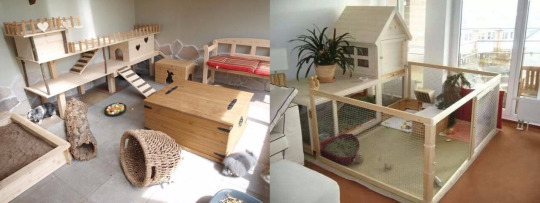
Rabbits shouldn’t be confined to a cage. (Especially a dog cage..?) Rabbits are curious creatures that need to jump, run, chew and play to be healthy. Keeping them locked in a cage 24/7 as a toy for your kids will make them sick or develop aggression from stress. Healthy rabbit lifespans are 10+ years. Rabbit cages should only be a place for your rabbit to use the litterbox and sleep after a long day of exercise and play. Also, never keep two rabbits together unless they are fixed. Rabbits are territorial and they will either fight or mate rapidly when intact. Up to 14 babies every month. This is the proper set up for a rabbit.
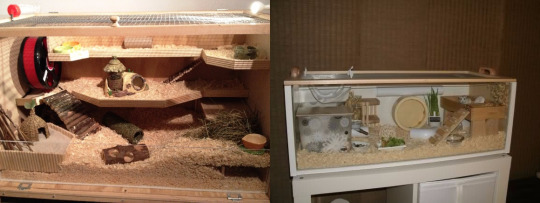
I’m cringing at that rainbow “my mommy got me a cute hamster” rodent cage. These are small creatures that need to run around and explore.They need to burrow and chew.This is the proper set up for a hamster or other small rodent.
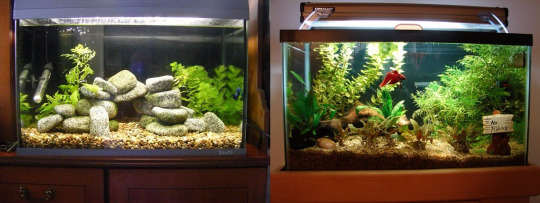
Betta fishget stressed from any confinement under 5 gallons. They are the worst pet for being sold to kids as “accessories” in small cubed tanks. When kept like that the fish will die a horribly stressed life within a year when they can live for 7 or more. They need calm filtration with many dark caves and soft plants. They are aggressive to other fish. These fish are so intelligent that they actually play with you, and they need mental stimulation to live healthy. These are proper Betta setups.
Who the fuck would even feed an omnivorous bearded dragon pellet food…? Do they want a sick pet? If pet stores even bothered to care about the keeping of exotic pets, they would know that shit is bad for them. If you can’t feed live meal worms and crickets than you shouldn’t own an exotic pet in the first place. Pellet food isn’t even real food, it’s chemically made with preservatives.
“but if we stop breeding [insert animal with debilitating characteristic], then they’ll die out!”
yeah that’s the entire point, innit
“that’s like if we killed all disabled people!! uwu!!”
humans aren’t intentionally bred with life quality destroying characteristics, and a disabled human is not in any way, shape, or form the same as a pet bred in a certain way, you piss guzzling baboon
this isn’t a hard pill to swallow, you’re just intentionally choking on it
A few weeks ago, I adopted the sweetest hamster from the worst home I’ve ever seen. My mom rescues/fosters bearded dragons and I was tagging along with her to pick up two beardies from this woman who couldn’t care for them anymore. She was keeping them in horrible conditions as well, not only cohabing them, but she also only fed them pate canned cat food and insisted that they were very picky. She was lying though, we got home and both of them ate crickets, dubia roaches and greens just fine. They also had an incredible amount of stuck shed.
When we got to her apartment, the woman greeted us and asked if we also wanted to take her hamster and I was originally going to say no because I didn’t have the room or the resources at the time, but then she showed me his cage and I literally couldn’t leave him there for another moment, she had him in a 20 gallon long cage with thick wood chips and pieces of carpet for his bedding. He had no way to burrow, his only hide was a PVC pipe. Instead of a water bottle, she’d prompted to give him a bowl that was filled with filthy, unsanitary water that stunk upon us dumping it out. His diet consisted of pieces of bread, corn flakes and sunflower seeds. When we were throwing out his bedding, the bottom of the cage was lined with mold. When I was loading him into the car, I asked the owner what she’d named him so I had something to call him and she said she’d never given him one. There’s nothing wrong with not naming your pets, but something about her not giving him one just struck me with sadness. Like she didn’t care about him enough to even give him a name.
Since then, I’ve decided to call him Rick. He’s in a 40 gallon tank now with fluffy carefresh bedding and a nice water bottle and a good hamster-safe diet. Unfortunately, he’s quite old, so I’m not sure how much longer I’ll have him, but I’m glad he can live the rest of his life somewhere clean and healthy.
I’m just begging anybody reading this to think and do research before purchasing any animal. Don’t subject them to bad conditions just because it’s easier for you to deal with. If an animal has care requirements that you aren’t able to achieve long term like how often it’s cage needs to be cleaned or providing it’s basic dietary needs, then it’s not an appropriate animal for you to be getting and you should seriously reconsider.
dogs are omnivore and IF YOUR VET APPROVES your pooch MAY be able to go on an APPROVED(!!!!!) commercial vegan dog food like the brand “v-dog” which has all the essential vitamins, protein, etc. (the oldest record winning dogs have been vegan)
cats are CARNIVORE and cannot fucking live on a vegan diet. a vet would laugh in your face and probably find some way to have your pet taken away from you because you’re obviously not fit to have an animal if you think you can feed a cat a diet based on your own ethics
i’m vegan but this is so fucking harmful.
it’s about minimizing your harm, not putting your animals on risky diets in an attempt to be perfect.
DON’T FUCKING DO THIS TO YOUR PETS
Idiot people
If you see someone you know doing this, report them for animal cruelty and neglect.
^^^^^^^^^^^^^^^^^^^^^^^^^^^^
This posts, and many of the notes on it, are bothering me. Ladies, gentlemen, esteemed colleagues from outside the confines of the gender binary; gather ‘round. Let’s throw some science in this joint.
1. Humans. Humans are not cats. Humans are not dogs. One would think this obvious, but people have a tendency to attempt such interspecies comparisons when discussing diet. Humans are order omnivora; we have essentially evolved in a manner that attempts to give us as much dietary flexibility as possible. We do, however, require a substance called B12 (or cobalamin), which is extremely important for brain and nervous system functions, as well as the synthesis of DNA and the construction of red blood cells. We cannot produce this vitamin ourselves–no animal, plant, or fungus can. The enzymes used in cobalamin production are essentially unique to bacteria and archaea–some species of which hang out in the digestive tracks of other animals. We get cobalamin in a roundabout way from fish, shellfish, meat, eggs, milk, and dairy products. While there is no naturally-occurring, vegan source of the vitamin that has been demonstrated effective in a human study of statistically significant sample size, effective synthetic forms do exist and can be used as a substitute. Cyanocobalamin is one of the most common and is frequently found in fortified foods and vitamins. In short: Humans are omnivores. Humans have evolved for dietary flexibility, including viable vegetarianism. Humans did not evolve for veganism (be extremely suspicious of people who tell you that we did, as they are lying), but due to modern technologies, veganism is also a viable diet that humans can thrive on, should they so choose.
Now, I did manage to find two veterinarians who disagree with every other study I dug up and the American Veterinary Medical Association. Their articles are here and here. They don’t really have sources, and are essentially wholly dependent on anecdotal evidence (“my dog is a vegetarian and hasn’t died!”), but for those of you data cherry-pickers reading this, there you go.
As a rule, dogs and cats need meat. If that makes you uncomfortable, that is your problem, not theirs. If you try to implement a vegan or vegetarian diet for your pets because you implemented one for yourself, you shouldn’t have those pets. That is animal abuse. (By the way, those of you not feeding your cats and non-allergic dogs the food they need to survive and thrive? What the fuck is wrong with you? Do you not love your pets?)
TL;DR If you do not want a pet that must be fed meat, you should under no circumstances acquire a cat or a dog. Thank you for your time.
Rebloobing for the more detailed info on B12 and obligate carnivore vs true omnivores
Reptiles are losing
more than just their tails to cats. In fact, new research shows that
entire reptile populations may be dropping due to the presence of
invasive felines.
According to researchers, coordinated critics have mounted a “misinformation campaign designed to purposefully fabricate doubt regarding the harmful impacts of outdoor cats and stymie policies that would remove outdoor cats from the landscape.”
The conflict stems from a groundbreaking study published in 2013 by scientists from the Smithsonian Conservation Biology Institute and the U.S. Fish and Wildlife Service. That study evaluated the combined impact of the tens of millions of outdoor cats in the United States. The authors found that roaming outdoor cats kill approximately 2.4 billion birds every year and are the leading source of direct, human-caused mortality to birds in the country. Similar results have since been confirmed in Canada and Australia.
To those of you still in denial about how bad outdoor cats are to wildlife not just in your own countries but globally here’s the cold hard scientific facts stating that you are apart of a movement of uneducated critics spreading misinformation.
Here’s the link to the open-source scientific artificial as well:
but what about…. all the rats, mice etc they kill… hmmmmm
Maybe click the actual scientific research and read it before leaving a comment hmmmmm it would have saved you the embarrassment of proving the point of research. Which was that people that criticise keeping cats indoors were found to have zero actual evidence to back up their criticisms, therefore all their claims were based on nonsense or emotions.
Yikes! Think this is a good lesson in clicking links before you comment!
This study is going to cause so many ructions in the public…. buckle in, guys
You have not seen ructions in public until you’ve seen me tell a bunch of farmers to keep their barn cats indoors and encourage black snakes to take care of their Rodent probs because at least the snakes don’t spread toxoplasmosis.
Nobody does a ruction like a six foot plus dude who is secretly afraid a five foot snake will casually slither by and be all “sup”
Anyway here is my Chief Rodent Control Officer after taking a tithe of eggs which she does when there’s not enough rodents around
Yeah it’s not too hard to predict how that conversation will go:
You: You know those cats running around your property that won’t let a human touch them if their lives depended on it? You need to bring them all in the house.
Farmer: haha good one. You know they’d freak the hell out, right? Assuming that I could catch them and drag them in in the first place. And how am I supposed to control the rats if all my cats are inside?
You: Bring in a bunch of snakes and…
Farmer: haha go away now.
I love it when people assume I am not in fact a farmer myself. I’m a shepherd, with sheep. I don’t have barn cats because, among other reasons, cats spread toxoplasmosis. You know what toxo does? Probably not. You’re probably not dependent on small ruminants for any part of your livelihood.
Toxoplasmosis causes abortion in sheep and goats. Every ewe or doe who fails to lamb or kid is lost milk, lost meat, a lost replacement animal in the flock, lost cash from the sale of a new herd sire to someone else. When you have rare breed primitive sheep like I do, each lost pregnancy is also the entire breed slipping closer to the brink of disappearing.
You also appear to be unaware that there are live traps for catching the very feral barn cats – I’m SO glad someone who knows my profession, life, and attendant tools so well chimed in – we also use them to eg trap raccoons, foxes, and possums who are predating small livestock like chickens and rabbits. Incidentally, did you know cats can shed salmonella which can go on to infect your chickens? Why are you raising your own chickens for eggs and meat if you’re just going to get the same salmonella roulette you could get at the grocery store without all the goddamned work?
Chickens will also eat mice and young rats, incidentally. If you’ve got an honest to God adult rat infestation in your barn your husbandry practices are fucked up six ways from Sunday and you need to build better feed containers before you do anything else. The country isn’t the city. We do a lot more mice here.
You could of course also get yourself a nice working terrier and while you’re doing chores let the dog go to town on the rodent population.
Because if you actually have barn cats you can’t get near, they’re serving as a potential reservoir for rabies (which will pass to any mammal including you, including cattle), feline distemper, toxo, salmonella, and a host of parasites starting with coccidia and running out to various worms that don’t much care if they infect a barn cat or, yknow, a pregnant cow worth $2000.
So no, actually, that’s generally not how the conversation goes. But thanks for chiming in, city kid, assuming I was not in fact a working shepherd.
THIS. Andrea knows her stuff and I highly recommend following her here and on Twitter.
In researching and thinking about leopard gecko care: how the fuck do those youtubers even think they can manage that many animals? How the fuck do they do it? Do they have time for anything else?
I really.. don’t think it’s possible. There’s a limit to how many animals you can own successfully (of course it depends on the specific animals but) and I think a lot of those youtubers are above that number




 ifesbob