So basically, you could go with something like a 40g for a juvenile (which is what the “basic” size is), but you’d be better off with something like a 75g, and I would plan on upgrading again as they get older. A vivarium would be a great idea for an adult – easier to move than a huge glass tank, easier to get into, and you can get them in better dimensions than tanks. I have a couple of Animal Plastics cages and love them – https://apcages.com/home The wait time is at least several months, so order early, but they’re great quality, easy to put together, and look really nice.
Edit to add: One of the reasons it’s better to go bigger (besides just room to move around) is that it’s way easier to provide a proper heat gradient with more space.
Adventure Cats: Living Nine Lives to the Fullest – by Laura J. Moss
I’m nearly finished reading the official Adventure Cats book, and I thought I would talk about it for a little bit! If you’re considering training up your own cat to be an adventure cat, I would definitely recommend this book. I certainly wish I had read this before I started training my own cat, Dave, to be an adventure cat.
The organization of this book is pretty linear, starting out with determining if your cat has a good “adventure cat” personality, then how to use +R and clicker training to train your cat to tolerate the harness and follow simple commands (such as “come here”). From there, they discuss cat safety, then how to transition your cat from backyard adventures to other environments and activities, such as hiking, camping, canoeing, skiing, and more. If you don’t have access to outdoor wild spaces, they also have sections at the end for city adventuring and indoor enrichment.
The book is easy to read and is organized in a way that it is easy to find specific information. I love the emphasis throughout the book on the comfort and safety of the cat, and how you shouldn’t force them to do anything they are unsure of. Cats are not dogs, and you can’t expect them to walk like one! Harness training your cat has a different kind of charm. They also include fun little stories and interviews of adventure cat owners and their experiences, to give you an idea of what adventuring is like.
If you can’t afford the book, a lot of the information within it can also be found on their website, though not quite as in depth or in as organized of a manner. Because it is an American book, I also found that some of the information in it isn’t as applicable to other countries (ie. which US national parks allow pets, toxic plants in the US, information about the ASPCA poison control help line, etc), but most of the content can be adapted for adventure cats anywhere in the world.
Those who consider themselves ‘experienced’ adventure cat owners might not find much new information on adventure cats in this book, but for anyone who is still learning (or interested to learn about) adventure cats, I would definitely recommend this read! Harness training is a fantastic way to let your cat experience the outdoors safely, and it provides you a great way to bond with your feline friend.
(Links to the book on amazon and to the Adventure Cat website will be in a reblog, because tumblr hates links apparently.)
Can’t believe there are still people arguing that reptiles don’t benefit from enrichment when there are literally studies showing that even invertebrates benefit from enrichment.
And to be clear, I’m not just talking about cephalopods. I’m talking enrichment studies on tarantulas, I’m talking training starfish, I’m talking puzzle toys for lobsters.
While parts of the hobby are still arguing about this reptile enrichment business the rest of the scientifically-minded, professional animal-keeping world is moving on with the fairly obvious assumption that most animals can benefit from varied stimulation of their brains (or neurons) and bodies.
Recently have seen this popping up quite frequently at vets, so wanted to give a warning to all bearded dragon (and iguana apparently have them?) owners.
These are the Femoral Pores! They’re glands which are believed to be used by males during breeding season to release pheromones which attract females. Above is the sexual dimorphism between normal male and female pores.
This is a close up of a males pores during breeding season.
These pores release either a keratinised sort of oil, or a fatty oil depending on the use of them (remember we don’t know their full purpose!) so they can sometimes become plugged and gunky, causing infection and inhibition of hind leg movement if the infection and inpaction becomes severe enough.
Here are two photos of males with severely impacted pores! Note the male in the bottom image is a recent rescue so is not in good shape with his pores or retained shed.
So why do they become impacted? Well naturally in the wild you will hardly ever (I’d argue never) see a dragon with impacted pores. Why? You guys won’t like this. SAND. Bearded dragons will use sand, dirt, trees, rocks, and all other sorts of rough material to wipe the secretions from their pores. As they climb over a log or run across sand the secretions will be rubbed off by the rough material and hence, none is retained in the pore or skin to harden and impact. Contrary to what many American care sites will have you believe, sand is natural and healthy for many species of bearded dragon and it is poor husbandry, mainly heating and nutrients, which caste impaction, not the sand itself. But I’m not getting into that debate today.
Femoral Pore Impaction has flared to life recently due to the poor husbandry of bearded dragons which is being encouraged by these sites.
This is not a suitable tank for a bearded dragon. And I’m not trying to shame anyone, just educate. This tank has minimum enrichment for the dragon, with only one hide and two ‘climbing’ items (and I would argue it would not use the ladder) hence its emotional and physical requirements aren’t being met. This tank is lacking any hard substrate or roughage items, so it is predisposed to both femoral gland Impaction and shedding complications. It could also end up with overgrown nails. Bearded dragons need either rough substrate (eg. Sand) to wear off shed and their gland secretion, or rough ornaments like logs and rocks. If you don’t want to use sand fair enough, but make sure you have a log in there for them! This tank isn’t the worst I’ve seen, however I feel as if the ornaments are more for the owners aesthetic than they are the dragons benefit. Hide is good, that log bridge is good, but it lacks other enrichment and roughage material the dragon desperately requires. I also see no water dish, which should be provided even if your dragon doesn’t drink incase it has mites, shedding issues, or overheating in which it will submerge itself.
I tried to find a fairly basic tank as my good example since I know we don’t all have the room or money to create our dragons some of those amazing tanks you see! But this is an example of a good tank at its minimum. Essentially this is the rule you should follow:
Roughage items (logs, rocks, substrate)
Climbing/vantage point (nets, logs, platforms)
Hides, preferably two
Water dish
Adequate floor space
This tank checks all but one of those points, as I can’t see a water dish (although that could be one in the background behind the logs?) and as this dragon grows, you may need to remove some objects to allow more floor space. Asides from that I’d say this tank is perfect for a dragon! I cannot work out what the substrate is, I think it’s one of those reptile matting things which I can’t speak on as I have no experience with, but as long as the substrate doesn’t crumble off the mat to be ingestible I see no issue with it.
This dragon is enriched, happy, and I hope has the adequate heating, nutrition, and UVB it requires.
Generally speaking, almost every issue a bearded dragon may experience usually can be accounted to poor husbandry. Impaction? Husbandry. Bad shed? Husbandry. Metabolic bone disease? Husbandry. Egg binding? Husbandry. There are exceptions of course, for example my old girl Kilgharrah was born with a deformed colon so could not defecate and was impacted her entire life. But if your dragon has an issue, look to its husbandry first.
It makes me upset to know that Femoral Pore Impaction is becoming such a prevalent issue when previously, it was a rare case (according to the vets I’ve spoken with) and I hope this post can serve to educate some people on how to prevent it.
If you want a quick summary, use newspaper or tile or whatever it is you use if you’re adamant against sand. However do your dragon a favour and get it a nice, rough log or rock.
Lizards love logs 🙂
If anyone is curious this particular dragon was posted by The Reptile Doctor on Facebook. I do disagree with @feathers-scales-and-tails on the subject of sand however, though mostly in the case of pure sand. Mixed into a bioactive substrate it is fine, but with the fine grained sands that you buy at pet stores there is a problem with heightened impaction risk. Washed play sand is a bit of a gray area though because it’s larger grains make it a bit less of an impaction risk with proper husbandry. Still, considering that the majority of beardies that people own are dehydrated to some degree, I wouldn’t risk it except in dig boxes. Central bearded dragons ( the ones most common in the pet trade) are able to tolerate a wide range of habitats and temperature ranges and are found in sandy deserts in some places, but even there they have the option to navigate between different substrates. They also dig burrows, something they can’t do in pure sand but can do in their desert sand habitats because it’s not just sand even though it looks like it on the surface. The burrows hold their shape because of plant fibers in the soil that are difficult to degrade (similar to the coco fiber we use when building the substrate in our tanks). The variance in particle shape and size that this mix produces is also why we don’t see impaction very commonly in wild dragons as well.
I agree wholeheartedly with the reasoning behind impaction though, and would just like to add that part of the problem stems from dehydration and poor nutrition, which can play a role in them producing abnormal secretions.
Edit: oops, accidentally tagged the wrong person a second ago so I changed it. Thanks @fantasticbeastsandhowtokeepthem for correcting me.
[disclaimer: I don’t currently keep snakes, but i kept them in the past]
So my personal experience is that feeding in tank did NOT result in a higher bite risk. But handling a snake DIRECTLY after feeding it? Yeah. That could cause a nasty regurgitation, which seemed much more harmful than being bitten. I’d rather be bitten than cause a snake to regurge. A snake bite would hurt for a few minutes, but a snake regurging could damage its health.
The thing that gets me about the whole ‘omg the snake is GOING TO BITE IF U FEED IN THE ENCLOSURE’ is that the snake is in feeding mode regardless. It knows that there’s food. It smells that m.ouse or r.at. So it seems to me that it’s much more likely to bite you when you’re trying to haul it out of its viv, put it in a feeding bin, and then trying to put it BACK in the viv.
if I felt particularly worried about being bitten, I’d just use a hook to remove the snake from its vivarium for handling purposes.
I am not sure how old this is, but the “don’t feed in the enclosure” is an old OLD thing that people used to do, that I genuinely have no idea why they did it. Its still spread around on popular *cough* shitty *cough* care sheets because petsmart and petco say its better that way and people listen. Its actually the opposite, a snake fed out of enclosure may start associating your hands with feeding time, because hands reach in, pull the snake out, and place in the feeding container. Feeding in the enclosure makes the snake associate tongs with feeding, and hands with handling. That, and often times if you take the snake out of the enclosure if its a shy species, it won’t eat anyways.
So you guys know that really annoying thing that bare rack keepers say when you say you want to emulate the natural habitat? Where they say “Well you might as well stick mites and other parasites/predators/etc etc in there too because that’s natural!” To avoid that annoying comment, I deem we start saying, instead of “emulating the natural habitat” we are “Emulating the positive aspects of their natural habitat”. It sounds much better that way, and we can avoid that annoying comment too 🙂
It’s a better sell! I think it might also be good to pitch it as the best of both worlds- all the advantages of captivity (medical care, safety), plus all the advantages of their natural habitat (mental stimulation, ability to build good muscle tone, etc.)
I also think that as a rhetorical device, this’ll be really good for convincing newer people to change. I don’t know how to actually change bare rack keepers’ minds- we know that facts don’t change people’s minds, and so many people are invested in extracting maximum profit for minimum keeping effort. But pitching naturalistic emulation to new snake keepers in a manner that isn’t just factual but also emotional (tacitly saying that this is a good thing to do for your pet’s wellness, and that you’re making it safer and healthier by keeping it this way), I think the idea could really resonate.
I’m working on putting together lists of enrichment ideas so I can implement regular enrichment plans for all of my animals. I think I’ve finished my cat list, so thought I would share it! I’ll be posting the other lists as I finish them (ball python, hermit crabs, rats; hedgehog is already posted).
Enrichment ideas are loosely separated into different categories – food, sensory (primarily scent-based for cats), environmental, and social. Feel free to share if you have any suggestions that I missed! 🙂
So there are quite a few unhealthy reptile morphs out there and I only discovered most of them by fluke, so I thought I’d make a masterpost. There are likely many more which I haven’t heard of yet, so feel free to expand on this post with others.
Enigma Leopard Geckos
The Enigma morph is one that covers the Geckos body in little spots that look like freckles, very cute but it comes with a devastating condition known as “Enigma syndrome” This disorder affects a Geckos fine motor control and results in many secondary symptoms such as stargazing (looking upwards frequently), walking around in circles frequently, wobbly and difficult walking, seizures, and an inability to catch prey due to their aim being affected from this condition. Overall it significantly decreases their quality of life. An animal may not demonstrate this condition for many years, it can come on years into their life. This is a dominant genetic disorder meaning any animal which is an enigma will pass this onto offspring. Even ‘healthy’ appearing animals will carry this gene and pass it along to offspring. The Enigma morph needs to be phased out completely since all who are Enigma have the potential to develop this disorder.
Sunkissed Corn Snakes
The Sunkissed morph is pictured above, rather striking in its vivid colouration. However the price for it is something known as “Stargazing Syndrome” which is pictured in the right side photograph. Stargazing syndrome is a vestibular syndrome (balance affecting condition) which prevents normal functionality of the central nervous system and causes these snakes to twist their necks and heads upwards towards the sky. Basically put, these snakes can’t work out which way is up and are often found upside down on their backs. It affects these snakes by causing difficulty moving, disorientation, inability to right themselves into a normal position if on their backs, and sometimes even tremors and seizures. Once again a genetic disorder, however since its recessive you often won’t know if the snake is a carrier or not. The only way to tell if a snake carries the stargazing trait is to breed them; any who prove to carry this trait should never be bred again.
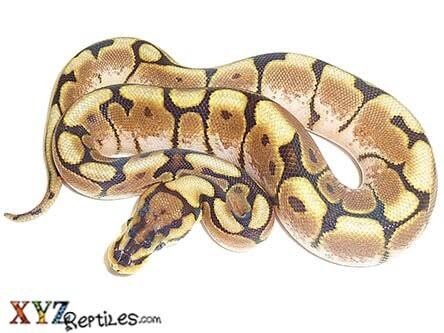
Spider Ball Pythons
The Spider morph is absolutely stunning, characteristic of that ‘drippy’ black patterning on the body and a rather unique head stamp/pattern. It can come in many varieties since it’s commonly bred into other morphs such as pied, banana, etc. However it causes something called “Wobble Syndrome” which is a severe neurological disorder. This is hypothesised to be caused by an error in the neural crest during embryonic development. The neural crest is responsible for arranging neurons in the correct positions and depositing pigmentation. This morph alters where pigment is usually placed in the body, giving them the gorgeous appearance, however it consequently prevents neurons from reaching their correct positions, hence the neurological disorder. Wobble Syndrome causes many severe and debilitating issues to the snake. The most noticeable being ‘corkscrewing’ which is where the snake will flip it’s head and neck upside down, right way up, and upside down again in quick succession. However they are also affected by head tremors, difficulty moving, lack of coordination, inability to right itself if upside down, torticollis (neck spasms), poor muscle tone, and difficulty eating due to head wobbling and missed strikes. Wobble Syndrome is a dominant genetic disorder meaning any snake which expresses the spider phenotype will suffer from and pass on this disorder to offspring. It can range from barely noticeable to severe, and an animal may not suffer at first, but can develop the disorder after several years of being ‘healthy’. The Spider morph needs to be phased out completely since all who are Spider have the potential to develop this disorder.
Jaguar Carpet Pythons
The Jaguar morph has to be one of the most visually stunning morphs out there, it’s characterised by it’s gorgeous spots which resemble a jaguars. However the price they pay for their beauty is once again, “Wobble Syndrome”. Jaguars are identical to Spider Ball Pythons in their suffering, and it’s even thought that the Neural Crest deformity is the cause for these guys too. It is important to note that there are several species who can carry the jaguar gene. The gene originated in Jungle Carpet Pythons but has since been bred into other Carpet Pythons (CP for short) species such as the Irian Jaya CP, Darwin CP, Coastal CP, and Diamond CP. Pretty much the only difference with the Jaguar morph is that it is not a dominant gene like the spider morph, and it’s not a recessive gene like the sunkissed morph. The Jaguar gene is a co-dominant mutation. What that means is that the Jaguar gene is visible along with whatever other gene the snake carries. You almost always have two genes for something, and in codominance neither of those genes are recessive to the other, and neither are dominating to the other either. This means both genes express, so to put that into a visual sense (but not genetically accurate!) if you bred a black and a white cat together, the offspring would be black and white if they were co-dominant. This just like the spider and enigma morph means any snake which expresses the Jaguar phenotype has the ability to develop Wobble Syndrome and will pass it along to offspring. The Jaguar morph needs to be phased out completely since all who are Jaguar have the potential to develop this disorder.
Silkback Bearded Dragons and Scaleless Snakes
Silkback bearded dragons and Scaleless snakes are exactly what they sound like, they are completely devoid of any and all scales and instead only have the layer of skin present beneath reptile scales. I admit I do not know much about Scaleless snakes, but assume they suffer the same affects as the silkback bearded dragons so have included them here. Silkback bearded dragons are produced when two leatherback bearded dragons are bred together. The leatherback gene is co-dominant (it can also be recessive) and if a dragon receives two copies of this co-dominant gene then they are a silkback. Co-dominance means two genes are working together, so one copy of leatherback and one copy of normal scales means together these genes create a dragon who has reduced spikes and scales but they still have scales! Two copies of the leatherback gene means the co-dominance has nothing to partner with, so the dragon we get is completely devoid of scales. Now, for an animal which is supposed to have scales, having no scales comes with many severe issues. The main being that they suffer extreme shedding difficulty and have no protection from sharp objects or other dragons. Scalesless animals can easily be cut or punctured from ornaments in a tank which are safe for their scaled or leatherback counterparts. Even a basking log, brick, or rock can cut them if they run against it wrong. This means their tank needs to be almost empty or only have soft, pliable decor which provides no risk of injury. This can be severely damaging to the animals mental wellbeing as there is no enrichment opportunities for the animal. Shedding wise, these animals need to be soaked in baths almost daily to maintain skin hydration, and when it comes time to shed their shed will shrink to their skin and it’s often for them to lose toes, bits of tail, or even get pieces stuck around their heads and necks which can cause severe damage. You can also not breed silkback bearded dragons (am unsure about Scaleless snakes?) pairing another dragon with a silkback will cause extreme injury. If the silkback is female, the male bearded dragon will cut her open with his claws as he mounts her and he will tear her shoulders and neck open where he holds her with his mouth. These injuries can be life threatening. Furthermore, if the silkback is male he may receive lacerations and cuts to his stomach upon mounting the female or he may be critically injured if she rejects him and bites or scratches in retaliation. If all of that isn’t bad enough these scaleless animals also have an increased risk of illness due to decreased immunity (immunity decreased due to unknown reason) and suffer extremely reduced lifespans. Scalesless animals are an incredibly unnatural and disgusting morph which needs to be completely phased out.
That’s all for my masterpost currently. There are likely many more unhealthy morphs I have yet to hear of, so please inform me if you know of any others I’ve neglected to mention and I shall research and add them here. Please do not ever support or purchase one of these animals as it encourages the breeding of severely unhealthy animals with significantly reduced quality of life. With so many healthy and wonderful morphs and species available there is absolutely no reason to ever purchase one of these.
I’d like to suggest adding lemon frost leopard geckos to this list. I’ve discussed their cancer problem here, and here is a link to two necropsies and histology of said cancer. I go into some detail here about the eye deformities often seen in LFxLF leopard geckos as well.
It’s really unlikely that someone would accidentally buy one of these animals since they still sell for 500-800 USD (a far cry from the original 3,000 USD that was common pre-cancer study), but I fully expect the price to fall even further. It may be within the reach of the average hobbyist in just a few years.
I don’t know too much about insect care, unfortunately!! But I know I follow a few people who do, including @the-awkward-turt, @tser (who has mantids), and I know @hedgehogsofasgard has some mantids! All I know about mantids is that the gorgeous orchid ones are much more difficult to care for, which isn’t a lot of help. XD
Also good for you for wanting to tackle your fear!! ♥ Good luck & I hope you enjoy your new smol friend when you get one!
Hey anon! I ran the mantis breeding program at a “bug zoo” for several years, so I’ve worked with many species and can definitely answer any questions you might have about mantis husbandry.
So, firstly, I am obligated to let you know that all non-native mantids are in a bit of a legal gray area in the US. The USDA forbids non-inspected facilities/individuals from owning non-native mantids but hardly enforces this restriction at all (a quick Google search will find lots of highly public websites displaying them for sale). However, I cannot advocate breaking laws.
If you were to be inspected and approved by the USDA as a containment facility (or if you were to move somewhere other than the US) I would say any mantids in the genus Hierodula (often called giant Asian mantids) and ghost mantids (Phyllocrania paradoxica) are the easiest and most rewarding species for a beginning keeper. Hierodula species get larger and more impressive, but ghost mantids have a lower nymph mortality rate and are very unique looking.
If you are limited to non-exotic species I would recommend getting a Chinese mantis (Tenodera sinensis). Although Chinese mantids are technically not native they are what’s called a “naturalized species” (i.e. they’ve been here so long they’ve basically found a niche in the local ecosystem, would be all but impossible to remove, and aren’t causing any significant ecological damage) and are therefore legal to own without permits. They’re big, handleable (though they can be a bit flighty, especially when young), and easy to care for.
The oothecas (egg cases) you see being sold at garden centers for pest control are usually Chinese mantis oothecas, but I would recommend against buying an ooth. 1) It’s fairly common for these ooths not to hatch (either because they were infertile or were incorrectly handled) and 2) if it does hatch you’ll have hundreds of baby mantids on your hands and you’ll have to either let them eat each other to cut down on numbers, release most of them outside (if the climate/weather is survivable), or euthanize (i.e. freeze) most of them, which is not a great way to start your mantis keeping journey.
Instead, I would recommend buying from a reputable mantis breeder. If you get nymphs, especially if you get younger nymphs, I would recommend getting a few. They can be pretty delicate when young and can sometimes die even if you do everything right. If you get a few it will be more likely that at least one or two will make it to adulthood.
Another note since you mentioned you are trying to work on your fear of insects: Remember that mantids are carnivores and must eat live prey, so if you keep mantids you’ll also have to deal with their food insects (fruit flies, crickets, roaches, etc). So make sure you’re comfortable with that.
If you decide you’re not up for mantis care (they can be a bit more complicated/delicate than some other pet insects) I would highly recommend Madagascar hissing cockroaches (they are a lot cuter and more appealing than the typical roaches you’d find in your house) or bess beetles.
Good luck! And feel free to message me or shoot me an ask if you have more questions!! I’m always happy to talk bugs (especially mantids)!
Oh shit, I didn’t know that! That’s really awesome, and thank you for all the info!! 😀




 ifesbob