i wish there was more talking going around about how keeping parrots as pets is a bad idea. when i got mine i did all the research, but no site i visited ever mentioned not to keep parrots, just how to take care of them, which is obiviously a good thing, but still i think people should be informed that, for the standard pet owner, keeping these birds is unethical. they are so easy to acquire too, and they are some of the most abused pets out there, it’s genuinely sad. parrots are highly intelligent, wild animals, that should only be kept by experts and zoos, to allow them to have happy lives in captivity. there are so many domesticated birds species already, with just as much personality as any parrot, but easier to look after and ethical to keep 100%. i just feel sorry for parrots man 😦
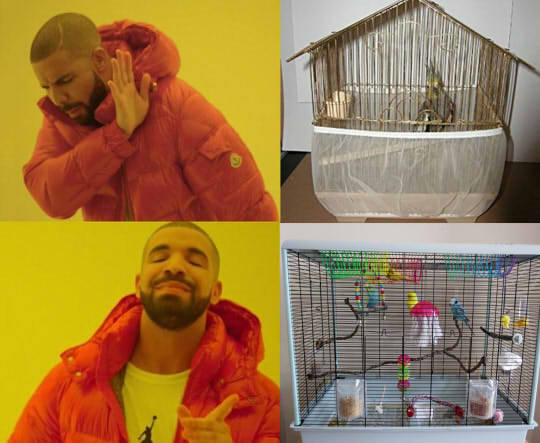
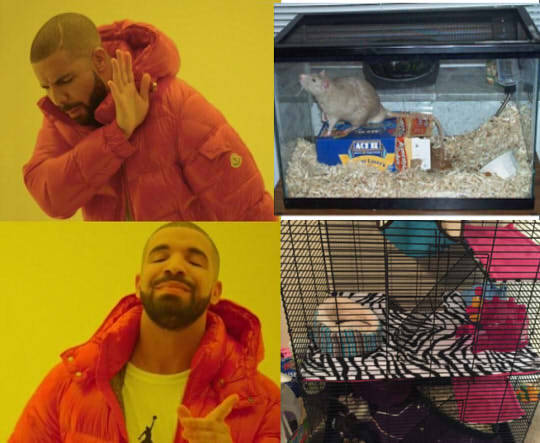
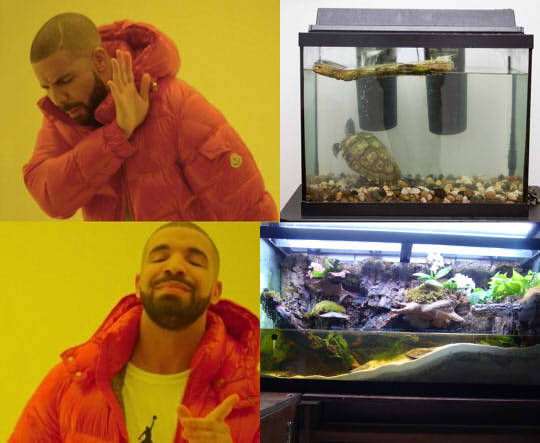
I’m adding to this because y’all gonna learn some shit about housing your pets.
Someone make more I love this new meme.
I know that huge homes are great for pets but also did it fucking occur to you that some people don’t have the room or money for those?
hey, guess what. those are all minimum requirements. actually, the person who added onto my post even made the bird cage still TOO small for those birds.
and if you dont have the money or the space for those pets, don’t fucking get the pet.
It’s definitely limited! Inverts are probably the one species I wouldn’t push for preventative care on (ok aquatics too) just because they’re so delicate. This is certainly an area that is still being discovered, but there is medicine that can be done. Inverts (at least many species we are aware of) can be anesthetized. We have some data on how certain drugs affect them. Super tiny suture meant for eyes can be used to repair defects. And of course husbandry! We can always talk to owners about husbandry. There is a Veterinary Invertebrate Society, which I joined, that has a ton of cool CE about real cases that people have done. A lot of them work with zoologic or research collections, so it’s not super common to have pets brought in but there are definitely options!
“you should research a breed/animal before you get the pet to make sure it’s needs and behavior match your lifestyle” and “we shouldn’t go for the jugular on people who rehome their pets after realizing they can’t handle the pet they got” are not mutually exclusive statements
i would 100% rather someone rehome their husky that they can’t handle upon realizing it than continue to poorly raise it because giving up pets bad
It’s not something they should get all the time, or in large amounts, but yeah, mice can eat pretty much anything that we can. I try to give my mice a little something from off my plate at least once a week for enrichment. If your mice are not used to being given novel foods frequently, though, start with very tiny amounts so they don’t get upset stomachs- especially with things that are especially fatty or sugary, like bacon or sweet fruits.
My remaining mice are very old so they pretty much get whatever they might like and I let them eat as much as they want of it because I probably don’t have much time left with them. But with young healthy mice, i recommend being more careful about how much they are allowed to eat that isn’t their nutritionally complete staple diet.
Ignorance regarding proper animal care can manifest either way unfortunately. While this blog has run into more of the latter, that’s mainly just happenstance. There are a number of people who applaud horrible husbandry like keeping a pet owl and cuddling it but condemn falconry because they see anklets and jesses as evil shackles chaining the bird down against its will while the pet owl doesn’t have that so obviously nothing could be amiss.
That sort of thought is very pervasive because people don’t understand falconry equipment as intuitively as they understand something like a dog wearing a harness. There’s visual parallels between shackles and jesses, so that’s the conclusion people jump to.
There was also that gif from an Adam Sandler movie that showed a (fake) cockatoo being covered in chocolate, the person who claimed it was animal abuse/parrot murder was the subject of copy/pastas and ridicule for years after the fact over that mistake. Consequently, legitimate critiques of actual animal care will tend to fall into that same niche in people’s minds as long as the animal doesnt appear wounded to a layman because they assume it’s just another person who doesn’t know what they’re talking about ranting over harmless content.
Having dealt with both types of people, I would actually say those looking for problems that aren’t there cause more problems in the long run since they can lobby against legislation that properly regulates responsible take of wildlife which can become a whole mess.
I try to be as kind as possible in my training. I strive to give my animals as much positive reinforcement and choice as possible in their lives, and strive to train least invasive and minimally aversive.
But there is a certain point where you need to consider your own and your dog’s quality of life when assessing your tools and your methods. And the fact that the dogs you handle as a FF trainer might be a better fit for your methods than a balanced trainer’s clients, or that the dog you’re really struggling with might have a better QOL with a different approach.
A dog who gets long sniffy hikes on a prong is better off than a “force free” dog confined to a yard because its owner doesn’t enjoy walking it. An ecollar trained dog who gets to go everywhere with its human and gets lots of off leash time is better off than one forever clipped to its owner’s belt by a headcollar or in a purse because she doesn’t trust it and can’t control it.
Yes, we should do things as kindly as we can, and strive to improve our abilities and methods as best we can. But we shouldn’t lose the forest for the trees. Quality of life will always come before training theory, and different dogs/owners are in different places.
I use training tools…… barely ever. My reward to correction ratio is probably 99-1
But my dogs and my partners’ dogs could not enjoy all the things they get to enjoy, and we, as disabled people, would not be able to handle the large energetic ones nearly as easily, if we didn’t ever use training tools or corrections.
As a sidenote, as somebody who worked for a force-fee trainer and saw her clients daily. Harnesses that tighten, martingales, and headcollars used as a bandaid, as she often prescribed her clients physically unable to handle large energetic dogs while training them….. they can cause as serious issues as the more “scary” looking training tools if used improperly. Nylon =/= not aversive
We use the tools we need to in order to maintain high quality of life for both the handler and the dog as individuals. I often see disabled and elderly people left out of conversations about prong collars
(won’t get into having large high prey drive dogs who dig into or jump over fences to attack livestock. None of my 4 now, but been there, and working on it now. Even my old FF boss admitted the ecollar was the best solution, bc treats were waaaay way lower value than the chase)
So much this. I’ve managed to reduce albus from needing a prong every walk to now mostly the flat collar but I wouldn’t of gotten there without it. We can do off leash sometimes because of the e collar. Right now I’m walking him safely with a fractured rib because he respects the prong. We do every walk and training session with more than enough treats but having the tools as a backup ? So so so valuable to me as a smaller human with chronic pain owning a reactive muscular animal
Just a reminder that it is not your vet’s job to report if your pet got into recreational drugs. We aren’t snitches, we have no obligation to report drug use. We do, however, want to save your pet so please be honest with us about what your pet got into. It could literally be life and death for them.
i initially read this as a cat picking up a cocaine habit on the street and not being a narc about it before i realised you meant pets accidentally ingesting their owners drugs
That’s a really hard question to answer because animals can’t exactly tell us why they don’t want to eat. Physiologically, it’s reasonable to think that this could happen, but we’ll never be able to know for sure. Stress, pain, illness, and nausea can all cause an animal to go off feed.
Ferox here.
Sometimes cats do seem to ‘blame’ food for making them sick. It’s not uncommon for them to completely go off a food that was force fed to them while ill, or what they were fed in hospital, plausibly from the negative association with hiw they felt at the time. Sometimes they want to eat but just wont unless given something completeky different.
I offered Morgan some a/d during her last presumed pancreatitis flare, and she gave me the most hilariously disgusted look I have ever seen a cat make.
Ooh it’s behavior nerd time! Taste aversion is one of the most widespread and strongest phenomena in learning theory. In most situations, what happens immediately following an action is what is considered the consequence. This is why we say you need to mark or reward a behavior within 1 second for the connection to be made.
Taste aversion is unique because feeling ill can be paired with something eaten hours ago. This is presumed to be an evolutionary survival instinct. If a food makes you feel sick, avoid it so you don’t get sick again (or die). When I was 5 I got a stomach bug after I had eaten fresh raspberries earlier in the day. I avoided eating fresh raspberries for a good 10+ years after that. It is an incredibly potent learning concept. It’s also the reason I never force feed animals or feed them in the hospital the food I would want them to eat when they get home.
I wish that dogs would have a food aversion to things that gave them foreign bodies…
There’s been a lot of uproar and concern about pet food diets, especially grain free and DCM in dogs after the FDA study citing a link between the two.
The truth is, science is messy. We’re always learning new things. Which is great, that’s how we get from the 4 humors and bleeding people to what we call medicine today.
And that’s frustrating. We want to know more to serve our patients as best as possible. We want definitive answers. But a lot of time, there isn’t one easy answer, and easy fix. Will I recommend grain free diets now after this study? Probably still no. Retrospective studies have their own issues, and the best study on this link would be a long term, prospective study on these diets.
As scientists, we need to keep learning more, and not hold on too tightly to any previous ideas in the case they’re disproven in the past. And as vets, we need to be advocates for our patients, using the most scientifically proven medical recommendations.
I wish science and medicine were more black and white, but more often than not it’s complicated shades of grey.
And even if it is genetically linked…. so what? Not all dogs get renal failure from eating raisins or grapes. Heck, before we knew that could be an issue I used grapes as a training treat for my first dog! He never had kidney issues, but that doesn’t mean I’m going to ever say it’s okay for a dog to have raisins or grapes, because it’s not! A genetic component just makes it more important for dogs to be fed diets that are scientifically tested and have lifetime feeding trials performed.
As someone who works at one of the major pet retailiers, I agree a complete study is needed but in the meantime I wish the veterinarians would stop recommending the crappiest diets we sell.
There has been speculation that the large amount of peas in some of the grain-free diets can deplete taurine levels and cause heart problems. That does not mean you have to feed your dog the junk from the huge conglomerates, full of corn, soy, unnamed protein sources (!) and ingredients from who knows where.
There are limited-ingredient diets that don’t have peas in them, there are companies that have been supplementing their diets with taurine for years, I understand that vets want to recommend what they sell, I get it, but it is not necessarily the best thing for your dog.
That being said, not all dogs need grain-free diets. The best advice I ever read was you should have several diets from different manufacturers that you feed in rotation, as long as your dog doesn’t have particular food sensitivities (and even then it may be possible). Personaly, I switch out my dog’s diet every three bags.
Dogs deserve a little variety, too!
And as a veterinarian I wish retailers would stop contradicting our advice and telling owners to buy expensive boutique diets that are formulated by people with 0 training. We recommend the diets that have a veterinary nutritionist on staff and have done feeding trials to prove that their diets are actually complete and balanced. As opposed to a random small town manufacturer that has no nutrition training but charges $80 a bag because exotic meat is the first ingredient. It’s not about “because we sell it” it’s about recommending diets formulated by actual nutrition experts. If a veterinary nutritionist isn’t formulating boutique diets, who is? What are their qualifications? Personally, I like to know actual experts are formulating the food my pet eats instead of some unknown person who thinks corn is scary.
You’re free to feed your pets how you see fit, but I’m over the hurr durr vets don’t know anything about nutrition bs. Maybe if the majority of the profession recommends something it’s not because we are corrupt or uneducated but maybe because it’s actually a good recommendation??


 ifesbob