Make them sit in their rooms in silent and do their homework alone
Side with the teacher and not get your child’s side of the story
Tell them that their grades are the most important thing they should worry about
INSTEAD:
Ask if they’re having trouble with other students or teachers
Sit down with them and help them with what they don’t understand
Speak calmly instead of yelling
Don’t invade their privacy by looking through their devices
Don’t take away their hobbies as punishment
Never make them feel unsafe or unable to trust you
This has been a message from a struggling high school junior that wishes their own parents actually did this stuff.
Bonus: Don’t look through their freaking backpacks. Chances are they know damn well they have loads of unfinished papers and the stress of knowing is so overwhelming they don’t even wanna look at it.
Also: Don’t belittle or minimize their struggles. If they need support with mental health, help them find a therapist – and for the love of all that is good, do not make therapy a punishment for bad grades. Actually genuinely care about their mental health and prioritize mental health above good grades.
Earlier today, I served as the “young woman’s voice” in a panel of local experts at a Girl Scouts speaking event. One question for the panel was something to the effect of, “Should parents read their daughter’s texts or monitor her online activity for bad language and inappropriate content?”
I was surprised when the first panelist answered the question as if it were about cyberbullying. The adult audience nodded sagely as she spoke about the importance of protecting children online.
I reached for the microphone next. I said, “As far as reading your child’s texts or logging into their social media profiles, I would say 99.9% of the time, do not do that.”
Looks of total shock answered me. I actually saw heads jerk back in surprise. Even some of my fellow panelists blinked.
Everyone stared as I explained that going behind a child’s back in such a way severs the bond of trust with the parent. When I said, “This is the most effective way to ensure that your child never tells you anything,” it was like I’d delivered a revelation.
It’s easy to talk about the disconnect between the old and the young, but I don’t think I’d ever been so slapped in the face by the reality of it. It was clear that for most of the parents I spoke to, the idea of such actions as a violation had never occurred to them at all.
It alarms me how quickly adults forget that children are people.
Apparently people are rediscovering this post somehow and I think that’s pretty cool! Having experienced similar violations of trust in my youth, this is an important issue to me, so I want to add my personal story:
Around age 13, I tried to express to my mother that I thought I might have clinical depression, and she snapped at me “not to joke about things like that.” I stopped telling my mother when I felt depressed.
Around age 15, I caught my mother reading my diary. She confessed that any time she saw me write in my diary, she would sneak into my room and read it, because I only wrote when I was upset. I stopped keeping a diary.
Around age 18, I had an emotional breakdown while on vacation because I didn’t want to go to college. I ended up seeing a therapist for – surprise surprise – depression.
Around age 21, I spoke on this panel with my mother in the audience, and afterwards I mentioned the diary incident to her with respect to this particular Q&A. Her eyes welled up, and she said, “You know I read those because I was worried you were depressed and going to hurt yourself, right?”
TL;DR: When you invade your child’s privacy, you communicate three things:
You do not respect their rights as an individual.
You do not trust them to navigate problems or seek help on their own.
You probably haven’t been listening to them.
Information about almost every issue that you think you have to snoop for can probably be obtained by communicating with and listening to your child.
Part of me is really excited to see that the original post got 200 notes because holy crap 200 notes, and part of me is really saddened that something so negative has resonated with so many people.
I love this post.
Too many parents wonder why their kids aren’t honest with them, and never realize their own non-receptive behavior and their failure to listen are the reasons why.
At one point or another, a child WILL keep a secret from you, but if it’s to a point where all their emotional feelings are being poured away from you as opposed to toward you, it’s probably because you haven’t been emotionally trustworthy or open.
Adultism 😦
not to mention, you then take away one of your child’s coping mechanisms. if your parents read your journal, you’re never writing in it again. if your parents monitor your conversations with friends, you won’t tell them when you’re depressed anymore. if you have a therapist that reports what you say to your parents, you won’t tell that therapist anything. now all those methods of venting, feeling better, self-soothing, sorting out your issues, and feeling safe are gone.
“i want information” is not synonymous with “i want my child to talk to me.” those are two separate goals, but i think parents conflate them – i want my child to talk to me, but since they won’t, i’m stealing information from them. no. you didn’t ever want them to talk to you. you wanted information. if you wanted them to talk to you, if that was your entire end goal, you would have approached things completely differently. stealing information from a child ensures they will never talk to you again. but if all you want is information, then you can take it however you want and call it a parenting success.
if what you wanted was a child who talks to you, you would apply the same principles you do to literally any other human interaction in your life, and cultivate a relationship and trust.
I had to stifle my horror and revulsion at my last job, when a conversation about removing the door from a child’s bedroom came up, and I was only one not in favor of it.
May be worth noting I was the only millennial in a conversation that was otherwise full of baby boomers.
Earlier today, I served as the “young woman’s voice” in a panel of local experts at a Girl Scouts speaking event. One question for the panel was something to the effect of, “Should parents read their daughter’s texts or monitor her online activity for bad language and inappropriate content?”
I was surprised when the first panelist answered the question as if it were about cyberbullying. The adult audience nodded sagely as she spoke about the importance of protecting children online.
I reached for the microphone next. I said, “As far as reading your child’s texts or logging into their social media profiles, I would say 99.9% of the time, do not do that.”
Looks of total shock answered me. I actually saw heads jerk back in surprise. Even some of my fellow panelists blinked.
Everyone stared as I explained that going behind a child’s back in such a way severs the bond of trust with the parent. When I said, “This is the most effective way to ensure that your child never tells you anything,” it was like I’d delivered a revelation.
It’s easy to talk about the disconnect between the old and the young, but I don’t think I’d ever been so slapped in the face by the reality of it. It was clear that for most of the parents I spoke to, the idea of such actions as a violation had never occurred to them at all.
It alarms me how quickly adults forget that children are people.
Apparently people are rediscovering this post somehow and I think that’s pretty cool! Having experienced similar violations of trust in my youth, this is an important issue to me, so I want to add my personal story:
Around age 13, I tried to express to my mother that I thought I might have clinical depression, and she snapped at me “not to joke about things like that.” I stopped telling my mother when I felt depressed.
Around age 15, I caught my mother reading my diary. She confessed that any time she saw me write in my diary, she would sneak into my room and read it, because I only wrote when I was upset. I stopped keeping a diary.
Around age 18, I had an emotional breakdown while on vacation because I didn’t want to go to college. I ended up seeing a therapist for – surprise surprise – depression.
Around age 21, I spoke on this panel with my mother in the audience, and afterwards I mentioned the diary incident to her with respect to this particular Q&A. Her eyes welled up, and she said, “You know I read those because I was worried you were depressed and going to hurt yourself, right?”
TL;DR: When you invade your child’s privacy, you communicate three things:
You do not respect their rights as an individual.
You do not trust them to navigate problems or seek help on their own.
You probably haven’t been listening to them.
Information about almost every issue that you think you have to snoop for can probably be obtained by communicating with and listening to your child.
Part of me is really excited to see that the original post got 200 notes because holy crap 200 notes, and part of me is really saddened that something so negative has resonated with so many people.
I love this post.
Too many parents wonder why their kids aren’t honest with them, and never realize their own non-receptive behavior and their failure to listen are the reasons why.
At one point or another, a child WILL keep a secret from you, but if it’s to a point where all their emotional feelings are being poured away from you as opposed to toward you, it’s probably because you haven’t been emotionally trustworthy or open.
Adultism 😦
not to mention, you then take away one of your child’s coping mechanisms. if your parents read your journal, you’re never writing in it again. if your parents monitor your conversations with friends, you won’t tell them when you’re depressed anymore. if you have a therapist that reports what you say to your parents, you won’t tell that therapist anything. now all those methods of venting, feeling better, self-soothing, sorting out your issues, and feeling safe are gone.
“i want information” is not synonymous with “i want my child to talk to me.” those are two separate goals, but i think parents conflate them – i want my child to talk to me, but since they won’t, i’m stealing information from them. no. you didn’t ever want them to talk to you. you wanted information. if you wanted them to talk to you, if that was your entire end goal, you would have approached things completely differently. stealing information from a child ensures they will never talk to you again. but if all you want is information, then you can take it however you want and call it a parenting success.
if what you wanted was a child who talks to you, you would apply the same principles you do to literally any other human interaction in your life, and cultivate a relationship and trust.
I had to stifle my horror and revulsion at my last job, when a conversation about removing the door from a child’s bedroom came up, and I was only one not in favor of it.
May be worth noting I was the only millennial in a conversation that was otherwise full of baby boomers.
there’s some assholes out there just letting their baby “cry it out”?
what the absolute fuck?
It’s a baby. It can’t fix its own problems. And it does, indeed, have problems they don’t just cry for no reason. Best case scenario you’re leaving a kid terrified and alone during its most formative years, more likely you’re risking serious health problems or even death by letting it sit in its own filth or starve or whatever because you can’t be bothered to take care of your fucking kid.
If you’re not willing to respond to a plea for help from somebody who is absolutely defenseless, you should not be anywhere near an infant. Put it up for adoption, hire a nanny, whatever, just don’t force them to rely on you for anything.
there’s some assholes out there just letting their baby “cry it out”?
what the absolute fuck?
It’s a baby. It can’t fix its own problems. And it does, indeed, have problems they don’t just cry for no reason. Best case scenario you’re leaving a kid terrified and alone during its most formative years, more likely you’re risking serious health problems or even death by letting it sit in its own filth or starve or whatever because you can’t be bothered to take care of your fucking kid.
If you’re not willing to respond to a plea for help from somebody who is absolutely defenseless, you should not be anywhere near an infant. Put it up for adoption, hire a nanny, whatever, just don’t force them to rely on you for anything.
teaching children that they are allowed to walk away and cool off if they are feeling overwhelmed might literally save their life as teens/adults
I am a preschool teacher.
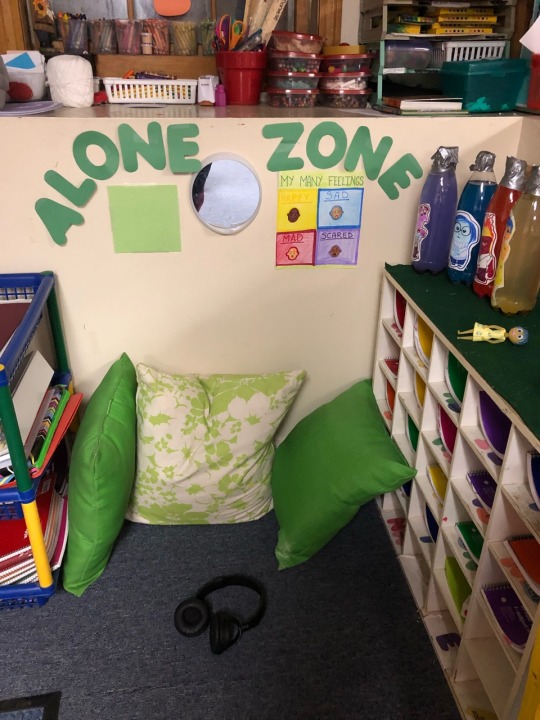
This is my “alone zone.”
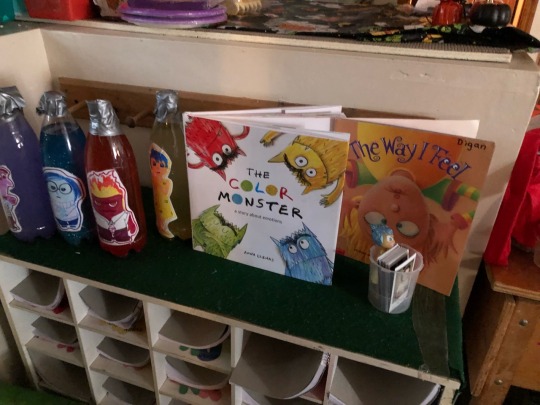
At any time of the day, if my kids are feeling stressed, they can go here to cool down. There’s stress toys, silly putty, bubbles, sensory bottles…there’s books and headphones to block out the loud noises.
The only thing they have to do is “check in” by putting their picture on which emotion they’re feeling so I know how I can help them when they’re ready.
Kids. Need. Space.
Kids. Need. Coping. Mechanisms.
Not. Time-outs.
And the sooner we as adults teach them that, the better off they’ll be as they grow.
teaching children that they are allowed to walk away and cool off if they are feeling overwhelmed might literally save their life as teens/adults
I am a preschool teacher.
This is my “alone zone.”
At any time of the day, if my kids are feeling stressed, they can go here to cool down. There’s stress toys, silly putty, bubbles, sensory bottles…there’s books and headphones to block out the loud noises.
The only thing they have to do is “check in” by putting their picture on which emotion they’re feeling so I know how I can help them when they’re ready.
Kids. Need. Space.
Kids. Need. Coping. Mechanisms.
Not. Time-outs.
And the sooner we as adults teach them that, the better off they’ll be as they grow.
so hey who else was taught as a kid that “”””wanting attention”””” in any way was wrong and shameful and has grown up unable ask for help or support even in great distress/suffering
Parent: why do you never come to me for help
(two days later)
Me: I need help with something
Parent: CAN’T YOU SEE I’M BUSY WHY CAN’T YOU DO ANYTHING BY YOURSELF GOD YOU’RE SO-
Me: never mind
And don’t forget the You Can Tell Me Anything (Except Things I Don’t Want to Hear)™.
Bonus round of You Can Tell Me Anything (But If I Don’t Like It You’re In Big Trouble Even If You’re Asking For Help)
I’m Always Here For You! (Until You Upset Me In Any Way)™.
One time in elementary school I was trying to get the attention of one of the recess officers (whose sole job is to watch and pay attention to the children) as she was talking to a teacher (another person whose job it is to watch us) and both proceeded to yell at me because it was rude to interrupt them.
So as the asshole I was I said. “Ok” and walked back to the kid who had dislocated his shoulder at the swing set walked him to the nurses and told them exactly why my third grader ass was the one that walked him to the nurses and not an adult
Now I don’t like trusting people to help with shit I can do well on my own.
This. I have never understood why parents and teachers don’t just sit and listen to kids. My co-teacher is on maternity leave and my guest teachers treat the kids like they’re basically dolls. They watch them, sure, but hearing what they have to say? Teaching them there’s two sides to every story? Teaching that actions have long term consequences? Pffft nope, too much hassle. Forget about it just go play.
Like. That’s. That’s your job. You get paid to teach these kids not only math and science and art but also kindness and generosity and honesty and respect. If I don’t respect the kids I know they will call me out on it because I have taught them that respect is earned AND it’s a 2-way street. Just like they understand that I don’t write notes home or have a serious conversation with them just because I’m out to get them, but because they have shown me or their friends a sort of disrespect that they know is not acceptable.
I remember thinking “whatever, I do what the teachers say because they’re the adult I guess” when I was in school.
The greatest compliment that I have ever received was that they listen to me because they have seen that I am kind and respectful and they want to be that way, too.
See: my stepmom and telling her I’m dating a trans woman.




 ifesbob