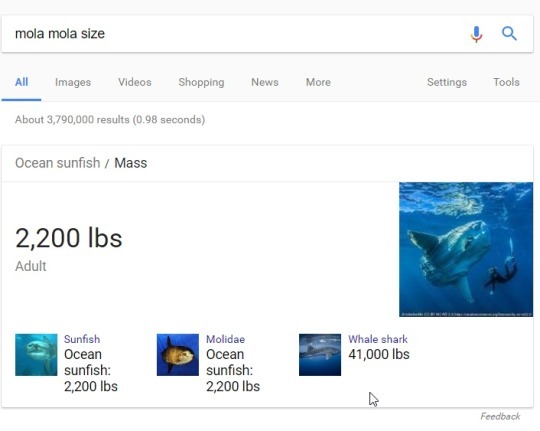
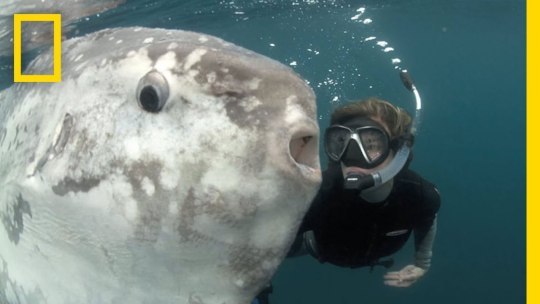
I love them so much because they’re about as sharp as a baseball and their anatomy is ridiculous to the point of them literally being classified as plankton for years because they just sort of get blown around by the ocean and look confused, but because they lay more eggs than ANY OTHER VERTEBRATE IN EXISTENCE, evolution can’t stop them
Why is no big predator coming and gnawing on them?
Their biggest defense is that they’re massive and have super tough skin, but they do get hunted by sharks or sea lions sometimes and they just sort of float there like ‘oh bother’ as it happens
Even funnier, because they eat nothing but jellyfish they’re really low in nutritional value anyway, so they basically survive by being not worth eating because they’re like a big floating rice cracker wrapped in leather.
So basically the only reason natural selection hasn’t taken care if them is because they are the most useless fish
yes, they’ve perfected uselessness to the point of being unstoppable
Oh god is it my turn to be the killjoy? I don’t want to. But also I’ve seen this video get increasingly popular so I’m going to break it down and also send it to @why-animals-do-the-thing to spread the word:
Octopodes (or octopuses, or octopi, all good) aren’t social/physically cuddly animals. While they are very curious and very intelligent, this octopus isn’t showing signs of willingly engaging with this diver.
To start with, it’s probably not trying to swim towards the diver to begin with: octopodes (like all cephalopods) swim backwards, and its initial jet towards the diver is likely unintentional. After this, the octopus repeatedly tries to adjust course to get around this unexpected impediment, and the diver repeatedly puts their hand in its way and prevents its escape. When the octopus successfully manages to turn towards the camera to escape, the diver catches it by the arm to stop it, then grabs its entire body and pulls it back towards them. This is the point when the octopus settles on the diver’s other arm and wraps its arms around the diver’s hand, an action we have no reason to believe it would have done without the diver’s interference.
Then, the diver begins to… I’m assuming try to pet the octupus? But in practice what they’re doing is kind of squinching its mantle. I suspect it’s not hurting the octopus, both because the hand motions look reasonably gentle and the octupus doesn’t do anything drastic like ink. However, when the diver’s hand first moves towards the octopus to do this, the octopus tries to crawl away along the diver’s arm and then eventually just… flattens out, at which point the video ends.
Good points: the diver isn’t being overly rough with the octopus, so I doubt it was hurt by this interaction. Also, this octopus is small enough that the diver wouldn’t be hurt by the octopus (it’s not going to be pulling out air hoses or biting through the wetsuit).
Bad points: literally everything else. This diver is forcing this octopus into an interaction that isn’t natural for the octopus and which is likely causing some stress to the octopus by the end of the video. The octopus repeatedly tries to avoid or escape the diver, including trying to avoid being petted. If you ever go diving, please don’t do this.
@alternatez is totally right – I’m glad they tagged me in this. This is one of those pieces of internet media that we so desperately want to be an example of connection between totally different species (who doesn’t dream of an octopus taking interest in them?) that we end up projecting terrestrial behavior and mannerisms onto a cephalopod. As the last comment pointed out, the octopus is not “headbonking” the diver; it is trying to swim away. The octopus is not “relaxing” when being petted; it is hunkering down away from unwanted tactile stimuli.
The part of this video that really bothers me is the diver just reaching out and grabbing an animal that is trying to escape and physically restraining it. That octopus has no concept that the human is expressing affiliative behavior. When things in the wild grab an octopus, it is to eat them (or, if another octopus, get it on). That is incredibly stressful for the animal and a totally inappropriate way to interact with wildlife.
It’s likely that the reason the octopus settled on the diver’s arm is due to one or both of two things: escape wasn’t working, and 2/3 of an octopus’ neurons are actually in the tentacles. What the latter means is that it’s theorized that while an octopus’ brain gives high-level commands, much of processing / action / reaction sequences occurs independently in their arms. Octopus also have a reflex to suction onto things they come into contact with (they’ve literally got specialized chemical signalling in their skin so they don’t stick to themselves). What this likely means is that when the octopus stopped trying to escape – because if you can’t get away from a predator, staying still and hoping it forgets about you is a pretty decent next choice – it’s legs automatically gripped onto the diver’s arm. That doesn’t mean it wants to be there, or that it wants to hang out with the diver; it’s probably a combination of reflex and survival instincts, nothing more.
Here’s an example of how an octopus that is actually curious / looking to engage with a diver will approach: tentacles first, and with measured, almost languorous motions. Even though the two octopi in the videos are different species, you can see how the one that is trying to escape from the diver is moving in a much sharper, jerkier manner.
Here’s another example of an octopus choosing to interact with a diver. In this case, it approaches carefully but intentionally and then contact’s the diver’s hand in a much sharper motion. While I am not enough of an expert on octopus behavior to be sure of what is occurring in this second video, this looks less like curiosity and more potentially some type of antagonistic behavior, given how intense the octopus’ movements regarding the diver’s hand is and how it tries to leave with the hand rather than stay and investigate it.
As always with topics like this on the blog, I have to remind you of our old mantra: don’t fuck with wildlife. You don’t know if you’ll end up contributing to something that will hurt it in the long run, and it can also probably hurt you more than you think. But especially, if you’re going to interact with a wild animal at all, make sure it approaches you voluntarily and do not attempt to grab or restrain it in any way. Don’t be like the diver in the top video.
Never mind the rules of diving are: You can’t touch the animals but they can touch you. That means if there’s an animal hanging around, you sit still and keep your hands to your damn self. That dark warning flash right at the start is enough of a giveaway – flashing black or high contrast patterns is a classic startle response in octopi.
Prior to the recent eruptions there was a large lava flow entering the ocean from Kilauea. This was cut off when magma broke through to travel farther down the East Rift Zone. As I’m writing this, we still don’t know whether molten rock will find its way back to Pu’u O’o or not – the crater that fed this huge lava delta.
guess what, it’s time for another episode of Weird Biology! today we’re going to learn about a creature that looks like a stained-glass window, but stalks the oceans with toxic might powered only by the wind like a sailing ship of old.
that’s right, it’s the devil’s own shopping bag-
the name is almost longer than the animal.
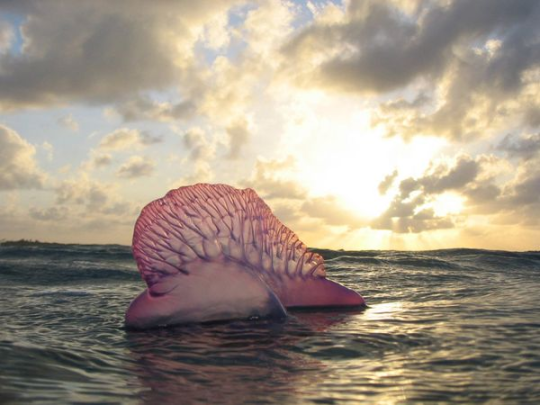
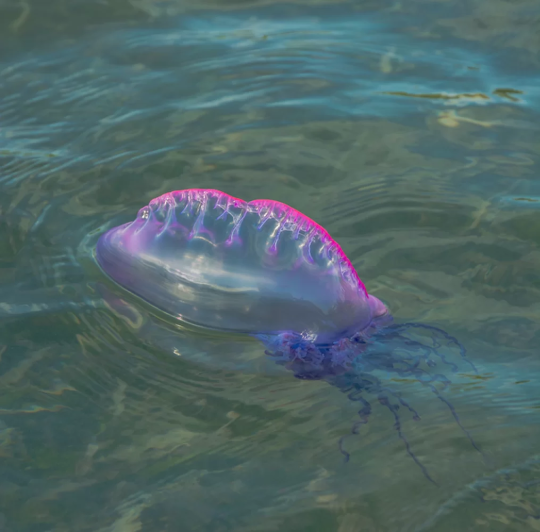
The Portuguese Man o’ War is a floating jellyfish relative called a Hydrozoan. it was named after the 18th century sailing ship, apparently by a blind person. “oh, it looks like a sailing ship under full sail” no it doesn’t, shut up. it looks like a rogue walmart shopping bag that blew into the Atlantic and makes a living by strangling innocent sea turtles.
but like the aforementioned plastic bag, the Man o’ War uses its lovely blue-purple air sac to catch the breeze. it wanders in groups through the warm waters of the Atlantic, driven along by the wind and tides. kind of poetic, really.
as long as you don’t look underwater, anyway.
I’m about to ruin it for everybody, hang on.
like so many other things in life, it’s not what you see on the surface that’s important but what is underneath that counts.
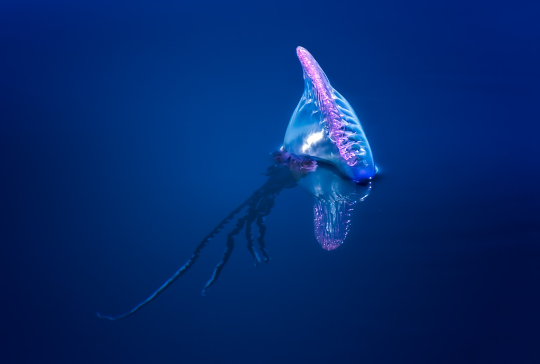
in this case, what’s underneath is up to 165 feet of venomous tentacles. it’s like that thing they say about icebergs, where you only see the top 10% and the rest is an invisible ship-killing nightmare? it’s exactly like that.
except with poison tentacles.
the Man o’ War is basically a biological fishing trawler, trailing these stupidly long tentacles like a fine mesh net through the water. and when an innocent fish who probably has a family at home comes into contact with this “net”, specialized cells called Nematocysts are triggered to fire tiny poison harpoons into the victim, causing instant death or paralysis.
the tentacle then reels itself upward into the body of the Man o’ War like a fishing line, dragging its helpless victim upward to be digested.
so, uh, actually not like a fishing trawler then, not like a fishing trawler at all.
unless the fishing trawler was designed by Junji Ito.
though the Man o’ War may look like a jellyfish, it’s definitely not. in fact, it’s not even a single animal! it’s actually four separate organisms jammed into a venomous trenchcoat like three best friends trying to sneak into an R rated movie.
“how the fuck even”, I hear you say. and that’s a valid question! it’s not everyday that we discover that what we thought was a single animal is actually four smaller animals living communally to form a larger, more dangerous animal. it would be like discovering that opossums are actually comprised of 17 rats each.
no word on if they do a silly dance and tap their fingers together to fuse or what though.
in the Man o’ War’s case, these four individual kinds of “polyps” that comprise the complete final form are the air sac polyp (gets the gang around), the digestive polyp (converts murdered fish into energy for the whole gang), the reproductive polyp (makes small clones of each individual gang member), and the tentacle polyp (murders things indiscriminately for the sheer joy of it).
that’s right, the tentacles are a separate animal! you might be wondering if they sometimes come loose, wander off, and just sting people/animals randomly when they drift into populated areas. what a silly question!
yeah, happens all the time.
SHIT.
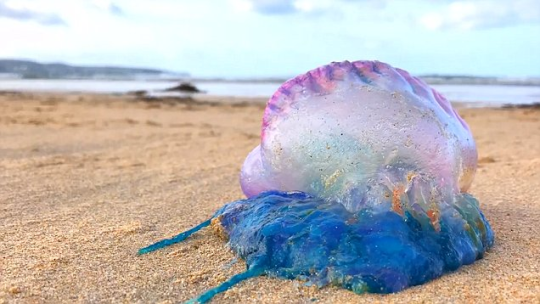
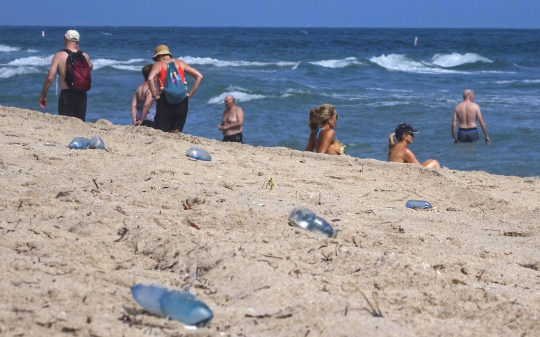
while rarely fatal, Man o’ Wars stings can seriously injure humans. this is a big problem in areas where Man o’ Wars are common, because storms and predators can knock the tentacles right the fuck off. the tentacles drift away, only to wash ashore and sting a hapless beachgoer weeks later. that’s right, rogue tentacles can still sting for days or weeks after separation! even if the Man ‘o War is beached! isn’t that neat! fuck!
the discovery of a beached Man o’ War usually closes the entire fucking beach, for this reason. would YOU want to go fuck around in the sand if it might be full of over a hundred feet of poison spaghetti too fine to notice with the naked eye?
if the answer is yes, I have great news about a bridge I’d like to sell you.
if all this information upset you, I’d like to offer my deepest condolences. but buckle up for one last upsetting fact, and here it is: Man o’ War are spreading.
usually restricted to warm waters, climate change has driven the Man o’ War as far north as Great Britain. that’s awful awful awful news for any country that touches the Atlantic ocean, which is lots of them.
luckily, we have dependable allies in this fight: sea turtles and the Mola Mola! (which I’ve written about before) unfortunately just about all we can do at this point is to cheer these awesome devil-balloon-munchers on from the safety of shore, while trying to invent a Man o’ War-proof barrier net.
for now, watch out for anything that looks like a floating plastic bag.
and for god’s sake, watch where you step.
–
thanks for reading! you can find the rest of the Weird Biology series here.
if you enjoy my work, maybe buy me a coffee or check out my Patreon to see extra content and support Weird Biology.
–
IMAGE SOURCES
img1- National Geographic img2- The Garden of Eadon img3- Sean Nash img4- Enrico Villa img5- livescience.com img6-
diply.com
img7- Daily Mail img8- Sun Sentinel
These lil hoes are in Galveston too
this is so dramatic. they’re called blue bottles and yeah they sting pretty bad and can cause severe stomach pain and the venom gets into your lymphs and that sucks but it goes away in 30 minutes. they’re not gonna close a beach over it lol
hey guys! I’ve been seeing a lot of responses like this on my post, and I just wanted to clear up a few misconceptions that I didn’t cover in my post, whoops
THE ATLANTIC MAN O’ WAR AND THE AUSTRALIAN BLUEBOTTLE ARE NOT THE SAME SPECIES.
My fish crush of the day is not just a single species but an entire family!
Meet the adorable and strange Sea Moth! (No, not the thing from Subnautica).
These benthic marine fish are just downright weird looking and I love them. I’m pretty sure they’re in the same order as sticklebacks (Gasterostiformes), but looking at them I never would have heckin’ guessed it.
They’re not a large family as far as fish go, with just two genera and a whopping total of 5 species. What is most charming is that the family is the Pegasidae, and the genera being straight up called Pegasus or Eurypegasus. This is on account of their wing-like pectoral fins and long rostrum (the snout looking thing – but their mouth is actually on the underside of their head). Even better: one of the species is Eurypegasusdraconis! That translates to short/little pegasus dragon. Two mythical creatures for the price of one!
And it’s frickin’ handsome too.
Beautiful.
A few other cool notes – they shed their armoured skin all in one go (they more or less jump out of their skin) on a regular basis to allow growth and rid themselves of accumulated parasites and algae. When you are a slow benthic fish that slowly crawls along the sea floor with your claw-like pelvic fins with a badass suit of armour I guess stuff just attaches to you.
These guys occasionally pop up in the aquarium trade as oddball fish. They have a max length of around 8-20 cm (3-8 inches) depending on species, probably due to differences in tail length. They would likely need a sizeable and dedicated tank, kept alone or as a pair, with little rock work and plenty of live sand/gravel to provide them enough food.
One of the five species is listed as vulnerable (P. Lanternaris) and the other four data deficient. They are rarely targeted for the aquarium trade, but they are regularly sold dried as traditional Chinese medicine.
hey everyone, happy friday and welcome back to another excellent episode of Weird Biology!
this week, we’re examining a charismatic and almost perfect oceanic killing machine! you might be picturing a shark, but you’re wrong.
it’s the flamboyant, fantastic, and fucking ecological nightmare, the
NAAAAAANTS INGONYAAAAMAA
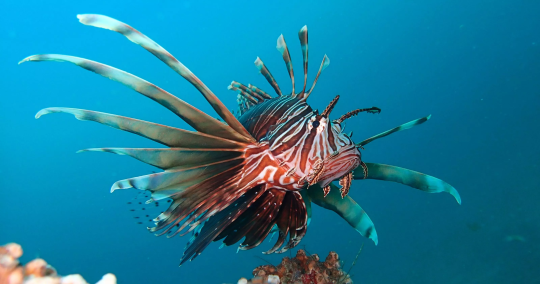
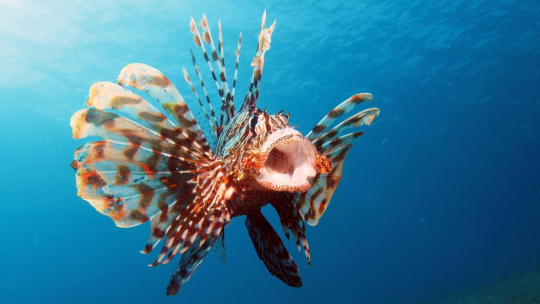
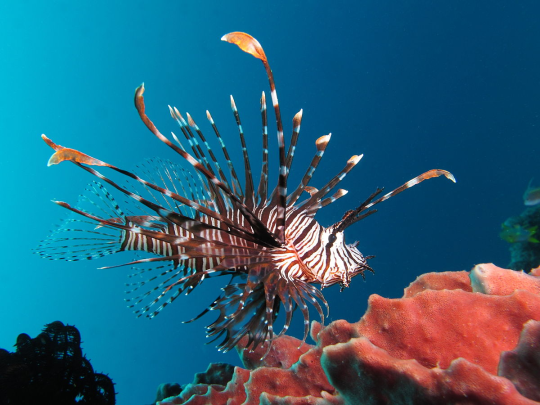
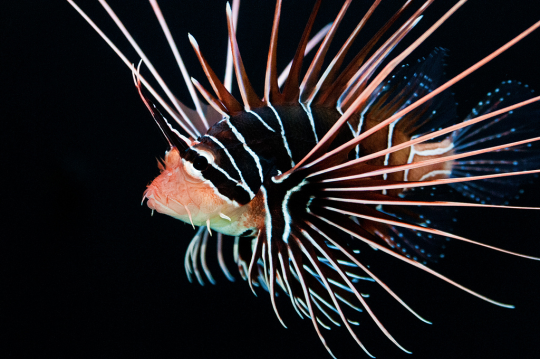
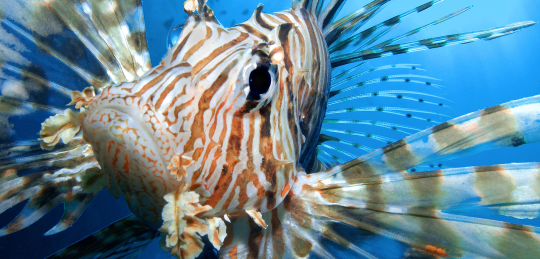
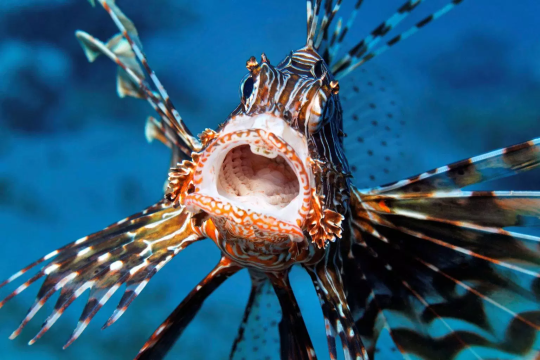
Lionfish are a group of 12 species in the genus Pterois (tare-oh-eese), meaning “winged”. these fish are among the most striking and beautiful in the ocean! they’re also full of poison knives, but more on that later.
also called Dragonfish, Firefish, Turkeyfish, Tastyfish or PEZ DIABLO (Devilfish, or “underwater satan” if you use Google Translate), Lionfish are native to the Southern Pacific and Indian oceans. they are mostly found on coral reefs, where they can grow up to 17 inches long and reach about 3 pounds.
3 pounds of pure whoopass.
small but mighty! SMALL BUT MIGHTY!
see, when it comes to sheer badass ability to survive anywhere, Lionfish are damn near perfect. most reef fish are specialized creatures with a fairly low set of tolerances. not Lionfish! for starters, they’re common in every level of the water column up to 1000 feet down. that’s impressive for a regular fish, let alone a reef specialist. they can also tolerate temperatures as low as 60 F, which again, fucking ridiculous. this fish could probably survive on the moon.
on top of that, their reproductive rate is insane. unlike many reef fish who follow a yearly cycle, Lionfish reproduce monthly. and every month a female Lionfish may lay- wait for it- 15,000 eggs. add in the fact that they have maybe three natural predators and it’s a wonder we aren’t knee deep in them right now.
good news! the Lionfish will submerge us before the oceans do!
Lionfish may look like delicate lacy parasols, but that bold coloration is actually Nature’s equivalent of wearing a bright orange hazard vest! but if we’re doing a direct comparison, in the Lionfish’s case it’s more like the equivalent of wearing a bright orange hazard vest while standing on the roof of a burned-out van, waving a submachine gun at traffic.
see, those lacy fins are are concealing dozens and dozens of long, razor-sharp spines venomous enough to incapacitate a human. any predator unwary enough to get a mouthful of the Lionfish’s poison shiv collection will experience immediate debilitating pain, paralysis, and almost certain death. (this venom isn’t strong enough to kill a healthy adult, but it really fucking sucks and can floor you for at least a day. do not touch.)
it’s time to play our favorite biology game, How Many Poison Knives Is This Animal Packing? if you guess wrong, you die.
Lionfish are voracious eating machines, in addition to being basically a floating wedding dress full of poison ice picks. they feed on fish, invertebrates, mollusks, and smaller Lionfish. these flamboyant cannibals feed by disorienting their prey with a jet of water, and then swallowing it headfirst like a Hardees breakfast sandwich.
and they’ll cram as many fish/shrimp/members of their own species into that ravenous maw as possible- a Lionfish’s stomach can expand to 30 times its original size on a binge! and in lean times, the Lionfish can slow its metabolism to a literal crawl. they can survive a three-month fast and lose only 10% of their body weight. jesus.
can anything stop these frilly nightmares?
SPOILER ALERT: no.
the question is unfortunately relevant. in 1992, Hurricane Andrew struck South Florida and demolished a public aquarium. Florida had bigger things to worry about, so nobody noticed that six Lionfish had been tragically swept out to sea. in the complete absence of natural predators, those six Free-Willied Lionfish (plus many others released from the pet trade) have become MILLIONS.
Lionfish have launched a hostile invasion of Carribean waters, and are now found from the Gulf Coast to North Carolina. this is a big fucking problem.
and that’s no joke.
apart from how dangerous they are, the Lionfish’s natural fish superiority allows it to easily outcompete meek and innocent native fish. this is putting stress on invaded reef ecosystems, and the problem is only getting worse as Lionfish continue to spread further north. Lionfish are even learning to tolerate mildly brackish water and have been found in estuaries four miles from the fucking ocean.
at this rate, we’re all going to wake up and find a Lionfish in our beds.
it’s their bed now. accept your inferiority before Earth’s true dominant species.
the fate of these oceans rests on the questionable shoulders of the Lionfish’s only (un)natural predator:
you.
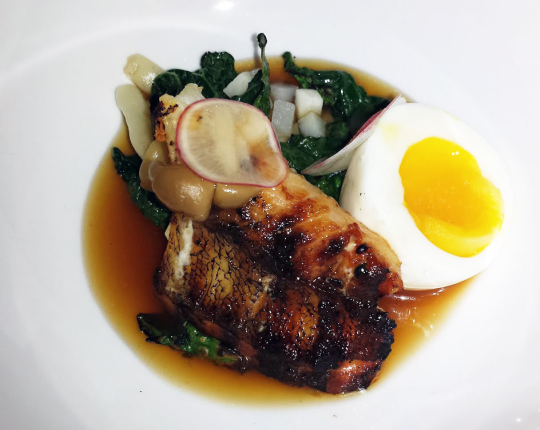
the only current way to slow their spread is to just eat the absolute hell out of them. that’s right, Lionfish are edible. and not just that, they’re completely fucking delicious and heart-healthy! they’re called Tastyfish for a reason. and for all their prowess, Lionfish have yet to evolve a defense for projectile weapons. (that’s what happens when you put all your skill points into Melee, Lionfish.)
and remember: eating a Lionfish is taking part in the front lines of a battle for the future of your oceans. also, they’re just delicious.
so do your part, and eat up!
WORLD IS A FUCK, 410,757,864,530
DEAD LIONFISH
–
thanks for reading! you can find the rest of the Weird Biology series here.
if you enjoy my work, maybe buy me a coffee to support Weird Biology.
–
IMAGE SOURCES
img1- Pensecola News Journal img2- Oceanea.org img3- Wikipedia img4- Don Johnson img5- Hakai Magazine









 ifesbob