•buy toys/dolls/crayons
•play with Legos
•play old videogames/dress up games
•weave friendship bracelets
•watch cartoons
•use stickers
•draw pics of your favorite characters
If it makes you feel nice, do it.
Don’t even worry about what other people think, because it doesn’t matter–if it brings you happiness, it’s not “ridiculous”, or “immature”.
You deserve to enjoy yourself.
Let me share with you what I consider to be the most important less I’ve learned in my adult life:
“Growing up doesn’t mean you can’t have Zebra Cakes. Growing up simply means that, if you want to have Zebra Cakes, you buy them for yourself.”
“What the hell are you talking about, Bear?” Well, let me explain. For those of you who live outside of the US, this is a Zebra Cake:
It’s a little pre-packaged snack cake that is horribly cheap and junky and really not that great, but it is like manna from heaven to me. I fucking love these things. When I was a little kid growing up, my mom bought Zebra Cakes but once in a blue moon. They were intended to be put in mine and my siblings’ school lunches, but my brother and I would eat them whenever we wanted, so Mom just didn’t see the point. (They also used to be kind of expensive, at least for our family’s budget.) Needless to say, the coveted Zebra Cakes were a luxury for me, and were one of the tastes of my childhood.
Fast forward to my college years. I was living in an apartment with three other people, doing my own shopping and cooking. I was in the grocery store, picking up some stuff, and I happened to walk past a display of snack cakes. Among them were several boxes of Zebra Cakes.
I paused at this, chuckling to myself. Oh man. Zebra Cakes. I haven’t had those in years. I loved those when I was a kid. I reminisced happily and thought about how much I missed the taste of Zebra Cakes, then started to walk away.
And then I stopped dead.
Because I had realized that there was literally nothing stopping me from buying a box of Zebra Cakes. There was nothing stopping me from buying ten boxes of Zebra Cakes. If I wanted Zebra Cakes, I could have goddamn Zebra Cakes, because it was my money and my decision to make.
I put two boxes in my cart (they were 2 for $5) and never looked back.
Here’s the secret I learned that day: The idea of something being “just for kids” is, by and large, bullshit. What you do on your own adult free time with your own adult money is, by its very nature, adult stuff. It’s like comedian Eddie Izzard (who frequently performed his routines in drag) once said when someone asked about him wearing ‘women’s clothes’: “They’re not women’s clothes. They’re my clothes. I bought them.”
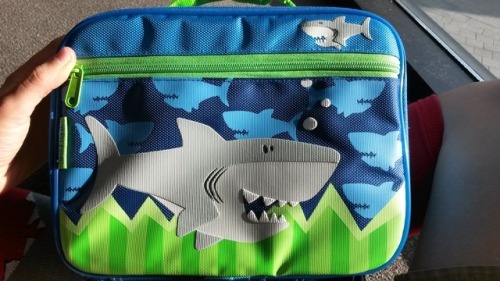
I am 25 years old, and yesterday I bought myself a shark lunchbox. Look at it. Look at how awesome my lunchbox is.
Was this lunchbox intended to by bought for and used by a child? Yes. The tag said it was for ages 3 and up. But it was bought by and will be used by an adult, and anyone who thinks that’s wrong is probably just jealous that they don’t have the self-confidence to rock a shark lunchbox at 25.
So like. Being “mature” and “an adult” doesn’t mean you have to completely abandon the things that made you happy when you were younger. It just means that you may have to approach them in a different way.
One of the ballsiest things Tolkien ever did was write 473k words about some hobbits called frodo, sam, merry, and pippin and then write in the appendices that their names are actually maura, ban, kali, and razal.
This just in: Eowyn and Eomer’s names actually start with the letter “L.” [source for other nerds]
What you’ve got to understand is that everything Tolkien wrote was him pretending to merely translate ancient documents. He was writing as if the Hobbit and The Lord of the Rings were actually been written by Bilbo, Frodo, and Sam (or Bilba, Maura, and Ban) and he was just some random contemporary academic translating it all into English for us.
There are many languages in his books, but generally speaking, everything written in English in the books is a translation of the language “Westron.” Therefore any names that come from Westron, he translated. Names coming from other languages, like Sindarin, he left as they were. Why? IDK. Maybe because the stories are from a hobbit perspective and hobbits speak Westron, so he wanted the Westron parts to sound familiar and the other languages/names to remain foreign?
“But Mirkwoodest!” you cry, “The word ‘hobbit’ isn’t an English word! And the names Bilbo Baggins, Frodo Baggins, Samwise Gamgee, Peregrin Took, and Meriadoc Brandybuck” all sounds super weird and not like English at all!”
Psych! They are in English! (Or Old English, German, or Norse.) Once again you underestimate what a nerd Tolkien was. Let me break it down:
In Westron, hobbits are actually called “kuduk,” which means “hole-dweller,” so for an English translation, Tolkien called them “hobbits” which is a modernization of the Old English word “holbytla” which comes from “Hol” (hole) and “Bytla”(builder).
“Maura” is a Westron name which means “Wise.” Weirdly enough, “Frodo” is an actual Proto-Germanic name that actual people used to have and it means the same thing.
“Razanur” means “Traveler” or “Stranger” which is also the meaning of the word “Peregrin(e)” This one is a twofer because “Razar” means “a small red apple” and in English so does “Pippin.”
“Kalimac” apparently is a meaningless name in Westron, but the shortened form “Kali” means “happy,” so Jirt decided his nickname would be “Merry” and chose the really obscure ancient Celtic name “Meriodoc” to match.
Jirt chose to leave “Bilba” almost exactly the same in English, but he changed the ending to an “O” because in Westron names ending in “a” are masculine.
I’m not going to go on and talk about the last names but those all have special meanings too (except Tûk, which is too iconic to change more than the spelling of, apparently).
The Rohirrim were also Westron speakers first and foremost, so their names are also “translations” into Old English and Proto-Germanic words, i.e. “Eowyn” is a combination of “Eoh” (horse) and “Wynn” (joy/bliss).
“Rohirrim/Rohan” are Sindarin words, but in the books, they call themselves the “Éothéod” which is an Old English/Norse combo that means “horse people.” Tolkien tells us in the “Peoples of Middle Earth” that the actual Westron for “Éothéod” is Lohtûr, which means that Eowyn and Eomer’s names, which come from the same root word, must also start with the letter L.
The names of all the elves, dwarves, Dunedain, and men from Gondor are not English translations, since they come from root words other than Westron.
The takeaway from this is that when a guy whose first real job was researching the history and etymology of words of Germanic origin beginning with the letter “W” writes a book, you can expect this kind of tomfoolery.
Notes: Sorry I said “Razal” instead of “Razar” in my original post I’m a fraud.
The marine eels and other members of the superorder Elopomorpha have a leptocephalus larval stage, which are flat and transparent. This group is quite diverse, containing 801 species in 24 orders, 24 families and 156 genera (super diverse).
Leptocephali have compressed bodies that contain jelly-like substances on the inside, with a thin layer of muscle with visible myomeres on the outside, a simple tube as a gut, dorsal and anal fins, but they lack pelvic fins. They also don’t have any red blood cells (most likely is respiration by passive diffusion), which they only begin produce when the change into the juvenile glass eel stage. Appears to feed on marine snow, tiny free-floating particles in the ocean.
This large size leptocephalus must be a species of Muraenidae (moray eels), and probably the larva of a long thin ribbon eel, which is metamorphosing, and is entering shallow water to finish metamorphosis into a young eel, in Bali, Indonesia.
…….And we don’t know what kind of eels they turn into
Lots of people surprised that eels have larvae at all but actually many fish have larvae!
This is the larva of a giant sunfish:
This is the larva of a colorful little reef fish called a basslet and the thing on its back is a chain of flotation devices:
This larval ribbonfish (I think) has its intestines in a bag outside its body for reasons we aren’t certain:
And my favorite thing ever, the larval viperfish and dragonfishes are skinny wormy things with duck bills and eye stalks:
As they mature into terrifying beautiful sea demons, the eye stalks are “wound up” by the skull and you can still find them coiled inside the sockets of the adults!
You don’t know how badly I wish there were just adult fish that looked like that though. The larval viperfish is my 100% ideal animal design.
Nevermind all the buzz about Tide pods, get ready for…ISOPODS!
Here’s one for you to enjoy:
Pretty nice, right? I agree. Let’s learn about them!
Isopoda is an order of crustaceans that includes woodlice and their relatives. These are woodlice, often called roly-polies or potato bugs:
Woodlice mostly feed on dead plant material, and they are usually active at night, so we have a lot in common.
Several centuries ago when I was in high school, we raised them in science class. They are good, friendly fellows. Please don’t kill them.
Isopodscan also live in water! Wow!
There are almost 20 species ofgiant isopod in the genus Bathynomus. They are abundant in the cold, deep waters of the Atlantic, Pacific and Indian Oceans and can be as long as 30 inches. Holy cow. That’s bigger than my dog.
They may look large and scary, but they are mostly opportunistic scavengers, feeding on dead whales, fish, and squid, and occasionally slow-moving live animals like sea cucumbers and sponges.
Food is scarce in the deep ocean, and giant isopods have adapted to long periods of famine; in captivity, they’ve been known to go five years without eating. I guess if I had to eat soggy dead whale blubber, I’d wait five years, too.
Just like Tide pods, I wouldn’t recommend putting these into your mouth. It’s just as horrifying as it sounds. Here, have this photo for your nightmares:
The tongue-eating louse is a parasitic isopod that enters a fish’s mouth through the gills, attaches itself to the tongue and severs the blood vessels there. The tongue eventually falls off and the isopod functionally acts as the fish’s new tongue, all the while sucking its sweet, delicious fish blood.
It appears that the parasite does not cause much other damage to the host fish, but I suspect any research scientists failed to ask the fish how they felt about it. I’m damaged just having seen the photos.
Anyway, there are over 10,000 species of isopod worldwide, so I’ll wrap this post up by sharing just a few more colorful varieties.
Thank you for reading about isopods! I hope you now consider them friends. Even the tongue-eating ones, who make some very questionable life choices. But who are we to judge, you know? Anyway, have a great day.
Okay so but how do we make an eating challenge out of this
If you let your body sink to the ocean floor, isopods will eat you instead!
why does that first fish have human teeth though…
My best guess is that it’s a sheepshead fish,
Archosargus probatocephalus. They have creepy, humanoid teeth that help crush the shells of oysters, clams, and other prey. Here’s a better look at the teeth:
That blue isopod has a virus!
From an isopod info site:
“An iridovirus can infect woodlice and at advanced stages of infection virus accumulates in such large numbers that it forms crystallinel structures in the diseased tissues. These crstalline structures give an intense blue or purple colour to the woodlice. Individuals infected to this extent will usually die within a short time.”
I’ve never seen the clown isopod before, nor that spiky yellow one. Astounding! Here are some of my personal faves, not listed:
They grow to be almost an inch and are considerably faster and stronger than the common Porcellio scaber. They love to bury themselves into the substrate, often hiding entirely underground. When flipped over they will play dead (very convincingly, I might add) by “curling” up and sitting utterly still.
The zebra isopod is strikingly patterned. I don’t know a whole lot about it, I took care of them only once as a failed culture last year or the year before. They get reasonably large, all things considered, and would prefer a warm environment over a cold one.
Feel free to unfollow me right now if you believe it’s okay to endanger your house cat or the local native fauna it absolutely will kill by allowing it outside unsupervised/off lead.
Outdoor cats have a lifespan of 2-5 years. Indoor cats regularly live 15+, even getting up to 20+ sometimes. Unsupervised indoor-outdoor cats often don’t make it past 5 and the ones that do are a very lucky exception. Why?
They get hit by cars. They get attacked by other animals (predators or other pets like dogs) including other cats. They eat things that are toxic to them. They get killed by other humans. They contract diseases like FIV and FelV.
Even if your cat DOES live longer than 5 years, cats that go outside are responsible for the deaths of billions of birds and other small fauna per year. There have been studies done on this. It’s not people pulling stuff out of their asses, it’s something scientists literally studied and reported results on. Don’t believe me? Google “do cats kill wildlife” and have a read. They’re on the IUCN’s list of worst invasive species and have contributed to the extinction of 60+ species, and they continue to cause a problem for other threatened species of small animals.
If you think it’s okay to expose your cat to these hazards and potentially cut its lifespan by more than half, if you think it’s okay to allow your cat to kill native fauna to indulge it’s “natural instincts” instead of, I don’t fucking know, playing with it with toys literally designed to allow it to safely indulge those instincts, then you have no business following me.
I’m not here to indulge your whimsy about how cats “need” to be outside unsupervised to be stimulated and lead a happy life- I can assure you, they don’t. There are p l e n t y of enrichment devices and structures people can buy or make to ensure that their cats lead happy, full lives indoors to the ripe old age they are supposed to lived to.
You also have the option of lead training your cat if you really believe they need to go out. This is something that proponents of “let cats go outside” ignore almost completely. They somehow believe that it’s all or nothing- either the cat lives 100% indoors without ever seeing sunlight OR it’s let outside without supervision where it can be injured, killed, or cause harm to the environment. Those aren’t the only choices. Cats adapt to leads very easily. They don’t like it the first couple of times, usually, but also usually when they figure out lead=outside, they get over it and the best of both worlds gets to happen- your cat remains safely under your supervision where it cannot come to or deliver harm, and it gets to go outside.
TL;DR Letting your house cat outside unsupervised is extremely dangerous both for your cat and the local wildlife and people arguing otherwise can see themselves out the door because I’m not about people endangering animals out of willful ignorance. You, along with every other pet owner out there, have a responsibility to protect your pets to the best of your abilities, and choosing not to do so in some misguided attempt to indulge their whims is poor animal husbandry. Any argument to the contrary is just an excuse to continue doing things which put animals in danger.
Your arguments sound very professional. Good for you being able to stay calm and argued your point so well.
Double on the unfollowing me if you have an outdoor cat.
Additionally if you do want your cat to go outside, you can buy “cat cage” installations and have them span your yard! It looks like this (pictures of our backyard):
We have this span your 4×6 meter backyard and is attached to the house directly. This enables the cats to go outside when they want without going off your property. And it’s nice to sit with them!
Here they call this a “catio” and it’s becoming more popular as a way to allow your cats outside time without having to directly supervise them, and they are GREAT.
Here’s one not attached to the house:
Here’s some from the outside view:
There are smaller versions too!
Catios and outside cat runs/perches are a fantastic way to give your feline access to the outdoors while still keeping them safe.
Serious question, because I agree with all of this but we have a naughty cat.
If our cat slips out when we open the door, and we can’t catch her, what should we do? We live in a place with a LOT of wildlife. She normally comes back in within an hour (she gets mad at us for “letting her outside”) but obviously we don’t want that to some day not be the case, and we want her to stop bringing us presents. Because gross and also not good for the environment/ecosystem.
Do we lead-train her and let her go outside and then she won’t get very far? Part of the reason she goes outside is to eat grass, so should we just buy some cat grasses and have them inside? We’ve thought about that but the grass isn’t always the only reason she’s outside, so we’re worried that she’ll keep getting out anyway and then that defeats the purpose of buying cat grasses.
Do we just not stimulate her enough inside? Like, seriously, what do we do about this cat?
For this, it sounds like she’d likely lead train fairly well. If she’s only gone for a short while, she probably just wants a little bit of outside time and she’d be fine. The thing about lead training isn’t that you just pop it on and let them out, you do need to stay with them while they’re out to ensure they don’t get tangled in anything or escape the lead. May I also recommend this person’s cat jackets for a harness? They are comfortable and fairly escape proof.
As for the “gifts” you may want to look into some additional toys for her that can satisfy her desire for that particular behavior. Stick and string toys and laser pointers are good for this, but a lot of people don’t reward their cats for a solid catch, which is fine, but if your cat is looking to chase and catch a thing she can eat, it may help to give her a treat at the end of playtime. This encourages play behaviors with you over going outside to do it.
As for the cat grasses, you can actually make her a little grass mat!
All it takes is a large litterbox (or if you want to do bigger, go to a hardware store and look for the cement mixing section, and they sell rectangular black tubs there- that’s what the first two tubs are at least), some clean dirt, and some grass seed without fertilizer in it (or if you can’t find that, you can plant cat grass from a pet store in the middle, it will spread but not as fast).
Again, any one of these on their own likely won’t completely solve the issue, but between the three, you may see a decrease in escapist behaviors.
As long as we’re here, @crabcakedraws asked what I say to people in apartments whose cats scream and destroy things demanding to be let out, and first you should go have a talk with @pangur-and-grim about Grim’s behavior around go-outside time. My own advice is to take the time and effort to train your cat to go outside on a lead with you. If you think that’s too much trouble and you’d rather just expose your cat to the risk of illnesses, injuries, or potential death by opening the door and just letting them out, I definitely can’t stop you. But that doesn’t make it right or good.
Think of it this way. Children, actual human children, throw tantrums when they’re not allowed to do whatever they want; does that mean parents should allow kids to do whatever they want all the time? Absolutely not, and you’d be appalled at any parent that said they did so. Even if a child screams and cries, even if they throw things or hit you, you’re still the parent. It’s still your responsibility to make sure that they are receiving the correct/best care you’re capable of providing. Don’t want to do that/think that’s too hard? I have news for you: you may have chosen the wrong pet.
I’m going to keep adding to this because I have been getting questions.
Stray/Feral cats that do not belong to anyone are not what we’re discussing here. If you are managing strays or ferals that don’t belong to you but that in your location, that’s a different situation than someone who buys/adopts a cat and then releases it outside either permanently or off and on. The best course of action for managing ferals is to get them fixed (low cost spay/neuter places are GREAT for this! We got some feral cats at my college fixed for like $30/per) and make sure you give them what protection you can from diseases (for example, offering them wet food with a liquid wormer in it a couple of times a year). You can also affix reflective cat collars to them with bells- this will make them more visible to cars, and the bell can reduce their kill success by up to 30% (which, if you or others are feeding them is a good thing for local small fauna). If you aren’t sure a cat is a stray or an indoor/outdoor cat, buy a reflective collar and a tag with your # on it (costs like $10 total for both in a lot of places)- I can almost guarantee that you’ll get a call soon if the cat has an owner.
I’ve also talked some about enrichment, but we’re gonna talk some more, since it seems like people aren’t sure what counts for indoor cats. SO, let’s start with toys.
Wand toys (stick and string) are great for interactive play with your cat. They look like this:
They stimulate your cat’s drive to chase moving, fluttering objects and allow you to provide that live “kick” response when they pounce on it, because you can pull the string. They’re widely available but easy to make yourself- Here is a tutorial on making them yourself for cheap!
Laser pointers provide the same entertainment with a different sort of allure. Laser pointers are better for if you have a cat that likes to run a lot- you can easily send the dot far from you! They’re like $3.
You can purchase any number of chase toys that you can throw for your cat, in all sorts of shapes and sizes from mice to birds to random shapes. Many of them come with catnip in them. Some of them have noise makers so they shriek like the wildlife your cat is not killing outside. Some of them rattle. Some of them crinkle (in fact, you can get neat foil balls to throw that are shiny and crinkle). Some of them are spongy. There are so many options and cats LOVE them!
Kick toys are another great thing! Kick toys are usually bigger than throw toys and somewhat oblong, like a fish. In fact, many of the toys are shaped like fish! But there are also other kinds- I’ve seen rainbows and cigars and just big thin rectangles and bananas and a lot of others). These toys help satisfy your cat’s fighting/gutting instinct. If they were to indeed catch a big fish, they would be able to grasp it in their front paws and kick with their back legs to disembowel it. The same goes for other animals your cat might find itself in a fight with, including other cats. If your cat likes to tussle, this might just be the toy for them!
Circular ball toys are good fun for containing the small fast object your cat wants to chase (so they don’t lose it under the couch or something.
If you want to spend a little more for an active cat, you can look into getting them an exercise wheel! Many cats, when they figure out what it does, will thoroughly enjoy running on these things (and the videos on youtube are GREAT, if you want a good time go type in “Cat exercise wheel”). The first photo is the original wheel, but there are others out there now too.
If you want to take your cat outside but don’t want to lead train them or build a whole catio, there are other options like cat tents!
Indoors, cat tunnels are totally a thing and cats love them, especially soft ones.
You can also buy window perches that just suction cup to windows and don’t cause any damage to walls (good for apartments!) and they come in a variety of styles!
You can get your cat an autogroomer device, they come in several different styles:
This allows the cat to receive grooming from a source outside of themselves when you aren’t around.
You can purchase a see-through window feeder for birds, and place it somewhere that your cat will be able to see, so they will have something to watch while you’re not playing.
In addition to toys and activity devices like the above, you can give your cat enrichment during feeding and watering times as well. Waterers that have moving water are preferred by many, many cats:
And puzzle feeders can both provide enrichment and slow down cats so they don’t gobble all their food quickly (which often results in an upset tummy… I have heard a lot of stories of folks whose cats eat a bunch and then immediately puke it up whole… puzzle feeders help alleviate that! And they can be DIY for extremely cheap!)
(this one has toys in it, but you can put food in it too)
Anyway, there’s no reason your house cat HAS to go outside unsupervised or uncontained, and there are P L E N T Y of ways to vastly enrich an indoor cat’s life experiences while under your care.
Also, on the cat escaping out the door thing.
Basically, close off any places the cat can hide near the door, and provide the cat a place where they can see the door but won’t be able to get out of it.










 ifesbob
.jpg)


