Literally none of the “pros” of self diagnosis have ever done shit for me in terms of whether I should support it personally

Because like, without a professional diagnosis, you don’t really have access to many resources. And resources you do have access to, you have access to whether you think you have a disorder or not.

Like.. I don’t think self diagnosis is inherently harmful, but I don’t think you need it to feel validated?

To be honest. I’m getting assessed for autism early next year. I don’t know what I want out of that, what I expect, or if I even think it’s worth the time. But I am, so my opinion.. is kind of irrelevant.

But like, regardless of what comes out of that, and whether I agree or not.. I still have the needs that made my parents think it was worth the effort. If they say I’m not and I decide I disagree.. that’s not going to make me self diagnose it. I can exist as myself, and do what I need to do to do that successfully, whether or not I agree or not.

I don’t know. I just don’t see why other people don’t have that attitude.

And like.. if you’re not diagnosed for some bullshit reason like perceived functioning level/grades/the stigma around the disorder/something else bullshit… That’s basically a professional diagnosis in my eyes? Like “I have x but because of poor attitude I didn’t actually get said diagnosis”

And like.. if you need resources that are only available if you have said diagnosis.. I don’t see any point in “self diagnosing”.. because 1. You were basically diagnosed and 2. Self diagnosis doesn’t get you accomodations/treatment. I’d.. get a second opinion if you can in that regard.

And like “self diagnosis gave me access to resources I could use to help myself” you.. understand.. that.. you could’ve used those even if you explicitly thought you didn’t have the disorder in question? Other people have said it more eloquently, but you.. don’t need a disorder to use coping mechanisms for said disorder

Also.. self diagnosis, especially with physical conditions, can do more harm than good if you get it wrong.

Also! One more thing! Self diagnosing with the common cold or diagnosing the cause of your headache is ENTIRELY different than saying you have a mental condition/serious physical disorder! They’re way more complex and conditions can easily look like others! Advocating for your needs even in the face of people not listening isn’t self diagnosis!

Literally none of the “pros” of self diagnosis have ever done shit for me in terms of whether I should support it personally

Because like, without a professional diagnosis, you don’t really have access to many resources. And resources you do have access to, you have access to whether you think you have a disorder or not.

Like.. I don’t think self diagnosis is inherently harmful, but I don’t think you need it to feel validated?

To be honest. I’m getting assessed for autism early next year. I don’t know what I want out of that, what I expect, or if I even think it’s worth the time. But I am, so my opinion.. is kind of irrelevant.

But like, regardless of what comes out of that, and whether I agree or not.. I still have the needs that made my parents think it was worth the effort. If they say I’m not and I decide I disagree.. that’s not going to make me self diagnose it. I can exist as myself, and do what I need to do to do that successfully, whether or not I agree or not.

I don’t know. I just don’t see why other people don’t have that attitude.

And like.. if you’re not diagnosed for some bullshit reason like perceived functioning level/grades/the stigma around the disorder/something else bullshit… That’s basically a professional diagnosis in my eyes? Like “I have x but because of poor attitude I didn’t actually get said diagnosis”

And like.. if you need resources that are only available if you have said diagnosis.. I don’t see any point in “self diagnosing”.. because 1. You were basically diagnosed and 2. Self diagnosis doesn’t get you accomodations/treatment. I’d.. get a second opinion if you can in that regard.

And like “self diagnosis gave me access to resources I could use to help myself” you.. understand.. that.. you could’ve used those even if you explicitly thought you didn’t have the disorder in question? Other people have said it more eloquently, but you.. don’t need a disorder to use coping mechanisms for said disorder

Also.. self diagnosis, especially with physical conditions, can do more harm than good if you get it wrong.

Also! One more thing! Self diagnosing with the common cold or diagnosing the cause of your headache is ENTIRELY different than saying you have a mental condition/serious physical disorder! They’re way more complex and conditions can easily look like others! Advocating for your needs even in the face of people not listening isn’t self diagnosis!

I plugged my genetic data into Promethease, and it turns out my educational attainment score is pretty much near the lowest it could be. The thing is… Well, I wanted to be a biologist, it’s always been a passion for me, and now it turns out I have practically no chance of academically achieving anything past high school. Do I keep doing, or do I just learn to cope with never being able to achieve my dreams?

underthehedge:

vassraptor:

sixth-light:

star-anise:

doomhamster:

JESUS FUCKING CHRIST NO. NO. 

If you want to be a biologist, then I have the first lesson for you right here – there is NO way a gene screening can predict your educational success. Even if you have a chromosomal disorder like Down’s syndrome that tends to be linked to intellectual disability, that’s not a sure-fire prediction.

What are your life circumstances? Do you have any neuropsychological disorders or mental illnesses (and no, last I heard none of those had been directly linked to any particular genes to an extent that’d let one screen for them – there’s no “ADHD gene”) that might make things harder for you? Can your family afford to support you financially so you won’t have to worry as much about debt or work? Do you have any personality traits or knacks that could help you in academia – are you curious, stubborn, disciplined, creative, competitive? Do you have a good memory? Can you read quickly, or write well? Are you good at networking and organizing?

All those things say a LOT more about your likelihood of succeeding in higher education than a gene scan ever could. 

( @grison-in-labs? @star-anise? Anything to add?)

I would be JUST as dubious over somebody deciding they can’t be a biologist from a look at their IQ test, honestly. This is both because low IQ isn’t a death sentence for your dreams, and because the ability for “educational achievement” isn’t a stable trait. 

We have long assumed that raw intelligence is what makes someone able to go to college. A baby would be born with Down’s syndrome and the doctor would blithely say, “This child will never succeed in school or live very long.” And guess what? That was because the baby wasn’t likely to be GIVEN adequate schooling and medical care! The same way the life expectancy of people with Down’s syndrome increased dramatically over the last century with better medical care, in the last few decades people with developmental disabilities HAVE started to get adequate educations, and HAVE started to get college degrees and professional careers!

So this is me giving that genetic test the greatest degree of latitude possible, giving it the very big benefit of the doubt as to whether it’s actually detecting a real intellectual disability. I’m not a geneticist; maybe it’s actually possible. In which case, the “educational attainment” scores of people with certain genes has been so low for so long because schools made a POINT of detecting them as early as possible and kicking them OUT of the educational system or warehousing them in “schools” that taught them nothing! For hundreds of years!

(deep breath)

But I actually deeply doubt that the test is picking up something real, because the best way to find out if someone’s going to struggle in higher education is to see how they’re doing in education now. In a good system, someone with intellectual or developmental disabilities should already have been noticed, identified, and given supports. In a crappy system, they or their teachers might notice things that make them a “bad student” in some particular way–bad grades, trouble paying attention in class, greater difficulty in some areas than others, frustration or anger problems, trouble socializing. Those would be the first sign of trouble, not a genetic test in someone old enough to write in a mature fashion about “plugging genetic data” into a DNA database and their passion to become a biologist.

Anon, if you’re worried about achieving your dreams, my best advice is to reach out to people–your teachers, your school’s counsellors, science mentoring groups, science bloggers, scientists you admire, or local professional scientific associations–and say, “I want to become a biologist; what help or advice can you give me for difficulties I might run into?” Even/especially if you’re having trouble already. If you’re at all worried you might struggle, then you need help figuring out how to succeed in school and how to find a job in your field. That comes from things like disability assessments, academic coaching or tutoring, camps, internships, mentors, peers, and colleagues.

So don’t just keep pursuing your dream, anon. Go even harder. If you want to be a scientist–especially a researcher–you’re going to need to learn how to bounce back from setbacks and disappointments. Almost every scientist I know has had to deal with rejected grant applications and research papers. Government priorities change and suddenly you have to pivot your entire career to stay in the business. And for a lot of young scientists, it’s a difficult dance to find good paying work in the area you want. You’re going to have to learn how to fight even when the going is tough; why not start now?

I’m not precisely a scientist (I’m a mental health therapist), but I flunked a lot of classes in university before my ADHD was diagnosed, and every time I got back marks with a D among them, I had to ask myself, “How bad do I want this? Do I want to keep going even if it’s this hard?” As it turned out, the answer kept being “yes”, so I kept going, and after I got my diagnosis my school did everything they could to keep me from flunking out, so I survived and graduated.

And it has been, let me tell you, EXTREMELY useful experience to have under my belt as I grow into An Old and start mentoring and counselling struggling students. Which might be something that you, as a scientist, will someday do.

Yo, I’m a biologist, they gave me the PhD and everything, and that “Promethease” thing sounds like 100% unadulterated bullshit. There is NO genetic test that can predict how you, an individual, will succeed academically. There just isn’t. 

Feel free to ignore the fuck out of it and take all the excellent advice above instead. 

Also, OP, consider how Promethease got those results. Dig into the methodology. I strongly suspect that you’ll find that this is a sampling size thing or a race or class thing or all of the above, and really means people with your genes are underrepresented either in education or in the pool of people sharing their DNA with 23andme or ancestry.com. Or both. “Discriminated against” is not the same thing as “lacks potential or ability,” and that’s an important thing to learn if you want a STEM career. And so is identifying bad science or bad science reporting/education when you see it.

(And please use Promethease with caution. It’s not all bullshit, but it’s not a qualified genetic counselor either.)

Yeah, another biologist here: Dear Anon, don’t give up based on this, go forth study biology, and you’ll find out exactly how much nonsense that is.

I’m with @vassraptor here, any gene variant or collection of them that apparently means  “poor academic achievement” I see two possibilities there.

1: The gene/s is linked to a specific mental impairment, in which case it would be labelled as such rather than just “poor academic prospects”.

2: The gene/s are linked with ethnic groups that are typically denied access to educational resources, and any correlation with poor academic achievement is just a product of social factors. 

Like, legit, if you ignore other factors you can probably correlate genes for higher skin melanin with lower academic achievement, not because black people are inherently stupid but just because there’s a load of places where they are denied access to quality education. If you predominantly sample from those places as well it will skew results further.

Lack of attainment does not equal lack of ability, and correlation does not equal causation. 

Other things to consider are that genes do not exist in a vacuum, they interact in a million ways with each other. I mean if you’ve got two damaged copies of the CFTR gene you’re definitely going to have Cystic-Fibrosis, but anything as nebulous as “academic achievement” or “intelligence”? Nah.

I have ADHD, and as pointed out there is no “ADHD gene”, what there is is a whole collection of genes associated with ADHD. Each of which having multiple variants (alleles), some of which contribute to ADHD and some of which don’t. You don’t have ADHD by having one gene that makes you ADHD, you have ADHD by having enough of these pro-ADHD alleles in the right combinations to cause ADHD. Neither of my parents have ADHD but I can see some of the traits in both of them, they clearly both have quite the collection of alleles that can lead to ADHD but below the disabling threshold. 

Why do I mention this? Because these genes can, in moderation, really be beneficial to say academia, however above a certain threshold they become a disadvantage. Depending on how you sampled though you could correlate many of these alleles either with enhanced achievement or academic failure and even if you sampled perfectly, the average of them does not paint the full picture.

Tl;dr: Don’t let some Highly Questionable voodoo-science tell you you’re doomed before you start. 

Oh also I just had a look at what they’re using to calculate this

theunitofcaring:

I think you’re giving that data vastly, vastly more weight than it ought to have. Scores can only predict “in a group of a thousand people with this trait, how many of them will accomplish this thing?” I think often we’re not even competent enough yet to predict that with any confidence. I’m not sure this should have much more weight than a horoscope. 

If you already know how you do in school, that’s vastly more information than you can get from your genetic data. You should basically not even consider your genetic data on any subject where the effects are also things you can directly observe. You know your grades and your ability-to-learn-stuff and your ambition-to-learn-stuff; Promethease adds, as far as I can tell, literally no information to that.

Please don’t sabotage yourself or abandon things you care about because of the output of a fairly inaccurate online test that even at its best would be screened off by ‘how do you do in class?’.

Since then, the SSGAC has uncovered more than 1,000 genetic variations associated with years of schooling. Benjamin’s team has gone out of its way to make it clear that each one exerts only a teeny tiny bit of influence—three additional weeks of education, max—and that even collectively, the variants are not powerful enough to predict an individual’s academic achievement.

So, yeah, don’t sweat it.

@biologyweeps you should make some interesting screeching noises upon reading this.

I plugged my genetic data into Promethease, and it turns out my educational attainment score is pretty much near the lowest it could be. The thing is… Well, I wanted to be a biologist, it’s always been a passion for me, and now it turns out I have practically no chance of academically achieving anything past high school. Do I keep doing, or do I just learn to cope with never being able to achieve my dreams?

underthehedge:

vassraptor:

sixth-light:

star-anise:

doomhamster:

JESUS FUCKING CHRIST NO. NO. 

If you want to be a biologist, then I have the first lesson for you right here – there is NO way a gene screening can predict your educational success. Even if you have a chromosomal disorder like Down’s syndrome that tends to be linked to intellectual disability, that’s not a sure-fire prediction.

What are your life circumstances? Do you have any neuropsychological disorders or mental illnesses (and no, last I heard none of those had been directly linked to any particular genes to an extent that’d let one screen for them – there’s no “ADHD gene”) that might make things harder for you? Can your family afford to support you financially so you won’t have to worry as much about debt or work? Do you have any personality traits or knacks that could help you in academia – are you curious, stubborn, disciplined, creative, competitive? Do you have a good memory? Can you read quickly, or write well? Are you good at networking and organizing?

All those things say a LOT more about your likelihood of succeeding in higher education than a gene scan ever could. 

( @grison-in-labs? @star-anise? Anything to add?)

I would be JUST as dubious over somebody deciding they can’t be a biologist from a look at their IQ test, honestly. This is both because low IQ isn’t a death sentence for your dreams, and because the ability for “educational achievement” isn’t a stable trait. 

We have long assumed that raw intelligence is what makes someone able to go to college. A baby would be born with Down’s syndrome and the doctor would blithely say, “This child will never succeed in school or live very long.” And guess what? That was because the baby wasn’t likely to be GIVEN adequate schooling and medical care! The same way the life expectancy of people with Down’s syndrome increased dramatically over the last century with better medical care, in the last few decades people with developmental disabilities HAVE started to get adequate educations, and HAVE started to get college degrees and professional careers!

So this is me giving that genetic test the greatest degree of latitude possible, giving it the very big benefit of the doubt as to whether it’s actually detecting a real intellectual disability. I’m not a geneticist; maybe it’s actually possible. In which case, the “educational attainment” scores of people with certain genes has been so low for so long because schools made a POINT of detecting them as early as possible and kicking them OUT of the educational system or warehousing them in “schools” that taught them nothing! For hundreds of years!

(deep breath)

But I actually deeply doubt that the test is picking up something real, because the best way to find out if someone’s going to struggle in higher education is to see how they’re doing in education now. In a good system, someone with intellectual or developmental disabilities should already have been noticed, identified, and given supports. In a crappy system, they or their teachers might notice things that make them a “bad student” in some particular way–bad grades, trouble paying attention in class, greater difficulty in some areas than others, frustration or anger problems, trouble socializing. Those would be the first sign of trouble, not a genetic test in someone old enough to write in a mature fashion about “plugging genetic data” into a DNA database and their passion to become a biologist.

Anon, if you’re worried about achieving your dreams, my best advice is to reach out to people–your teachers, your school’s counsellors, science mentoring groups, science bloggers, scientists you admire, or local professional scientific associations–and say, “I want to become a biologist; what help or advice can you give me for difficulties I might run into?” Even/especially if you’re having trouble already. If you’re at all worried you might struggle, then you need help figuring out how to succeed in school and how to find a job in your field. That comes from things like disability assessments, academic coaching or tutoring, camps, internships, mentors, peers, and colleagues.

So don’t just keep pursuing your dream, anon. Go even harder. If you want to be a scientist–especially a researcher–you’re going to need to learn how to bounce back from setbacks and disappointments. Almost every scientist I know has had to deal with rejected grant applications and research papers. Government priorities change and suddenly you have to pivot your entire career to stay in the business. And for a lot of young scientists, it’s a difficult dance to find good paying work in the area you want. You’re going to have to learn how to fight even when the going is tough; why not start now?

I’m not precisely a scientist (I’m a mental health therapist), but I flunked a lot of classes in university before my ADHD was diagnosed, and every time I got back marks with a D among them, I had to ask myself, “How bad do I want this? Do I want to keep going even if it’s this hard?” As it turned out, the answer kept being “yes”, so I kept going, and after I got my diagnosis my school did everything they could to keep me from flunking out, so I survived and graduated.

And it has been, let me tell you, EXTREMELY useful experience to have under my belt as I grow into An Old and start mentoring and counselling struggling students. Which might be something that you, as a scientist, will someday do.

Yo, I’m a biologist, they gave me the PhD and everything, and that “Promethease” thing sounds like 100% unadulterated bullshit. There is NO genetic test that can predict how you, an individual, will succeed academically. There just isn’t. 

Feel free to ignore the fuck out of it and take all the excellent advice above instead. 

Also, OP, consider how Promethease got those results. Dig into the methodology. I strongly suspect that you’ll find that this is a sampling size thing or a race or class thing or all of the above, and really means people with your genes are underrepresented either in education or in the pool of people sharing their DNA with 23andme or ancestry.com. Or both. “Discriminated against” is not the same thing as “lacks potential or ability,” and that’s an important thing to learn if you want a STEM career. And so is identifying bad science or bad science reporting/education when you see it.

(And please use Promethease with caution. It’s not all bullshit, but it’s not a qualified genetic counselor either.)

Yeah, another biologist here: Dear Anon, don’t give up based on this, go forth study biology, and you’ll find out exactly how much nonsense that is.

I’m with @vassraptor here, any gene variant or collection of them that apparently means  “poor academic achievement” I see two possibilities there.

1: The gene/s is linked to a specific mental impairment, in which case it would be labelled as such rather than just “poor academic prospects”.

2: The gene/s are linked with ethnic groups that are typically denied access to educational resources, and any correlation with poor academic achievement is just a product of social factors. 

Like, legit, if you ignore other factors you can probably correlate genes for higher skin melanin with lower academic achievement, not because black people are inherently stupid but just because there’s a load of places where they are denied access to quality education. If you predominantly sample from those places as well it will skew results further.

Lack of attainment does not equal lack of ability, and correlation does not equal causation. 

Other things to consider are that genes do not exist in a vacuum, they interact in a million ways with each other. I mean if you’ve got two damaged copies of the CFTR gene you’re definitely going to have Cystic-Fibrosis, but anything as nebulous as “academic achievement” or “intelligence”? Nah.

I have ADHD, and as pointed out there is no “ADHD gene”, what there is is a whole collection of genes associated with ADHD. Each of which having multiple variants (alleles), some of which contribute to ADHD and some of which don’t. You don’t have ADHD by having one gene that makes you ADHD, you have ADHD by having enough of these pro-ADHD alleles in the right combinations to cause ADHD. Neither of my parents have ADHD but I can see some of the traits in both of them, they clearly both have quite the collection of alleles that can lead to ADHD but below the disabling threshold. 

Why do I mention this? Because these genes can, in moderation, really be beneficial to say academia, however above a certain threshold they become a disadvantage. Depending on how you sampled though you could correlate many of these alleles either with enhanced achievement or academic failure and even if you sampled perfectly, the average of them does not paint the full picture.

Tl;dr: Don’t let some Highly Questionable voodoo-science tell you you’re doomed before you start. 

Oh also I just had a look at what they’re using to calculate this

theunitofcaring:

I think you’re giving that data vastly, vastly more weight than it ought to have. Scores can only predict “in a group of a thousand people with this trait, how many of them will accomplish this thing?” I think often we’re not even competent enough yet to predict that with any confidence. I’m not sure this should have much more weight than a horoscope. 

If you already know how you do in school, that’s vastly more information than you can get from your genetic data. You should basically not even consider your genetic data on any subject where the effects are also things you can directly observe. You know your grades and your ability-to-learn-stuff and your ambition-to-learn-stuff; Promethease adds, as far as I can tell, literally no information to that.

Please don’t sabotage yourself or abandon things you care about because of the output of a fairly inaccurate online test that even at its best would be screened off by ‘how do you do in class?’.

Since then, the SSGAC has uncovered more than 1,000 genetic variations associated with years of schooling. Benjamin’s team has gone out of its way to make it clear that each one exerts only a teeny tiny bit of influence—three additional weeks of education, max—and that even collectively, the variants are not powerful enough to predict an individual’s academic achievement.

So, yeah, don’t sweat it.

@biologyweeps you should make some interesting screeching noises upon reading this.

princess-has-a-pen:

someoneintheshadow456:

thank-you-based-bear:

someoneintheshadow456:

mojave-red:

gray-firearms:

rainbowloliofjustice:

samael-d-h:

amarretto-cowboy:

I’ll never forget the last in person conversation I had with with a woman I was on and off with for years because whenever there was an issue, she would just stop talking to me for months at a clip.

At one point she straight up blocked me and bragged to mutual friends about it. Friends went to me and told me to move on and that it’s her loss. Her and I didn’t talk for 2 years. In that time, I moved on to the point of getting married. Soon after I got married, she popped in to see if I was single still and lost her shit when she found out I had gotten hitched.

She tried to convince me to get a divorce and called me and idiot for getting married in the first place.

The best part… When she asked why I didn’t wait for her to “come around”. I told her she gave me no choice but to move on when she blocked me.

This was her answer: well a block is only temporary. You should have just waited for it to end then hit me up!

Yeah…. I’m so glad I didn’t.

fuck those people who play these games

People who play these games should be kneecapped

I had a few girls try this shit with me. They get real surprised when I just up and walk away. Dont play this shit cause I wont play it. No one got time for this bullshit. Time is to expensive to be wasting it on this dumb shit.

That’s why y’all should date women instead of girls.

^^^^

Girls play mind games and probably perpetuated the #wastehistime tag when it was at its height. Women know better. 

I don’t understand why people do this. Tell people it’s over and you’re done instead of blocking them like cowards. Once I want someone out of my life it’s forever there’s no temporary block bullshit.

Romcoms are to blame. A lot of older romcoms made this idea that you should temporarily give your partner the silent treatment or pretend to reject them as a “true love test.” If your partner truly loves you, they’ll apparently come after you in spite of the rejection. 

Too bad in real life, most people are straightforward in nature and that NEVER WORKS. 

princess-has-a-pen:

someoneintheshadow456:

thank-you-based-bear:

someoneintheshadow456:

mojave-red:

gray-firearms:

rainbowloliofjustice:

samael-d-h:

amarretto-cowboy:

I’ll never forget the last in person conversation I had with with a woman I was on and off with for years because whenever there was an issue, she would just stop talking to me for months at a clip.

At one point she straight up blocked me and bragged to mutual friends about it. Friends went to me and told me to move on and that it’s her loss. Her and I didn’t talk for 2 years. In that time, I moved on to the point of getting married. Soon after I got married, she popped in to see if I was single still and lost her shit when she found out I had gotten hitched.

She tried to convince me to get a divorce and called me and idiot for getting married in the first place.

The best part… When she asked why I didn’t wait for her to “come around”. I told her she gave me no choice but to move on when she blocked me.

This was her answer: well a block is only temporary. You should have just waited for it to end then hit me up!

Yeah…. I’m so glad I didn’t.

fuck those people who play these games

People who play these games should be kneecapped

I had a few girls try this shit with me. They get real surprised when I just up and walk away. Dont play this shit cause I wont play it. No one got time for this bullshit. Time is to expensive to be wasting it on this dumb shit.

That’s why y’all should date women instead of girls.

^^^^

Girls play mind games and probably perpetuated the #wastehistime tag when it was at its height. Women know better. 

I don’t understand why people do this. Tell people it’s over and you’re done instead of blocking them like cowards. Once I want someone out of my life it’s forever there’s no temporary block bullshit.

Romcoms are to blame. A lot of older romcoms made this idea that you should temporarily give your partner the silent treatment or pretend to reject them as a “true love test.” If your partner truly loves you, they’ll apparently come after you in spite of the rejection. 

Too bad in real life, most people are straightforward in nature and that NEVER WORKS. 

its-sappho-bitch:

its-sappho-bitch:

its-sappho-bitch:

its-sappho-bitch:

its-sappho-bitch:

its-sappho-bitch:

its-sappho-bitch:

its-sappho-bitch:

listened to Bohemian Rhapsody today…
i’m so very sorry

If this post gets 100 notes I’ll recreate the entire song through memes

OK so I’ll do my best to get this done soonish–it may be a week or two, but I’m doing it

My masterpiece… is complete.

drawingwithdinosaurs:

ridiculouslyphotogenicsinosaurus:

tyrantisterror:

muchymozzarella:

thecuckoohaslanded:

simon-newman:

theonewhocheeps:

sometimesihavequestions:

thecuckoohaslanded:

cn123017:

thecuckoohaslanded:

thecuckoohaslanded:

thecuckoohaslanded:

specsthespectraldragon:

thecuckoohaslanded:

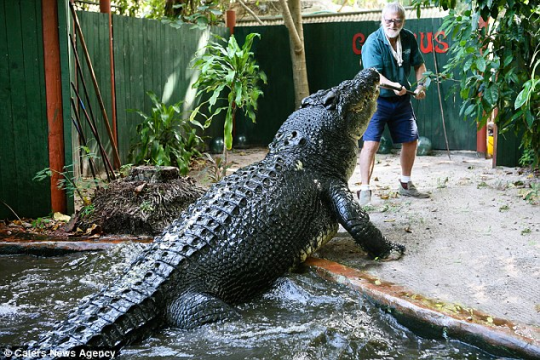
I can’t stop thinking about crocodiles for some reason so here’s some cool pictures I found of probably the second largest one in captivity, his name is Utan:

isn’t he beautiful

listen to the SOUND when he bites

and that’s not even a real power bite, that’s mostly just heavy bone falling on heavy bone from his jaws and the air rushing out from between them

2000 pounds of Good Boy

you get me

I honestly expected like 5 notes, what HAPPENED here

More tags on this ridiculous post:

Wait, thats the 2nd biggest crocodile? Then what does the biggest one look like?

That would be Cassius, a very old Saltwater crocodile who is estimated to be around 114 years old and lives at Marineland Melanesia in Green Island, Australia.  His official measurement is 5.48 meters, which makes him the largest in captivity currently.  Because Utan is only slightly smaller and much younger, (only in his 50s), he will likely break Cassius’ record eventually.  But for now, Cassius holds the title:

He is NOT, however, either the largest crocodile ever captured in Australia OR the largest ever in captivity.

A slightly larger crocodile has been reported (though not yet comfirmed) to have been captured at 5.58 meters.

And while the famous Brutus of the Adelaide River was estimated to be just slightly larger than Cassius at 5.5m, he was driven out of his territory by a younger and even larger crocodile, who as a result has been given the name, The Dominator.  He is estimated to be just over 6m.

This is Brutus, with an appropriate caption:

It is believed that he lost that arm in a fight with a Bull Shark.  

The Bull Shark lost.

THIS is the crocodile who kicked him out.  The Dominator:

And that’s STILL not the biggest.  

The largest living crocodile ever reliably measured was Lolong, who for the 1.5 years between his capture and his death was the largest crocodile ever held in captivity, at a whopping 6.17 meters (20 feet 3 inches) and 1075 kg (2,370 lbs).  He had been feeding on both humans and very large livestock in the Bunawan creek in Agusan del Sur in the Philippines.  It took 100 people all night to drag him to shore during his capture.

And here’s why:

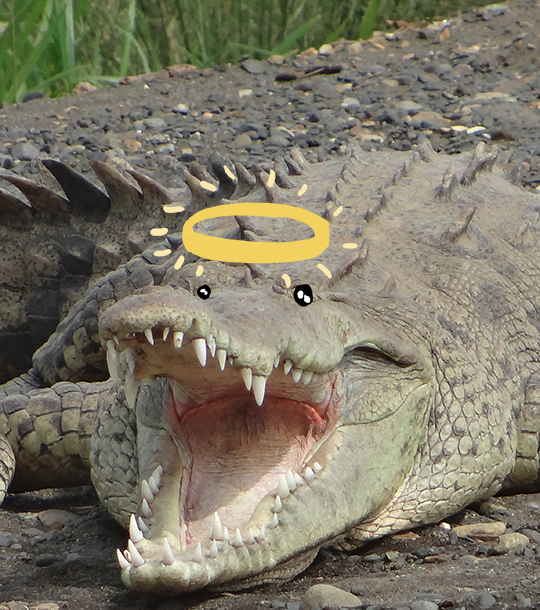
Also, to prevent credit from getting buried on a separate reblog, I have been informed that the above image of the crocodile with the cartoon eyes and halo was made by @rashkah!  (And it is wonderful and I would like to thank him for its existence, because it perfectly captures my feelings about terrifying giant primordial reptiles.)

@theonewhocheeps

Holy fuck

As far as Brutus is concerned I was led to believe that he lost that arm when relatively young.

Since then Brutus developed a habit of hunting and eating Bull Sharks.

image

Here’s him with a prey.

And if you thought that you’ll be safe if you just stay out of Australia then think again!

Meet Gustave the Nile Croc.

image

This crocodile became almost legendary for both it’s size and the habit of hunting both livestock AND humans.

So how big is Gustave?

No one is sure. Since he was NEVER captured.

His estimated size is of at least 5,5m  but some give him over 6m.

The terrifying parts are:

1) He is still growing having only about 60 years.

2) Adult crocodiles often perform a gesture of submission to him – something usually done by young crocodiles toward adults – Gustave is just THAT BIG.

3) His sheer size makes it difficult for him to catch agile prey Nile crocs tend to feed on – hence why he developed a habit of hunting either larger prey like Hippopotamus or creatures which are not good at spotting danger in the first place like livestock and humans.

And this is NOT ALL.

Gustave actually has a noticeable scars on his body – he was shot at east 3 times and stabbed with a spear or something similar at one occasion.

He lived to tell the tale – my question is:

What happened to that one dude who attacked Gustave with a spear?

image

*Crocodile Dundee voice*  Mate, that’s not Gustave:

THIS is Gustave:

And he is the PERFECT CROCODILE.  He is the perfect example of what I mean when I talk about (as I do) how the morphology of extremely large crocodiles adapts to the changing physics of their bite.

This is a typical adult Nile Crocodile:

And THIS is a god among his kind:

This is it, folks.  The Final Form.  THIS is what peak performance looks like.

Crocodiles and physics have an interesting relationship.  Crocodiles have, by a CONSIDERABLE MARGIN, the strongest bite of any animal on Earth.  EVER.  Scaled up estimates (based on Nile and Saltwater crocodiles) give the extinct Deinosuchus an estimated bite force MORE THAN DOUBLE the recently updated Tyrannosaurus bite estimates.  Living crocodiles have bite forces measured in the range of 5000 pounds per square inch, for an individual around 15-16 feet.  It is estimated that modern crocodiles in the range of 18-20 feet would have bit forces around 7-8000 psi or more.

That’s a problem.

Because a crocodile’s skull is only designed to handle so much pressure.  Go beyond that limit and the force of impact when those jaws snap shut could literally shatter their own skulls.

But evolution has spent hundreds of millions of years perfecting crocodiles, so PHYSICS ISN’T GOING TO STOP THEM.  What ends up happening in the skulls of these extremely large crocodiles is they will increase dramatically in mass to compensate for the increased forces.  A crocodile’s skull is almost exclusively solid bone, with only minimal space for nasal passages, a surprisingly advanced brain, and some slightly porous looking framework that helps the bone distribute the force over a larger area.  The effect is by far the most pronounced in Nile crocodiles, which most regularly feed on larger prey and need to make use of all that power.

Compare, 26 inch skull:

vs 29 inch skull:

Both of those are Nile crocodile skulls (or rather, replicas thereof).

And just for fun, here are the skulls of completely different (and very extinct species), Deinosuchus:

and Purussaurus:

The bigger the crocodile (within a given species), the more massive the skull needs to be to compensate for that UNBELIEVABLE bit pressure.  This is one way to see from a distance whether you are looking at a normal sized crocodile:

and a truly extraordinary individual:

One of the things about Gustave that’s so impressive is how healthy his teeth look.  A lot of large crocodiles, in their old age, have very worn down and often missing teeth.  They do replace them many times over a lifetime, but when they get very old this slows down.  Gustave, at least in every picture taken of him, had teeth that were in very good condition.

Even crocodiles much smaller than Gustave’s reported size (probably similar in size to Dominator or Lolong) tend to have smaller or more worn teeth:

than the pinnacle of his kind:

Lolong! It means Gramps or Grandpa, because he’s a relic of an ancient world where crocs more massive than he was walked the earth. His body is on display somewhere right now though I forgot where.

Every time I see this post there’s more crocodiles.  It’s the gift that keeps on giving.

That above image of the Deinosuchus skull is outdated. It was an early estimate of what the skull might have looked like based on scant fossil remains (if you look closely, you’ll see parts of the skull that are darker than the rest. That’s the real bone, the rest is a plaster reconstruction) and a poor understanding of the animal’s evolutionary relationships (that skull is based on the Cuban Crocodile, whereas Deinosuchus was more closely related to alligators).

Many years and a lot of better fossil material later, this is a better example of a Deinosuchus skull, specifically D. rugosus (from Schwimmer, 2002)

And a more generic, non-species-specific Deinosuchus skull for scale, courtesy of Gaston Design:

(You know you can buy this from them? I mean it’s crazy expensive, of course, but still!)

Also, to dispel any potential rumours, according to palaeontologist Mark Witton, common length estimates of 10 metres for D. rugosus are inaccurate, with a more likely size being no more than 8 metres, which is still FUCKING big. However! There is a second, if much rarer species, Deinosuchus riograndensis, which could have reached 9 metres, and that would have been a sight to behold. Also, the common rumour that Deinosuchus preyed on dinosaurs is not… entirely true. There is evidence that it occasionally ate dinosaurs (though whether that was through active predation or scavenging is unknown), there is far more evidence to suggest it mainly hunted sea turtles, given that many fossils of Cretaceous turtles have been found with Deinosuchus-like bite marks, not to mention that Deinosuchus’s exceptional bite force is far more suited to getting through the bony shells of turtles than the hollow, relatively delicate bones of dinosaurs, which would not require such… excess.

One more thing, Deinosuchus riograndensis, in all its 9-metre glory, is not the largest known crocodilian. That title belongs to the aforementioned giant caiman, Purussaurus brasiliensis, at 10 goddamn metres long.

(Credit to randomdinos over at DeviantArt for this one)

Jesus.

image

Preach it

//platform.instagram.com/en_US/embeds.js

why-animals-do-the-thing:

ftpalpacas:

llamanonymous:

catsbeaversandducks:

“Who the f*** are you and why are you filming here?!”

Video by ʇɥɓıu ǝıpoſ

A greeting from a friend

I was going to touch on this in a separate post, but I can see it’s already made its way to Tumblr, so hello again everyone, welcome to another “teachable moment”. Also, sorry that this may be a little long, but this is a super important area to discuss, for reasons outlined below.

So, to start off with, the behaviour this alpaca is engaging in is 100% NOT okay, and is 100% NOT normal. I know the poster edited their video to say that they feel comfortable and safe with this behaviour (which may be fine for them, although I find it curious that all of their photos and videos are taken from the other side of the fence) however, I am here to tell you that as someone who has worked with hundreds of alpacas, who is part of a community of owners who collectively have worked with thousands of alpacas and llamas alike across the world (who are all in agreement, BTW.), this kind of behaviour is NOT normal, and is the kind of behaviour which can become a precursor to more dangerous behaviours, which can and have hurt people.

What we are seeing is an animal displaying sexual aggression towards a human, which is not a good thing. That noise he is making is called an “orgle”, which is the noise males make when they are trying to “woo” their partner to lay down, so that they may breed them. There is speculation that the sound of orgling also helps stimulate the female’s reproductive tract to better improve the chances of a pregnancy; but in practice, many females won’t lay down for a male who isn’t orgling.

So yes, he is excited to see her. He is very excited to see her, just not the kind of excitement she seems to think it is.

Alpacas and Llamas who display sexual aggression towards humans are often the unlucky recipients of well meaning, but ultimately misguided handling practices, and are extremely likely to develop another behavioural problem called “Aberrant Behaviour Syndrome” (ABS), which was previously known as “Berserk Male Syndrome” (BMS). 

Animals who are at highest risk of developing ABS usually fall into a few categories:

  • Were weaned early and separated from the herd to live alone or away from other camelids.
  • Were hand-reared, away from other llamas and alpacas.
  • Were improperly socialized as young animals, which may have included being overwhelmed by strangers constantly petting/touching (as in a petting-zoo situation), or having been overwhelmed by stressful situations on a regular basis.
  • Are currently being housed alone away from other llamas and alpacas, and have been kept in isolation for a long time.
  • Were curious as babies, and allowed to engage in “cute” play behaviours such as jumping up, nibbling, picking at clothes, etc.
  • Are more likely to be male, however females can develop these behavioural problems too.

Many of these handling practices are carried over from other species, like goats and cows, where hand-rearing and allowing babies to “play” like this is used to encourage the animals to be more human-friendly as adults. However, llamas and alpacas are not cows and goats, so when handled in this manner, the end-result is drastically different.

Camelids with ABS are likely to engage in all sorts of dangerous behaviours, which may include 

  • jumping up on people
  • chest-butting people
  • knocking people over
    • this may be followed by mounting/orgling
    • or may be followed by biting and stomping
  • biting people
  • wrapping their necks around legs to pull your feet out from under you
  • “rushing” where the animal runs at you with their head down, or while with their head up
    • “rushing” may also include a “clucking” noise, which is a noise some males will use to challenge other males to fight
  • chasing/herding people in the pen
  • stomping and excessive kicking at people nearby
  • pushes you around/gets super up close in your personal space

The sad thing is, that it takes a lot of time and dedication to train an animal with these behaviours out of engaging in them, and once they have displayed these behaviours, they can never be 100% trusted to not revert to them again (because no behaviour can be completely unlearned). Most males will end up needing to be castrated once they start engaging in these behaviours because the hormones in an intact male will only add fuel to the fire. Particularly bad cases are often euthanized, because they are a danger to their handlers.

It is even sadder knowing that ABS seems to be extremely easy to prevent in the majority of cases (because, as with any behavioural issue, one cannot account for all issues of abuse or physical trauma and whether an animal will develop problematic behaviours). As herd animals, llamas and alpacas need to be kept with other llamas and alpacas, especially as juveniles. Even if an animal needs to be bottle-fed because their mother cannot supply them with milk, bottle-fed cria can often go on to develop normal, healthy behaviours if they are kept with other llamas and alpacas when not being fed.  Keeping young llamas and alpacas with their herd, and not letting them “play” with you in ways which will become scarier dangerous if they do this to you as a 150lb adult, seems to be, by and large, the easiest way to prevent ABS from developing. 

Because lamas engage in strict social order amongst one another, and recognize very clear personal space boundaries, when young llamas and alpacas are raised with the herd, the other herd members “teach” them what are and are not appropriate behaviours, and also show them how to be a normal camelid. When we raise llamas and alpacas away from other camelids, they never really learn how to distinguish us humans from other members of their camelid herd, making us fair-game for behaviours that would normally be reprimanded soundly by other llama and alpaca herd members. 

As humans, we also have completely different connotations behind affection-behaviours. Humans are a species that engages in social grooming, and we enjoy touching each other immensely and use it to display affection (as do dogs, cats, horses and cows!); however, llamas and alpacas do not engage in social grooming. They don’t like touching each other unless it is for purposes of procreation or competition (for reference, mother llamas and alpacas don’t even lick their babies clean after they have been born). So when we “coddle” or “play with” babies who don’t have adult camelids as a barometer, their instincts are telling them that we’re playing with them when they’re little, and when they’re adults and their priorities change, we’re no longer playing but are challenging them for breeding rights or territory. 

In short, the alpaca in this video is engaging in a behaviour which has the capacity to turn very south very quick for his owner if he is allowed to continue to behave in this manner. She is lucky that there is a physical barrier between the two of them, because many males who show this level of sexual aggression, will readily knock people over and will attempt to breed them, which is not good for anyone involved. 

It is especially concerning to me as a camelid owner, to see that the woman who own’s this animal has multiple videos of him engaging in the same behaviour (with her safely on the other side of the fence); as well as photos and videos of him actually jumping on her while very clearly trying to mount her. 

If you have a llama or alpaca who engages in this kind of behaviour (or any of the behaviours listed above)  or you know someone who does; I cannot emphasize enough how important it is to reach out to your local llama/alpaca organization to find experienced breeders near you, who can hopefully help you curb those behaviours in your animal before you, or a loved one, or a future owner of that animal (because sadly, these kinds of animals get passed around a lot because they are so difficult to handle) get hurt. 

These behaviours are not normal, and they are not okay or cute. They are a disaster waiting to happen. 

Sorry to be a buzzkill, but this is an important aspect of camelid husbandry, that many people overlook and then ultimately regret (or worse, experience and then become afraid of the animals because they don’t know its not normal!). 

Boosting because I was in the process of researching this when I saw the post come across my dash – this appears to me to be an accurate description of the behavior and why it’s a problem.