I continue to be impressed by the level of transparency that the Cheyenne Mountain Zoo has committed to regarding medical issues with their animals. I frequently call for radical accountability and communication from the zoo industry, and they’re killing it What I really want to share with you is the video and accompanying explanation the zoo put out yesterday about what happened when Malaika went down. Since I can’t embed FB videos in tumblr, you can click through here (I highly recommend it – it’s not often the public gets to see how emergency elephant responses work) and I’ll copy their text below:
“This morning, a team of Cheyenne Mountain Zoo staff used specialized equipment to successfully assist Malaika, a 33-year-old African elephant, who was found lying on her side during an overnight check. If an elephant can’t get up on its own and is down for too long, it can cause stress to its internal organs and can be fatal. The team responded in the early-morning hours to mobilize a specialized crane-and-hoist system in the barn to help the elephant to her feet, since she was unable to stand on her own.
The team was made up of more than 20 cross-discipline Zoo staff members, including Malaika’s animal keepers, veterinary staff, maintenance and grounds personnel, The Colorado Springs Fire Department Heavy Rescue team, Broadmoor Fire Department, and more.
The Zoo’s emergency response team was able to use the barn’s hoist system to help Malaika into a sternal position (on her belly, with legs in a better position to stand). Malaika was then able to stand on her own, with the hoist strap still in place for support, at 6:47 a.m. Since then, her care team, including her keepers and veterinary staff, have been monitoring her for any additional medical concerns. She is drinking electrolyte water, eating some of her favorite treats, and taking medication for inflammation and pain.
Malaika has a history of not being able to get back up from laying down, and had to be rescued once before, on Jan. 1, 2018. Some elephants are able to lie down and get back up with no problem, but some, like Malaika, don’t ever lie down and instead just lean on objects for rest. This is partially due to a life-long issue with bowing and lack of strength in her back right leg, which is worsening as she ages.
Because of Malaika’s history, Zoo staff monitor her throughout the day and with checks every two hours overnight. Our monitoring system shows that Malaika went down around 3:45 a.m., from what appears to be a leg wobble during a deep sleep. She was discovered down during the 5 a.m. check. A core Zoo team was assembled at the elephant barn between 5:30 and 5:45 a.m., with a full team on-site by 6 a.m. Protocols were immediately put into place to help her stand.
The Zoo cares for an aging female elephant herd, so the barn is equipped with state-of-the-art equipment that helps address the inevitable complications that come with multi-ton animals that need medical assistance. Equipment includes a remote video surveillance system for animal care staff to monitor the elephants, the crane-and-hoist system that can lift a disabled elephant and a care system that provides a safe area for weighing, veterinary care and husbandry training. Outdoor wellness features of the exhibit include an exercise path, built-in enrichment activities, a pool and a spacious vacation yard, where our elephants can take time to roam and explore by themselves.
Zoo staff performs drills to practice and test protocols for situations like these. The last “down elephant” drill occurred in January 2019, which is likely one reason the procedure to help Malaika today ran as successfully as it did.
We appreciate your support and well wishes for Malaika. We will bring you an update on how she is doing in the coming days.”
Okay, so there’s a couple things I want to talk about here:
I love the full transparency here. The amount of detail on her medical history, the little things like specific times being referenced… they give a very intimate view into the incident that avoids feeling like a nice slick PR statement. They’re earning the trust of their audience with each post like this.
Down elephant drills are really important, and every zoo with elephants does them. I’ve gotten to sit through a really cool conference session where a bunch of different facilities discussed their plans and drills and how they coordinate with local emergency response. For instance, if an elephant goes down outside, and you need a crane to help stand them back up – better have done a dry run getting that piece of machinery into the habitat before you have an emergency! And yes, some zoos do have “elephant stand-ins” they’ll practice rescuing.
The reason “being down” is a problem for elephants is because the sheer weight of their body crushes their own tissues, or cuts off circulation. They can and do lay down to sleep at night naturally, but not for long periods at one time. The issues start when an elephant can’t shift position or get back up on their own. This is also a consideration for veterinary procedures involving anesthetizing elephants – the longer they’re out and laying still, the more risk there is.
Overall, I know what a hard call that is for the keepers to get, and what an effort it is to get an animal the size of an African elephant back on her feet. I’m glad it was successful, and super proud of CMZ for being this open about it.
I continue to be impressed by the level of transparency that the Cheyenne Mountain Zoo has committed to regarding medical issues with their animals. I frequently call for radical accountability and communication from the zoo industry, and they’re killing it What I really want to share with you is the video and accompanying explanation the zoo put out yesterday about what happened when Malaika went down. Since I can’t embed FB videos in tumblr, you can click through here (I highly recommend it – it’s not often the public gets to see how emergency elephant responses work) and I’ll copy their text below:
“This morning, a team of Cheyenne Mountain Zoo staff used specialized equipment to successfully assist Malaika, a 33-year-old African elephant, who was found lying on her side during an overnight check. If an elephant can’t get up on its own and is down for too long, it can cause stress to its internal organs and can be fatal. The team responded in the early-morning hours to mobilize a specialized crane-and-hoist system in the barn to help the elephant to her feet, since she was unable to stand on her own.
The team was made up of more than 20 cross-discipline Zoo staff members, including Malaika’s animal keepers, veterinary staff, maintenance and grounds personnel, The Colorado Springs Fire Department Heavy Rescue team, Broadmoor Fire Department, and more.
The Zoo’s emergency response team was able to use the barn’s hoist system to help Malaika into a sternal position (on her belly, with legs in a better position to stand). Malaika was then able to stand on her own, with the hoist strap still in place for support, at 6:47 a.m. Since then, her care team, including her keepers and veterinary staff, have been monitoring her for any additional medical concerns. She is drinking electrolyte water, eating some of her favorite treats, and taking medication for inflammation and pain.
Malaika has a history of not being able to get back up from laying down, and had to be rescued once before, on Jan. 1, 2018. Some elephants are able to lie down and get back up with no problem, but some, like Malaika, don’t ever lie down and instead just lean on objects for rest. This is partially due to a life-long issue with bowing and lack of strength in her back right leg, which is worsening as she ages.
Because of Malaika’s history, Zoo staff monitor her throughout the day and with checks every two hours overnight. Our monitoring system shows that Malaika went down around 3:45 a.m., from what appears to be a leg wobble during a deep sleep. She was discovered down during the 5 a.m. check. A core Zoo team was assembled at the elephant barn between 5:30 and 5:45 a.m., with a full team on-site by 6 a.m. Protocols were immediately put into place to help her stand.
The Zoo cares for an aging female elephant herd, so the barn is equipped with state-of-the-art equipment that helps address the inevitable complications that come with multi-ton animals that need medical assistance. Equipment includes a remote video surveillance system for animal care staff to monitor the elephants, the crane-and-hoist system that can lift a disabled elephant and a care system that provides a safe area for weighing, veterinary care and husbandry training. Outdoor wellness features of the exhibit include an exercise path, built-in enrichment activities, a pool and a spacious vacation yard, where our elephants can take time to roam and explore by themselves.
Zoo staff performs drills to practice and test protocols for situations like these. The last “down elephant” drill occurred in January 2019, which is likely one reason the procedure to help Malaika today ran as successfully as it did.
We appreciate your support and well wishes for Malaika. We will bring you an update on how she is doing in the coming days.”
Okay, so there’s a couple things I want to talk about here:
I love the full transparency here. The amount of detail on her medical history, the little things like specific times being referenced… they give a very intimate view into the incident that avoids feeling like a nice slick PR statement. They’re earning the trust of their audience with each post like this.
Down elephant drills are really important, and every zoo with elephants does them. I’ve gotten to sit through a really cool conference session where a bunch of different facilities discussed their plans and drills and how they coordinate with local emergency response. For instance, if an elephant goes down outside, and you need a crane to help stand them back up – better have done a dry run getting that piece of machinery into the habitat before you have an emergency! And yes, some zoos do have “elephant stand-ins” they’ll practice rescuing.
The reason “being down” is a problem for elephants is because the sheer weight of their body crushes their own tissues, or cuts off circulation. They can and do lay down to sleep at night naturally, but not for long periods at one time. The issues start when an elephant can’t shift position or get back up on their own. This is also a consideration for veterinary procedures involving anesthetizing elephants – the longer they’re out and laying still, the more risk there is.
Overall, I know what a hard call that is for the keepers to get, and what an effort it is to get an animal the size of an African elephant back on her feet. I’m glad it was successful, and super proud of CMZ for being this open about it.
When a tiger’s first response to having a tooth yanked is not a roar, snarl or swipe with claws, but a test nibble to check that its mouth works as well as it suddenly feels, it speaks volumes about how much the bad tooth* must have hurt.
*You can see, briefly, that it’s black and nasty on the inner side. Yuck.
poor baby
I’m just awed by the amount of trust in this gif. That tiger totally trusts that the human is going to help with that scary metal object on an already painful area and the human totally trusts that the tiger is just test nibbling and not chomping down on his arm. I flinch when a house cat comes at me too fast and these two don’t even hesitate to trust each other.
baby :3
I cannot explain my fondness for the words “test nibble”
Initially I thought this was an odd slight of hand because look:
This tiger has a retained upper canine. See the two teeth coming out of the same socket next to his thumb? The adult tooth is the shorter one closer to the nose. The baby tooth needs to go, but that’s not something you can do with a yank.
This is the same sort of tooth from a dog patient. It’s just a poodle, but look how long the root (between the calipers) is compared to the crown you could see above the gum.
That’s at least what you can see outside the gum also being under the gum, and these are difficult to extract in their entirety. And initially I thought that’s what the guy in the gif was doing, or trying to do.
But he’s not touched the upper teeth at all.
He’s grabbing the baby lower canine, which is a bit grey and has bugger all root in this screenshot.
But there’s no blood there.
That’s a baby tooth that was ready to come out. This tiger would have to be only about 6 months old. It’s a kitten. That is a baby tooth that is meant to fall out, and usually it would on its own. This tiger is teething, that’s why it wants to chew everything.
That tooth probably would have come out with a good chew toy. It’s grey because the tooth is dead, just like when you lost your baby teeth. Ever swallow a tooth that you didn’t notice immediately as a kid? The tiger is likely to be in that little pain, judging by such a brief reaction.
It’s not even a really bad tooth. The tooth is dead, because it’s supposed to be, and supposed to fall out on its own.
I was waiting for @drferox to weigh in on this before I added my commentary, since we approach this type of media from different perspectives.
This video is from 2013, and the man who owns the tiger and is pulling the tooth is Michael Jamison. He’s a pretty infamous pet tiger guy from South Africa: if you’ve seen a tiger on a kitchen counter or in an enclosure with astroturf, it’s the same dude. This isn’t a cat in a professional management scenario, and that guy isn’t a vet. This is a pet owner who habitually shows off his exotic pets online and – for some reason – likes to repeatedly videotape himself pulling his tiger’s baby teeth out. There are actually three of these videos that I’ve found so far: two from 2013, which appear to be the same cat, and one that’s much more recent.
I asked @drferox if it’s a good idea to remove teeth by hand when an animal is conscious, even if they’re about to fall out naturally, and unsurprisingly her response was no. It’s possible the tooth might break and you wouldn’t get all of it out, leaving shards below the animal’s gumline. Not to mention that if pulling the tooth hurts the animal you’re seeing them up for a really nasty experience – and potentially yourself for getting bitten or mauled.
I also have to comment on how this video – like many others involving pet tigers – falsely portrays them as being “safe” to interact with; this one is egregiously bad because it shows a tiger tolerating something that most people know even domestic pets wouldn’t stand for. Content like this perpetuates the idea that these animals are not dangerous wild predators – and this video specifically also makes it seems like there is ever a “safe” or “appropriate” situation in which a wild animals can put it’s mouth on you. (When you’re raising any kind of animal, domestic or wild, to be around humans, it is crucial that you do not let them practice behaviors as babies you don’t want them to engage in as adults. With wild animals – like those hand-raised in zoos due to medical necessity, or as ambassador animals – one of those cardinal rules is that mouths do not go on people’s skin. Ever).
So overall: not actually a cute video. It’s a trifecta of irresponsible husbandry practices, irresponsible animal management practices, and the perpetuation of dangerous misinformation about big cats.
Speaking of crocodile mummies: The “sacred crocodile” is a recently-described cryptic species from remote desert oases in the Sahara; this was apparently the crocodile species venerated in Sobek-worship ceremonies in Ancient Egypt, and DNA from crocodile mummies helped reveal the species. They’re smaller and much friendlier than Nile crocodiles.
This is a mummified crocodile from Egypt, about 2,500 years old, now at the British Museum. The museum put scans of the crocodile on display in 2015-2016. The species is probably the “sacred crocodile.”
There was anecdotal evidence about the weird behaviour of this
crocodile. Many people, from Herodotus to current researchers, have
described a sort of Nile crocodile that behaved differently. From my
reading of the earlier literature about the exploration of the Nile,
there were some suggestions of a smaller crocodile hanging out in the
estuaries while the large, aggressive ones that everyone was afraid of
lived in the middle of the Nile. Matt Shirley and I have thought about
analysing the fine-scale ecological differences between the two to see
if you could tap into how they could have overlapped in the Nile for so
long before the recent period. Did they use different habitats or have
different prey?
Tara Shine found these crocs living in caves in Mauritania that
initially appeared to be sluggish because they were hanging out at the
hottest time of the year. But people could feed them and come up to them
and they weren’t aggressive at all. And some of the local populations
apparently consider these crocs sacred. She took some samples and we now
know that these are C.suchus.
Were the Egyptians aware of the differences between the two species?
Herodotus wrote that the ancient Egyptians recognised one crocodile
that was larger and aggressive and another that was tamer and considered
sacred, which they raised in temples. That’s part of what Geoffrey St
Hilaire used in his description of the species.
(End of excerpt.)
Y’all like Sobek, the Egyptian crocodile deity, right? It had always been assumed by Western scientists that the crocodile living in Egypt and in oases in the Sahara were Nile crocodiles (Crocodylus niloticus). But it turns out that a smaller, more docile, cryptic species was hiding in plain sight. This crocodile has since been recognized as a distinct species – Crocodylus suchus. Its common name is sometimes given as “West African crocodile” and sometimes given as “sacred crocodile” – an allusion to its heightened status in Ancient Egypt.
Here’s ya boy, Sobek (from the mortuary temple of Amenemhet III at Kom Ombo).
How was it determined to be a different species than the Nile crocodile?
An excerpt:
In Chad, Klemens had stumbled across six crocodiles in a small oasis
and, at his guide’s recommendation, jumped in with them. Puzzled by
their docile behaviour, Klemens took tissue from a dead one.
(…)
The iconic Nile crocodile actually comprises two different species —
and they are only distantly related. The large east African Nile
crocodile (Crocodylus niloticus) is in fact more closely
related to four species of Caribbean crocodile than to its small west
African neighbour, which has been named (Crocodylus suchus).
Evon Hekkala of Fordham University in New York and her colleagues
revealed evidence for the existence of the second species by sequencing
the genes of 123 living Nile crocodiles and 57 museum specimens,
including several 2,000-year-old crocodile mummies.
“It wasn’t even remotely related to the Nile crocodile samples I had been working on.”
Hekkala’s group collected as many Nile crocodile samples as they
could find, including several from ancient mummified animals. All of the
mummies were of C. suchus, indicating that the
ancient Egyptians had recognized the differences between the two
reptiles. Indeed, the ancient Greek historian Herodotus wrote that the
Egyptians selectively used a smaller, tamer crocodile in ceremonies and
regarded it as sacred.
(End of excerpt.)
The preserved DNA in mummified crocodiles from Ancient Egyptian sites
helped taxonomists to determine that crocodiles used in Egyptian
ceremony were distinctly different from the Nile crocodiles of East
Africa.
These are crocodile mummies, prepared by Ancient Egyptians, on display at the museum at the Kom Ombo temple.
How do they occupy the desert?
During the early Holocene, the Sahara was much wetter, with some broad lakes and swamps occurring throughout the huge desert region. Over the past several thousand years, as these swamps disappeared, underground waterways continued to feed some oases. This resulted in the isolation of small pockets of some freshwater animals. There are genetic lineages of pygmy hippopotamus and desert crocodiles that have persisted in remote oases in the desert.
Outside of the Sahara, the sacred crocodile appears to be present across West Africa. Here’s a comparison between the distribution of the sacred crocodile and Nile crocodile.
Here’s where the sacred crocodile lives in the Sahara at present, including known sites that they used to inhabit over the past couple thousand years when the Sahara was much wetter. Though the crocodile used to live throughout the Sahara, notice that the crocodile is now mostly limited to Mauritania, though it’s possible that the Tibesti of Chad still hosts some crocodiles. They certainly used to be present in Egypt near Thebes and the Nile Delta.
Here are some examples of the desert oases where the crocodile persists.
Look at these little crocodiles and their desert oasis cave habitat!
–
They’re less massive than Nile crocodiles, which I think makes them c u t e r.
I grew up hearing the phrase “you never stick with anything, what’s the point” a lot. I’ve always been attracted towards seemingly disconnected interests, and gone through phases of being really into something. But eventually my interest would fade and I would move onto something else.
Or at least that’s always how it’s been phrased for me, by others. Now I realize that my interest for the old thing didn’t fade so much as my interest for something new outshined it, and that’s vastly different.
I was always made to feel bad about it, with every abandoned endeavour I was told I needed to stop starting things if I wasn’t going to stick with them. I was told I was wasting time and money picking up these random interests and abandoning them after a year.
So eventually, I stopped picking things up. I told myself “what’s the point, I’m going to give up in a year anyway”. Even worse, I started dismissing every new interest, because I had no way of knowing if my interest was “real” enough or just another passing phase. I stopped trying new things, I stopped looking up stuff that piqued my curiosity, and having chronic depression made it really easy to leave everything on the dirty floor of neglected ideas. The more they piled up, the more depressing it was. All these things that could be nice, but I just can’t take care of them.
I realize now how bullshit that kind of thinking is. So what if I stopped doing karate after a year? That’s one more year of karate than most people I know. And in that year I learned discipline, I learned to listen to a teacher, something I had never done before in all my years of private education. I learned the true meaning of respect, that it’s something you do out of faith at first and maintain as it’s reciprocated, not something you do blindly and regardless of how you’re treated.
It gave me the foundation for the determination and grounding I needed to practice yoga. Another year. Not enough to be good at it maybe, but again a year more than most people I know and a year that is not lost, but gained. I learned balance, I learned to listen to my body, I learned how to let go of emotional tightness through physical stretching.
And then iaido, only a few weeks because I couldn’t afford to keep going. The year of yoga I had done a couple years previous had given me a better starting point than the other newcomers to the class. I already had balance, I had strength in my legs and I had better posture. In those months I learned the importance of precision, the true definition of efficacy, the zen state that is incessant repetition.
Did I practice long enough to get good at iaido, and yoga, and karate? No. Of course not. It takes years to become proficient and decades to master any of those things, but I learned other skills and those skills were an invaluable part of my growth both spiritually and emotionally. Likewise for my forays into painting, sewing, graphic design, film. I’m a photography student now heading into my second year of school, and every single second of practice I have in those other disciplines has given me more experience in those areas and made learning easier.
Skills carry over. They intersect and connect in ways that are sometimes unexpected. Nothing is ever lost, experience is never a waste of time or worthless or stupid. Allow your focus to wander, reflect on what you learn, and consider how you can keep using it in other aspects of your life. Stop telling people their interests aren’t worth their time.
‘A jack of all trades is a master of none, but oftentimes better than a master of one’
^^^^The real jack of all trades quote if anyone’s i interested.
For a week I was super into making LED arrays.
For a few months I was really into costume makeup.
For a year I was into sewing clothes
For a few months I was into sculpting and molding and casting
I’ve always had a sustained interest in animals, but the hyperfocus on birds in particular made me very familiar with feather formations.
Couple months I loved the idea of engineering moving sculptures.
Add all that together, and hot diggity shit, that’s some SOLID basework for making costumes, cosplay, and other impressive props.
—–
For a week I was into welding and took a welding class.
A year of interest in woodworking and fiddling with the tools means I’m fairly good at that as well.
Add that to the engineering from earlier and the focus on balance and stable structures means I can make my own furniture – Couches, shelves, desks, just give me the material and tools and I can make it happen.
—
Brief interest in business law meant two classes taken in college, and an accidental qualification for a business degree.
Those same classes let me point out some serious litigation bait in a friend’s startup company.
—-
A wide array of interests means I also have a TON of little nitpicky facts about how the world works, which translates into amazing immersive writing.
I know how it feels to use a chisel, and the delicate precision of electronics. I know the smell of forests and barns and old yarn being put to use again. The bloody smell of a freshly slaughtered chicken, and the anticipatory fear moments before skydiving.
The pattern of a bad weld and a good one, and the careful calculation of load bearing walls when building underground.
Anyway, this world is HUGE and really cool. Why on earth would I want to stick to learning ONE thing, when there’s HUNDREDS of THOUSANDS of things I could learn?
For anybody still struggling with this, I highly recommend this book:
Sorry for reblogging my own post (again), but this is another awesome addition to it, and there have been several people commenting who have also read this book or went out to get it at @primarybufferpanel‘s suggestion and are loving it.
And for all of you saying “I needed this post”, check the comments! There are some really beautiful replies and encouraging stories that people have shared.
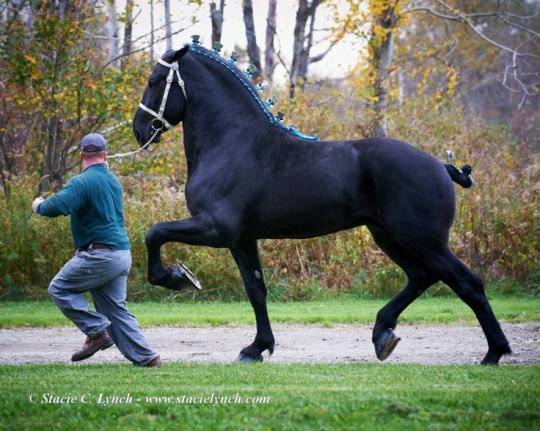
I never made a post about draft horses. :T They are the gentle giants of the horse world, sometimes growing as large as 20 hands and over 2000 lbs. The tallest horse in the world is an American-type Belgian horse named Big Jake (I think???).
A very big (but good) boy!
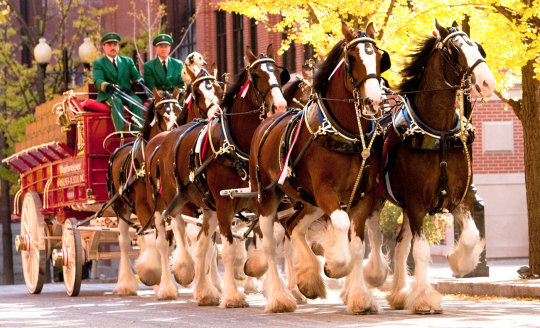
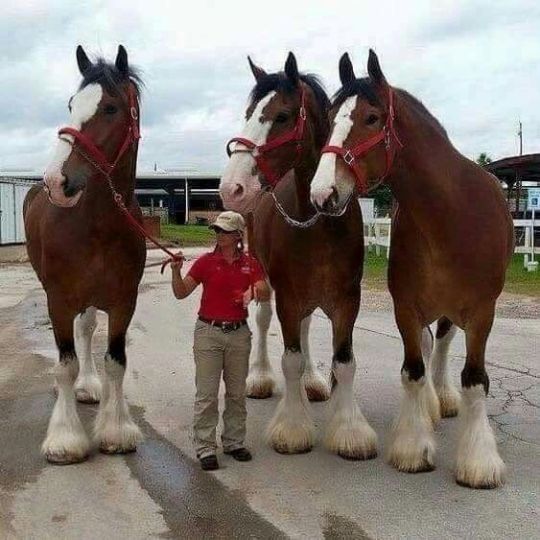
Despite their size, draft horses are known for their quiet, even temperaments, which make them good work horses. They were originally bred to pull wagons and plows, and they still do that. The most famous draft horses are probably the Budweiser Clydesdales, i.e. the horses in those Superbowl commercials that make us cry every goddamn year.
Draft horses can be ridden, and they are often crossed with lighter breeds, such as Thoroughbreds and Quarter Horses, to create tall, sturdy-boned, quiet sport horses.
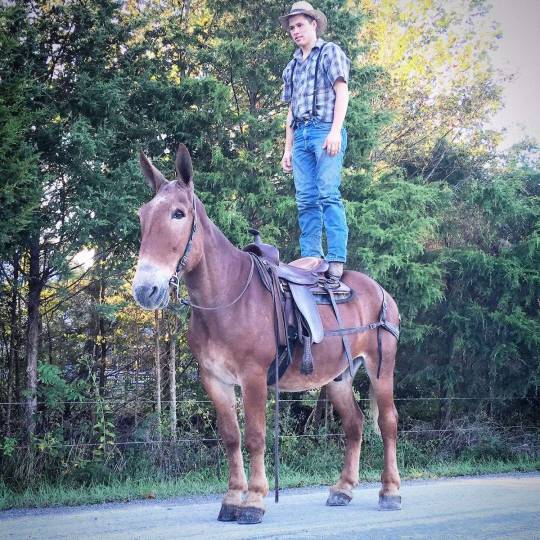
Such horses were a common sight during foxhunts, as “hotter” breeds, like Arabians and Thoroughbreds, tend to lose their minds a bit in the chaos of the hunt. Draft horses can also be crossed with Mammoth Jack donkeys to create draft mules, which are also used to pull plows for the Amish.
Mammoth Jack donkey:
Draft Mule:
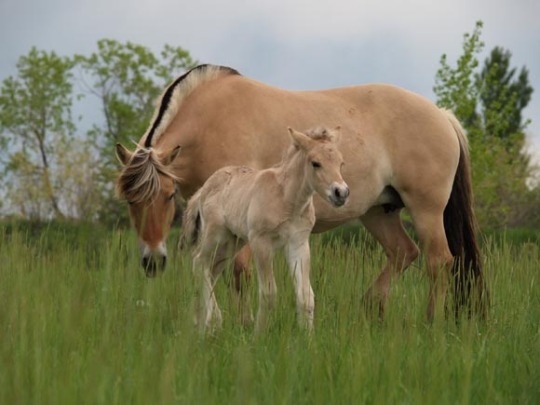
There are a lot of draft breeds, some more common than others. Many of the common ones are easy to tell apart from the others, but they’re all large-boned and tall, except for the draft ponies, such as Halflingers and Norwegian Fjord horses.
The Belgian
There are two Belgian horses, one that’s popular in Europe and another that’s very common in the US.
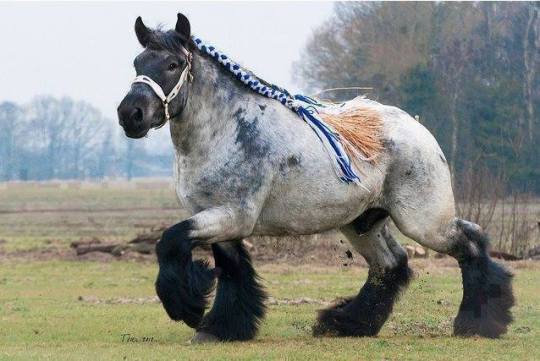
This is the European-type “Brabant” Belgian, which tends to be very thick boned and roan in color.
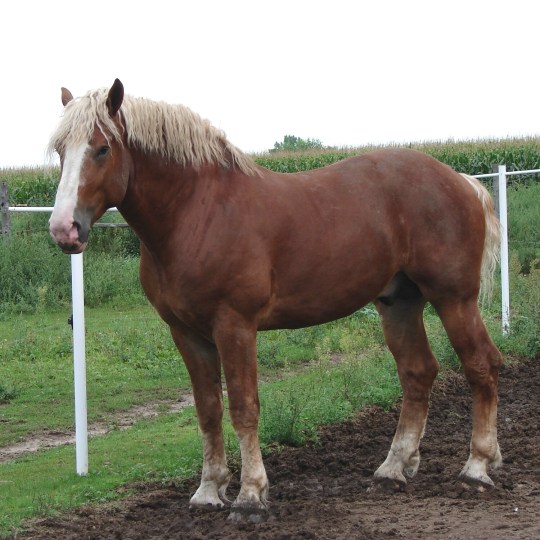
This is the American-type Belgian, which is lighter-boned and always sorrel/palomino in color:
Here is a Brabant Belgian mare pulling some shit:
A lot of draft horses really do enjoy pulling stuff, as much as a horse CAN enjoy doing anything that’s not eating grass and farting. Horse pulls are a common sight in Middle America, often done using Belgian horses. Here’s one of a team pulling 9200 lbs. They pull for a very short period of time, often only a few seconds.
Next up is the Percheron, which has a similar body type to the Belgians but are always black or dapple. They can be slightly more spirited than Belgian horses, with some demonstrating high stepping action.
They are not to be confused with Friesians, who have much more “feathered” legs and feet (long hair around the lower legs) and are lighter-boned. Friesians also don’t come in dapple colors, like the horse at the top of this post.
Clydesdales
Clydesdales are recognizable because they are a) always bay colored and b) almost always have four white socks and a blaze on their faces. They also have much more feathering on their legs than Percherons or Belgians. Clydesdales are more common in parades and the like because they tend to be slightly lighter than Percheron and Belgians, and because of this, they’re more agile and “showy”. You probably would not want to plow with a Clydesdale. You could, but their feathering means their feet get dirty much easier than a Belgians might.
Shire Horse
Shires come in a variety of colors, usually black or bay, and they are probably the most “feathered” horses of the popular breeds. They’ve got lots of fur on their feet.
Gypsy Vanner Horses
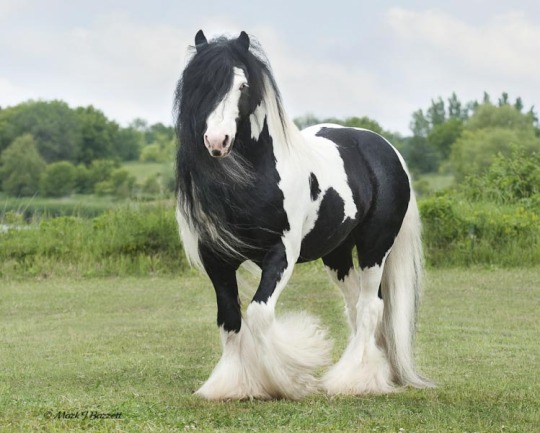
Gypsy Vanner horses got their start pulling Roma wagons, but now they’re mostly used in fantasy photoshoots, and you can see why. They are beautiful horses, definitely not the type you’d want toiling in the muck. They are almost always paint colored, which distinguishes them from Shire horses.
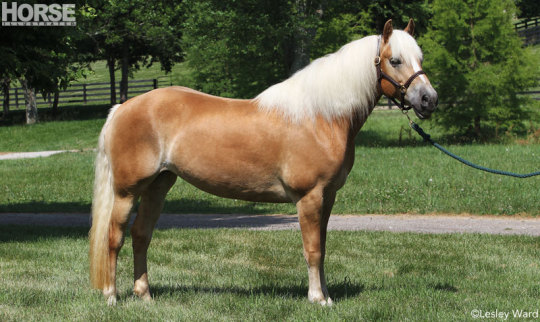
These are the main, most popular and commonly seen full-sized draft breeds, at least in the US. However, there are also draft ponies, the most popular of which is the Halflinger, which resembles a shrunken Belgian horse. They are ALWAYS sorrel/palomino colored, but their frame can vary. Some Halflingers are lighter-boned and more suitable for riding. Others are thicker-boned and better for pulling.
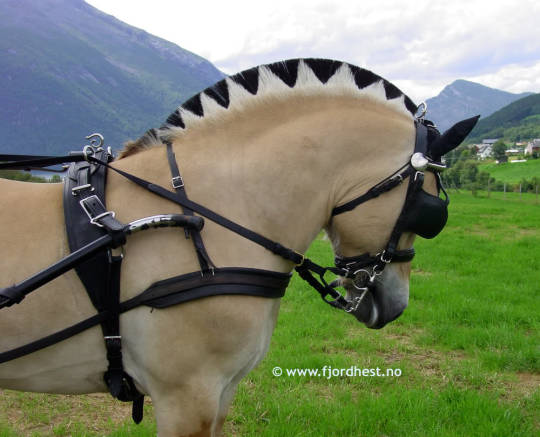
The other unmistakable draft pony is the Norwegian Fjord, easily recognized by the black stripe in the center of its mane, like a reverse ice cream sandwich.
This can lead to some creative hair cuts
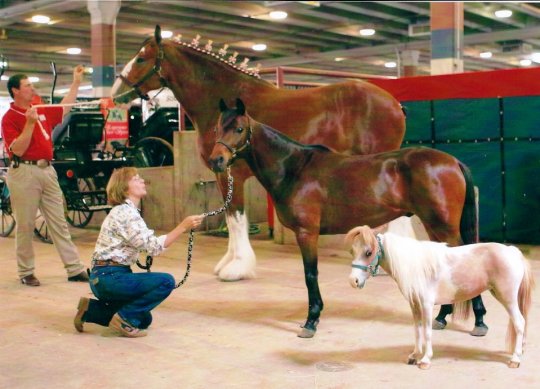
So there you go. That’s a somewhat comprehensive review of draft horse breeds. Here is a size comparison for funsies, with the average riding horse in the middle.
@mothbug I believe this may pertain to your interests
Thats the prettiest donkey I’ve ever seen
Magestic beasties
I’ve been face to face with Percherons and they. Are. GLORIOUS.
Most discourse about self-driving cars and nuclear power:
“We need to be more careful about saving millions of lives! A few dozen people might die in the process!”
Honestly, I’m nonzero sympathetic to the viewpoint that technology can make things worse, and we should be cautious about it. You want to argue that social media and clickbait have made our lives worse? That’s a defensible position.
But that caution seems incredibly misplaced when the technology is specifically designed to fix one of the major causes of death in the status quo.
I feel like the main problem here is that people just entirely forget that, like, new tech should be compared to the status quo, not to perfection.
Imagine Toyota came out with a new car, which was half the price of existing cars, and also was twice as safe, and put out half as much pollution. It would be amazing!
Now imagine they didn’t call it a car, they called it a kuruma or something. Everyone would hate it! “Dozens of people are dying in kurumas!” “Kurumas are taking up lanes that could have been used by cars!” The media would report on “The Kuruma Menace”. Some poor people who couldn’t afford cars would buy kurumas, and everyone would complain about the increased traffic/pollution caused by them.
This is how I feel about people’s reactions to basically every transit innovation ever. Scooters, Uber, self-driving cars, Lime, etc. People always hate them even if they’re a strict improvement over cars. Because instead of comparing them to cars, they compare them to what if people stayed home and did nothing.
And, like, maybe that holds water if you’re the kind of person who think everyone should stay home and do nothing. But most of the critics are people who drive cars! I could talk about how not being stuck at home is a human need, that people are willing to pollute and risk their lives for, but I don’t need to, because these people already know that, that’s why they have cars!
Drilling down into specifics: A lot of the criticism of Uber comes because it’s taking people away from public transit as well as from cars. And yes, cars are in fact less safe, more polluting, cause worse traffic, etc, compared to public transit.
But, like, notice basically everyone I know who complains about Uber owns a car.
People who don’t own cars tend to like Uber. It gets them home when buses aren’t running; when they’re in a rush, it gets them in town in half an hour rather than three hours by bus; it lets them go places while being blind; or while in suburbs underserved by transit. It gets them to hospitals when they’re too sick to bike, for 1/50th of the cost of an ambulance. It lets children go places when their parents don’t feel like driving.
But the car owners? They’ll tell you all about how Uber is ruining their city, because it allows poor people and disabled people the convenience of a car every once in a while, and the convenience of a car just happens to come with tradeoffs.
i’d love to hear how your logic ties into nuclear energy
Like the others, nuclear energy is one of those things where it always gets compared to “not using energy”, rather than to coal.
And as long as a single coal plant exists, the question isn’t “is nuclear power better than nothing?” but “is nuclear power better than coal?” – i.e. “should we replace this coal plant with a nuclear plant?”
Because you don’t need to get bogged down in the tradeoffs of “are deaths and environmental effects worth having electric power?” when we as a society have already said ‘yes’ to the same question regarding coal. If you disagree with those tradeoffs, you should be lobbying for dismantling coal, or at least for replacing it with nuclear as we move towards
Estimates for coal deaths range in the millions of deaths per year. Nuclear is responsible for, like, on average, one death per year? Most meltdowns result in zero deaths. Literal meltdowns!
(Nuclear is even safer than solar and wind – if you’re wondering how, people sometimes die falling off roofs while installing solar panels. Nuclear power hysteria kills more people than nuclear power itself does – more people died in the Fukushima evacuation than would have died if they just ignored it!)
Sure, nuclear energy has byproducts which are not great. But the question isn’t “are the byproducts better than nothing” but “are the byproducts as bad as millions of deaths every year?”
Which, even if you didn’t know anything about them, it’s probably less bad than millions of deaths per year, considering there are relatively few things in the world quite that bad, and we’d probably hear about them if they were. [1]
Casual research (skimming the Wikipedia article) confirms this: nuclear waste is being dealt with. There’s room for improvement, but considering there hasn’t been a single death involved, it’s clearly significantly less bad as millions of deaths per year.
It’s not like nuclear waste is magic. We have a pretty good understanding of it: It emits radiation which lessens over long periods of time, and we know how to block radiation, how far away from it is safe, etc etc.
I know this has some good points, but please for the love of god do not try and convince people that nuclear energy is good. Nuclear waste is a huge issue actually and the u.s. technically still has no plan in place for it. Also meltdowns can have serious, long ranging and long term effects on people’s health.
Deaths caused from solar or wind are due to improper implementation, not something that the energy in of itself causes. Interactions with coal and muclear energy in of themself cause damage to the environment and to living things.
Do you notice that this is the exact thing I was talking about, though? I could talk about how you’re wrong about how big of a problem nuclear waste and meltdowns are, but I shouldn’t even need to, because they’re nothing compared to the widespread environmental destruction and death caused by coal power.
Deaths caused from solar or wind are due to improper implementation, not something that the energy in of itself causes.
Deaths aren’t less bad when they’re accidental… The deceased’s family isn’t going to feel any better if you tell them it was preventable.
The only way this matters if we’re talking about what we should do in the future, when these deaths can be entirely prevented. At that point, yeah, I agree, we should stop using nuclear power, and switch to, like, Dyson spheres or something. But that’s not relevant to what we should be doing now.
Also, if accidental deaths don’t count, Nuclear has zero deaths.
Not to mention that the half-life for fossil fuels’ impact on the carbon cycle is infinite. It’s just easier to ignore when you can dump your toxic waste into the atmosphere
Also coal power stations still release more radioactive waste than nuclear plants do, just because they burn through so much coal that the trace amounts of radioactive elements adds up. And with nuclear power plants you actually bother with trying to contain it.
It’s horrifying to me that some of you are only against bullying when
1) The victim is of a marginalized group and
2) They are being bullied specifically because of that marginalization,
And everything outside of that is fair game to y’all and “totally okay.”
❄💙 Aria 💙❄
Like, some of you will see a kid of color being bullied for their race or an LGBTQIA+ kid being bullied for their gender or orientation or a disabled kid being bullied for their disability or whatever, and you’ll be like “Oh no, that’s tragic, how horrible.”
But that same kids gets bullied for watching anime or playing a video game that isn’t popular or for “talking/walking/acting weird” or for not being a good dancer or for some other totally harmless thing, and suddenly you are all oh “Well, they did it to themselves basically. They deserve it. Maybe if they get shoved in a locker, they’ll grow up and be normal instead of some creepy freak.”
Some of you will even go out of your way to join the bullies! And you think this is totally okay!
“We should embarrass and humiliate kids more. That way, they won’t grow into weirdos.” Fuck no. We should be standing up against bullying instead of supporting it.
And then some of you will come in like, “Well, maybe we should be careful about who we bully, just in case they’re actually disabled and mentally ill or something. Like, maybe we should make sure we don’t accidentally bully someone who is marginalized.” And you think that’s noble. You’re basically saying, “Let’s bully these other people instead,” but you think you’re doing a good deed.
And you’ll write these posts like, “Hey, we should stop bullying people for being oppressed. We shouldn’t bully people specifically for having traits of their oppressed group.” And you’re not wrong, but you hear how that sounds, right? Like you’re saying if you bully them for any other reason, then it’s okay.
And honestly? Many of you think that. You absolutely do. And it’s terrifying.
Others of you? It depends on the age of the victim. Like, bullying a 10 year old for any reason might be wrong, but a 15 year old or an 18 year old or a 25 year old? That’s different, apparently.
I’m sick of it. It’s disgusting.
Can no one see how this rhetoric about bullying is dangerous?
Like, I’ve been bullied. I know how hurtful it can feel. It literally should not matter why it’s happening; it’s wrong and it kills and destroys people.
But I guess that doesn’t matter to you as much as weeding out the freaks, right?
❄💙 Aria 💙❄
Yes! This, so much!
You can’t justify bullying by saying “oh this is a good reason to bully them” – my bullies thought they had good reasons to bully me too!
You justify your behaviour in the same way as them, and you have to realize that and then stop doing it.
I had three slider turtles surrendered today – three. Two are babies, like the little one shown up top. Yes, they were each surrendered in one of those. One is an adult female, pictured below with the turtle “habitat” on her back for comparison. All are in neglected condition with poor shell health.
SO…
This is what you need to understand when getting a turtle. 1. The little baby turtles sold on the beach, the fair, at flea markets, in little hole-in-the-wall shops? Are illegal. Turtles under 4″ in general are not being legally sold. This has been a federal law since about the mid-70′s due to salmonella outbreaks linked to the turtles (google it if you don’t believe me). Anyplace selling these turtles for any reason other that research or education is doing so illegally and, if they come in a little “habitat” like the one shown here, unscrupulously. 2. Turtles can not survive in tiny critter keepers. They should live 30+ years but most will only make it a few months in such containers. Why? Well: 3. Turtles need 5-10g of water (not tank, water) per inch of shell length to keep clean and happy. What’s more, they need: 4. Heat and UVB to digest, absorb calcium, and grow. Both of the tiny turtles we got in today have severely soft shells from calcium deficiency, and one has a mild respiratory infection from inadequate heat. 5. They also need filtration to help keep clean, or they can develop shell rot, bacterial infections, eye infections, etc. Even with a filter, expect large WEEKLY water changes. 6. A dry area to get totally out of the water to bask. Lacking a basking spot can lead to shell rot, which can go bone deep and be lethal. 7. A nutritious, fortified diet, PLUS fresh foods. Baby turtles need plenty of protein items while adult (sliders) will need a good portion of their diet to be vegetation. Those crappy oversized pellets baby turtles are sold with are not complete nutrition in and of themselves. 8. Finally, turtles need educated owners committed to a high-maintenance, long lived, LARGE pet with significant space requirements. Slider turtles and cooters, the most common species sold in those horrid little boxes, can grow to over a foot in length. The big girl pictured could still easily put on another 5″ or more in size and will need to live in a good hundred gallon tank (at least) to be happy and healthy.
Don’t be an impulsive, uneducated, crummy pet owner. Only get a turtle if you’re ready to provide everything – I mean everything – they need to grow, survive, and thrive.
And yes, the turtles pictured are now all living in spacious, filtered, heated, UVB’d environments to recover from their negligent care.
This post is making the rounds again and I wanted to add that ACS is currently home to 20 sliders (red ears and yellow bellies) and is totally maxed out and now turning away turtles left and right, which breaks my heart. Spread this like wildfire if it means even one person who shouldn’t have a turtle won’t get one.
Please please please please PLEASE spread this. Turtles (especially semi-aquatic turtles and even more especially sliders) are NOT low-maintenance beginner pets. Please don’t believe anyone who says they are.
A long time ago when I was 7 years old, I put a bunch of different pets I wanted on my Christmas list because I was ready to own my first pet. My parents agreed and looked to my grandmother to do the buying of the pet. But rather than agreeing upon an animal whose care is even slightly easier (a tortoise comes to mind, but please don’t think that most children are actually ready to handle the commitment that is tortoise care), they chose a Red-Eared Slider.
I’m not going to sit here and tell you RES’s make terrible pets, because they actually make fantastic pets. They can be super engaging and they’re really smart! My turtle was always really excited to see me and I had even trained him to do a couple of “tricks.” He was like a little dog, honestly, and I loved him very very very much.
But here’s the problem. Water is HEAVY. Backbreakingly heavy, in fact. You can do every single bit of care for your turtle right, but if you can’t do weekly water changes and a full water change and scrub-down of the tank/decor at least once every month, you are neglecting your turtle.
To reiterate: You can do every single bit of care for your turtle right, but if you can’t do weekly water changes and a full water change and scrub-down of the tank/decor at least once every month, you are neglecting your turtle.
Semi-aquatic turtles are filthy animals – and I say that in the most endearing way I can. Seriously they are filthy. They make a LOT of waste – way more than any filter (especially any indoor filter) can actually handle. Filter changes happen often, and so do full blown deep-cleans.
Like I said – water is heavy. It takes a hell of a lot of hard work to get the enclosure drained out (especially if your turtle isn’t close to any sort of drain). It doesn’t matter if you’re using a glass tank or a large plastic tub – it takes incredible amounts of strength. I mean seriously – way more strength than a young child can exude and perhaps even more strength than a man in the army (hi, dad) can give. It takes ESPECIALLY more strength than what a disabled child can give.
I couldn’t clean his enclosure. My parents were both always too busy and seemed annoyed any time I asked them to help me. My brother certainly wasn’t going to help either. When I developed my disability, they still didn’t lend a hand. I physically was incapable of being able to clean out his tank so it literally got to the point where the filter couldn’t even work and the tank was such a murky mess that it was pretty much impossible to see into. My turtle died at 8 years old and frankly – I’m surprised he even lived that long. I still to this day feel miserable about it. The day he died, I posted to Facebook about the importance of making sure you do all of your research first and also being sure that you as a parent are absolutely willing to help your child care for the animal when they are struggling to do so. Instead I got blamed wholly for his death by my parents, and my grandparents still hold a slight grudge on me to this day. I had tried really hard. I had overexerted myself trying to do it myself. I had asked for help over and over and got none. But it wasn’t enough because I just wasn’t able. I tried finding somebody new to take him, but nobody would. I tried getting my parents to let me surrender him to a shelter and they refused. Here I am again though, telling the story in hopes that somebody will say “oh maybe I shouldn’t get my child this pet.” Seriously. Save yourself the pain unless you yourself are willing to put the work in too. Even if it’s you or a friend you know looking for one as a pet, you NEED to consider if you are PHYSICALLY ABLE to care for this type of animal. I’m legitimately not joking when I say a rabbit can be significantly easier to care for than a red-eared slider or any other semi-aquatic turtle.
So the moral of this story is – PLEASE dont get a semi-aquatic turtle unless you are sure that you can cater to ALL of its needs, including the strength and time it can take to clean out its enclosure.
Thanks for this addition. I often hear parents saying that their child is going to be responsible for their turtle entirely, and I’ve had parents say this of kids as young as four to “teach them responsibility.” Nevermind the fact that someone incapable of caring for themselves should not be in charge of another life – really if you’re one of these parents I hate you and you shouldn’t have kids. A child can not PHYSICALLY care for a turtle.
Even a 1" turtle being kept in five gallons of water requires the child be able to drain nearly 50lbs of water, and that’s not counting tank and gravel weight, on their own, then refill that amount of water. Maintaining a larger turtle in a larger tank is tough for many adults. I have broken ribs right now and I’m REALLY struggling with the upkeep of my turtle stock tanks – and I guarantee I have better equipment for tank maintenance than a four year old has access to.
Honestly, very few people should probably own large semi-aquatic turtles, and the fact that you can buy them for $20 at any pet store kinda makes me sick to my stomach.
Recently have seen this popping up quite frequently at vets, so wanted to give a warning to all bearded dragon (and iguana apparently have them?) owners.
These are the Femoral Pores! They’re glands which are believed to be used by males during breeding season to release pheromones which attract females. Above is the sexual dimorphism between normal male and female pores.
This is a close up of a males pores during breeding season.
These pores release either a keratinised sort of oil, or a fatty oil depending on the use of them (remember we don’t know their full purpose!) so they can sometimes become plugged and gunky, causing infection and inhibition of hind leg movement if the infection and inpaction becomes severe enough.
Here are two photos of males with severely impacted pores! Note the male in the bottom image is a recent rescue so is not in good shape with his pores or retained shed.
So why do they become impacted? Well naturally in the wild you will hardly ever (I’d argue never) see a dragon with impacted pores. Why? You guys won’t like this. SAND. Bearded dragons will use sand, dirt, trees, rocks, and all other sorts of rough material to wipe the secretions from their pores. As they climb over a log or run across sand the secretions will be rubbed off by the rough material and hence, none is retained in the pore or skin to harden and impact. Contrary to what many American care sites will have you believe, sand is natural and healthy for many species of bearded dragon and it is poor husbandry, mainly heating and nutrients, which caste impaction, not the sand itself. But I’m not getting into that debate today.
Femoral Pore Impaction has flared to life recently due to the poor husbandry of bearded dragons which is being encouraged by these sites.
This is not a suitable tank for a bearded dragon. And I’m not trying to shame anyone, just educate. This tank has minimum enrichment for the dragon, with only one hide and two ‘climbing’ items (and I would argue it would not use the ladder) hence its emotional and physical requirements aren’t being met. This tank is lacking any hard substrate or roughage items, so it is predisposed to both femoral gland Impaction and shedding complications. It could also end up with overgrown nails. Bearded dragons need either rough substrate (eg. Sand) to wear off shed and their gland secretion, or rough ornaments like logs and rocks. If you don’t want to use sand fair enough, but make sure you have a log in there for them! This tank isn’t the worst I’ve seen, however I feel as if the ornaments are more for the owners aesthetic than they are the dragons benefit. Hide is good, that log bridge is good, but it lacks other enrichment and roughage material the dragon desperately requires. I also see no water dish, which should be provided even if your dragon doesn’t drink incase it has mites, shedding issues, or overheating in which it will submerge itself.
I tried to find a fairly basic tank as my good example since I know we don’t all have the room or money to create our dragons some of those amazing tanks you see! But this is an example of a good tank at its minimum. Essentially this is the rule you should follow:
Roughage items (logs, rocks, substrate)
Climbing/vantage point (nets, logs, platforms)
Hides, preferably two
Water dish
Adequate floor space
This tank checks all but one of those points, as I can’t see a water dish (although that could be one in the background behind the logs?) and as this dragon grows, you may need to remove some objects to allow more floor space. Asides from that I’d say this tank is perfect for a dragon! I cannot work out what the substrate is, I think it’s one of those reptile matting things which I can’t speak on as I have no experience with, but as long as the substrate doesn’t crumble off the mat to be ingestible I see no issue with it.
This dragon is enriched, happy, and I hope has the adequate heating, nutrition, and UVB it requires.
Generally speaking, almost every issue a bearded dragon may experience usually can be accounted to poor husbandry. Impaction? Husbandry. Bad shed? Husbandry. Metabolic bone disease? Husbandry. Egg binding? Husbandry. There are exceptions of course, for example my old girl Kilgharrah was born with a deformed colon so could not defecate and was impacted her entire life. But if your dragon has an issue, look to its husbandry first.
It makes me upset to know that Femoral Pore Impaction is becoming such a prevalent issue when previously, it was a rare case (according to the vets I’ve spoken with) and I hope this post can serve to educate some people on how to prevent it.
If you want a quick summary, use newspaper or tile or whatever it is you use if you’re adamant against sand. However do your dragon a favour and get it a nice, rough log or rock.
Lizards love logs 🙂
If anyone is curious this particular dragon was posted by The Reptile Doctor on Facebook. I do disagree with @feathers-scales-and-tails on the subject of sand however, though mostly in the case of pure sand. Mixed into a bioactive substrate it is fine, but with the fine grained sands that you buy at pet stores there is a problem with heightened impaction risk. Washed play sand is a bit of a gray area though because it’s larger grains make it a bit less of an impaction risk with proper husbandry. Still, considering that the majority of beardies that people own are dehydrated to some degree, I wouldn’t risk it except in dig boxes. Central bearded dragons ( the ones most common in the pet trade) are able to tolerate a wide range of habitats and temperature ranges and are found in sandy deserts in some places, but even there they have the option to navigate between different substrates. They also dig burrows, something they can’t do in pure sand but can do in their desert sand habitats because it’s not just sand even though it looks like it on the surface. The burrows hold their shape because of plant fibers in the soil that are difficult to degrade (similar to the coco fiber we use when building the substrate in our tanks). The variance in particle shape and size that this mix produces is also why we don’t see impaction very commonly in wild dragons as well.
I agree wholeheartedly with the reasoning behind impaction though, and would just like to add that part of the problem stems from dehydration and poor nutrition, which can play a role in them producing abnormal secretions.
Edit: oops, accidentally tagged the wrong person a second ago so I changed it. Thanks @fantasticbeastsandhowtokeepthem for correcting me.







 ifesbob
