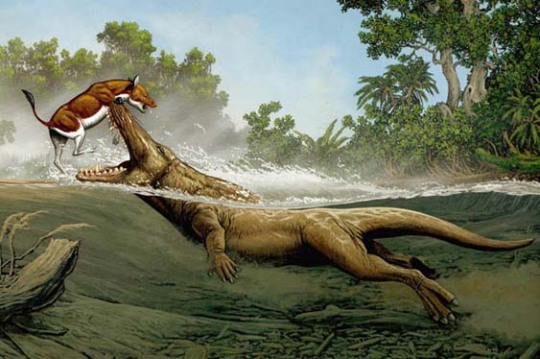
The Titanoboa, is a 48ft long snake dating from around 60-58million years ago. It had a rib cage 2ft wide, allowing it to eat whole crocodiles, and surrounding the ribcage were muscles so powerful that it could crush a rhino. Titanoboa was so big it couldn’t even spend long amounts of time on land, because the force of gravity acting on it would cause it to suffocate under its own weight.
I’m so glad they aren’t around
omg me too. I’m scared enough of 26 ft long anacondas. I’m so happy Megalodons, those giant sharks, aren’t alive either
Praise natural selection
I remember watching Walking with Beasts or something similar, or some British tv show about evolution
The subject was something like a 12 foot long water scorpion
I was so startled by its sudden appearance and narration that I yelped: “12 fucking feet?!?! I’m fucking glad it’s extinct!”
Dude, prehistory was home to some fucking TERRIFYING creatures. For some reason, everything back then was enormous and scary. Extinction doesn’t always have to be a bad thing!
And Poppy, what you saw was an arthropod known as Pterygotus (it was actually featured in Walking With Monsters). Not only was it as big (or maybe even bigger) than your average human, it had a stinger the size of a lightbulb. REALLY glad that bugger isn’t around anymore.
Also, Megalodon deserves to be mention again, because just hearing its name makes me want to never be submerged in water ever again.
GOD, I HATE THIS POST. HOW DO WE EVEN KNOW THAT SHIT ISN’T STILL AROUND? LURKING? EVOLVING? WE DON’T. WE DON’T KNOW SHIT ABOUT SHIT DOWN THERE. THE OCEAN IS A PRIMEVAL HELLSCAPE NIGHTMARE AND WE ALL JUST DIP OUR STUPID FRAGILE UNPROTECTED FETUS BODIES AROUND THE EDGES OF IT LIKE THAT’S NORMAL. FUCK THE OCEAN.
this is so relevant to my interests
It wasn’t just the predators. North Carolina was once home to giant ground sloths…
THAT IS A GODDAMNED LEAF-EATING SLOTH.
We’ve got a skeleton of one of these fuckers at the museum downtown, and man, just being NEAR it is unsettling.
DON’T FORGET PREHISTORIC WHALES, SOME OF THOSE FUCKERS WERE TERRIFYING
AMBULOCETUS WAS AMPHIBIOUS AND PRETTY BADASS
BASILOSAURUS WAS THIS GIANT REPTILIAN CETACEAN THAT PROBABLY SWAM LIKE A DUMB EEL BECAUSE OF ITS TINY FLUKES BUT THIS FUCKER WAS 60 FEET LONG AND AT THE TOP OF THE MARINE FOOD CHAIN
AND THEN THERE’S MY FAVORITE, ZYGOPHYSETER, WHICH WAS THIS HUGE EARLY SPERM WHALE THAT ATE SHARKS AND OTHER WHALES
IT WAS NOTHING BUT TEETH
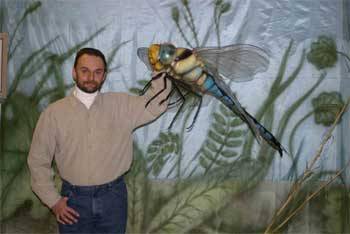
The reason why the animals in the prehistoric times were so big was because there was much more oxygen in the atmosphere if I recall correctly. Because there was so much oxygen and so few carbon gasses, life on earth was able to grow to terrifying lengths and heights, don’t forget how giant the bugs were.
I have never seen so much prime nope in a single post
Also important to note that megalodon is theorized to still be alive,possibly living in the darkest depths of the ocean. They haven’t found signs of its extinction
scientists: “we haven’t seen a megalodon in quite some time now, let’s just hope it’s exstinct”
This whole post is my JAM not gonna lie I am fascinated by massive prehistoric animals
The best thing about this is to any prehistoric species we would be so mini even our cities would be small lmao.
there is no credible scientist that believes megalodon is still extant. it is only theorized to be alive by cryptozoologists and other conspiracy theorists. “they havent found signs of its extinction”?? thats not ..how anything works.
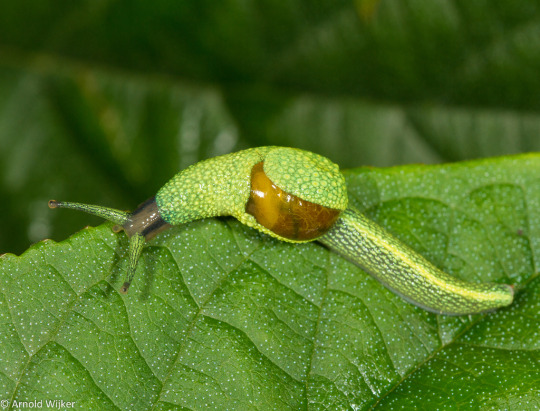
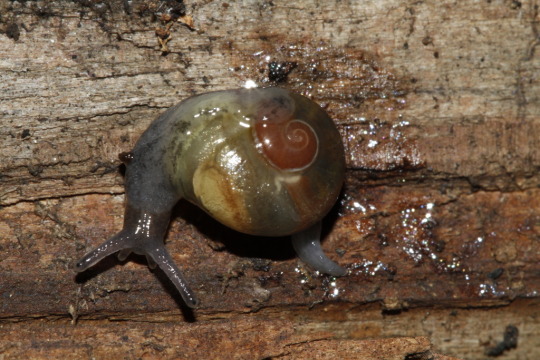
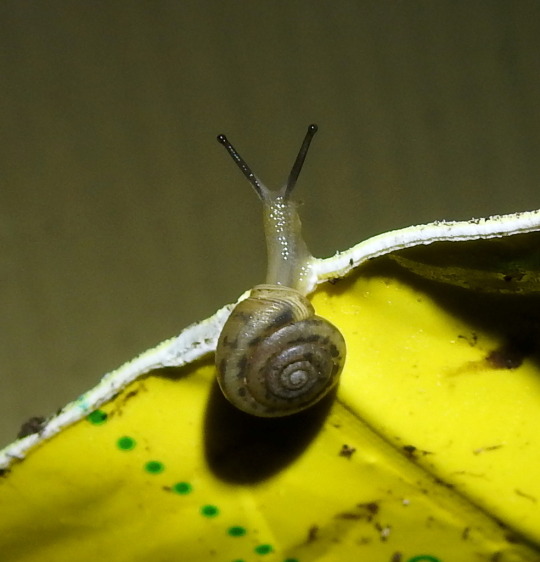
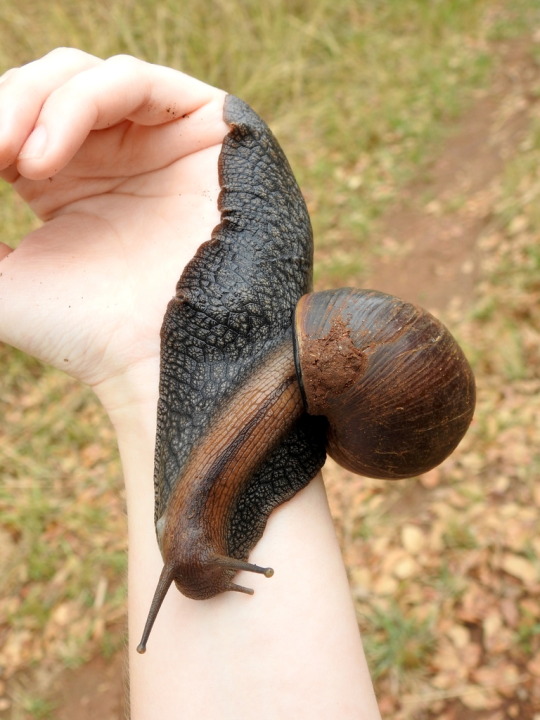
Snails are in the class Gastropoda with slugs, and the only difference between the two are that slugs don’t have a shell. But, it’s hard to tell what to to call some species.
This is a Long-tailed Semi-slug from Malaysia (Copyright Arnold Wijker, photo from iNaturalist [link]). It has a shell, but it can’t fully retract into it, so it acts more like a slug. The shell is partially covered by flesh in this photo, but the semi-slug can completely cover the shell with its mantle.
If you go up one taxonomic level to phylum, slugs and snails are mollusks–same as clams (bivalves, two shells!) and cuttlefish (which is where cuttlebones come from, if you have pet birds, you are giving them cuttlefish bones chew up!). So you can trace the evolution of the shell in Mollusca from bivalves, to gastropods, to cephalopods (one internal shell, though the chambered nautilus still has an external shell!)
But back to your questions!
Do snails create their shells?
Yes, absolutely! Do you create your skeleton? Do you create your skin? It’s the same situation for them.
Snails are born with their shells! I used to keep a planted aquarium, which meant I often had snails GALORE (they would ride in on my new plants, and reproduce like crazy). Snails are hermaphrodites, so you don’t have to worry about if you have males and females, as long as you have two (or even one–some species can self-fertilize!), you will have a million in a week. The eggs of the snails I had in my aquarium were held together with a clear jelly, and the developing snails in the eggs were white. In the lower photo below, you can see the babies in the eggs. The white parts are their shells–their skin was still transparent.
A much larger baby snail I found in my tank is in the above left, with my index finger for scale (still a tiny baby!). In the top right, I have included a very tiny baby snail from my back yard in Texas. This baby was so small his shell was still transparent!
Another question you asked kinda answered another one:
Why that shape? Do the shells grow with them?
This one gets really interesting! So, snails are born with their shells. But unlike arthropods, they don’t molt. They keep the same shell their entire life, for the same reason turtles do:
So what do they do when they need to grow? Let’s look a little closer.
Here is a common snail in Texas, called a Texas Liptooth Snail [iNat link]. This is a full-grown adult:
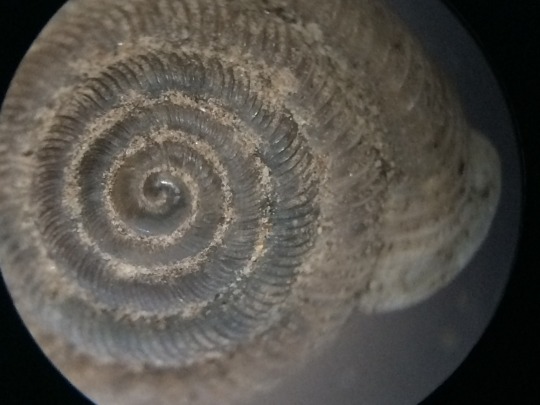
These are pretty small snails, so let’s look in the microscope:
Check out those ridges! Maybe you have noticed these ridges on other snails before, or maybe you haven’t. The ridges are much more pronounced on this snail because the shell is so small, but those ridges function similarly to a ring on a tree–it represents a period of growth. The shell is made up almost entirely of Calcium Carbonate, the same mineral that composes limestone and eggshells (you know, like in bird eggs?). That tiny smooth area in the center of the shell is the portion that formed while the snail was inside the egg, then as the snail ate, the nutrients from its food were used to grow extra rings at the opening of the shell, which became steadily bigger, which allowed the snail’s body to grow! Then it could eat even more food, put down bigger rings, and on and on.
So now you may be wondering, I’m talking about snail shells which are usually spiral shaped, which can be long and narrow, wide and flat, or any variation of the two. But I’m not even talking about that weird… pointy cone thing I included in my opening collage?
You mean… the limpet?
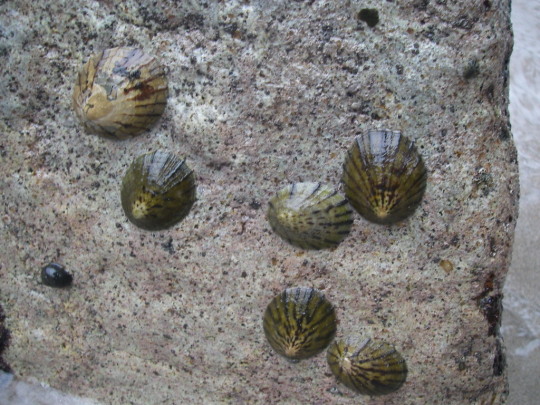
Oh yes, the limpets. These ones are Tortoiseshell Limpets from New Zealand [link] You may have noticed them on saltwater beaches, stuck to the rocks, and you may have confused them for strange looking barnacles, or maybe you had no idea what they were and you just ignored them or forgot about them. Or maybe you had a different name for them. But, yes, they are gastropods. And yes, that makes them snails.
These grow almost exactly like trees: much more simply put, they are little cones, and as they grow, they make a ring at their base, which makes them a little bit larger. For some species, the availability of nutrients will result in different colors in their rings, so you can see their age very clearly!
So what happens if they lose their shell?
I think by now, you can probably guess. They can’t really “lose” their shell, because it’s part of their body, which you can see if you take a really close look at snails (or you just, harass the heck out of them like I do).
I am but one person with too little time and too many hyperfixations and even though my yard is actually kinda small it ends up taking on a life of its own because hey let nature do its thing, right? What’s the worst that could happen?
*sigh*
So, right now, the very back of my yard is a mini-forest of hackberry, elm, and soapberry saplings about chest high (so thick you can’t walk through them without cutting them down, it’s a situation). Behind those, there’s this tangled mass of common hedge parsley and catchweed bedstraw. Both of these plants are terrible. The catchweed is essentially nature’s velcro and it tears into your skin as a bonus. The parsley is fine until is goes to seed—I have clothes I can’t wear until I sit down for a few hours and pick all the burr-covered parsley seeds off them. No, they don’t come off in the wash.
The back of the yard is the worst, but the catchweed and the parsley are all over my entire yard (along with the invasive rescue brome grass I can’t get rid of). I’ve been picking as much of it as I can every time I go outside. I want to destroy ALL OF IT!!!
Except… uh… today while I was watering my trees… uh…
Sorry for the grainy quality, I was far away. But… uh… Swallowtail Butterfly host plants include… plants in the… carrot family…
You know, like… parsley? She laid several eggs while I watched, and I found three total. I know there’s gotta be more. Well, I guess that’s one host plant I’m not going to run out of… and I’ve never raised swallowtails before!!!
So I put the plants with the eggs inside, and went back to watering. Okay, maybe I don’t hate parsely as much. But I still hate catchweed. GRRR!!!
Oh! Hello Mexican Honey Wasp friend! What are you doing over here?
Wait… are you…
Nectaring on…
Catchweed?!
I watched this wasp, and… yes. The only flowers that seemed to interest her were these tiny catchweed flowers.
Well. I guess I’m not pulling out all of the parsley and catchweed. As if I’d have been able to in the first place.
Just goes to show how even “weeds” are essential components of any ecosystem. My current situation is just a gross imbalance of three particular species.
March 18, 2019
Is catchweed Galium aparine? Because if so, you can eat it cooked like spinach which should get rid of the unpleasant texture (gather leaves and stems before the burrs appear).
“Can I eat it?” is always my first thought when I have to deal with masses of weeds.
Yes, that is my catchweed, and good lord if I ate it all, I’d turn into one! Maybe I’ll make catchweed and hedge parsley ravioli. The burrs are starting to come in on some of them though (grrrrr too late)
Not even done hatching and already causing trouble
Who needs a groundhog when your stick insects start hatching before January is even over?! This one escaped from the enclosure with one of his feet still in his egg!
To be fair, it is sunny and warm this week. Like, Seattle people would be wearing tank tops and sweating if they were here (they all got a ton of SNOW!!), so I don’t blame the sticks for busting out. But they could have maybe waited for more of their host plants to have LEAVES maybe???
For those keeping track, this is Generation #3! I caught their grandarents as babies in my yard, back before I had any idea what I was doing. My iNaturalist profile photo is their grandma on my face!
Megaphasma denticrus stick insects, longest insect in North America!
February 4, 2019
*sigh*
That’s it I’m going to bed
February 5, 2019
**edit: I forgot to mention I have like 200 eggs SAVE ME**
Okay, no new escapees, that I know of, but I counted no fewer than 27 wiggling stick babies out and causing mischief. I added another branch from my rose bush, which involved getting stabbed with a huge honkin’ thorn. That thorn-impalement was the second time these babies have caused me injury (I sliced open my finger with a wayward x-acto blade while doing emergency egg-removal surgery on a dehydrated early-hatching baby).
At least they have *something* to eat. The weather here is confusing the trees. Last year, my plum tree was the first to awaken, growing flowers in March. But… my cypress is growing new leaves… now. It almost hit 80 degrees this week, but it’s dropping down to almost freezing tonight (everything’s bigger in Texas… yaaaayyy). So who knows when the hackberry trees will start leafing out.
February 7, 2019
A much belated update
The hackberry leaves are finally in, so feeding them is easier and less painful than giving them rose. One of the fun things about feeding them rose, however: a lot of them ended up being pink!!!
They are larger and much easier to deal with, but they are quickly outgrowing their habitat. I need to reach out to schools in the area and see if any of them want some free class pets, otherwise I’ll be releasing a bunch of them.
fun fact there’s literally no books out there showcasing all the species of isoetes in the world like u might find for other plants. if u want to know that information u gotta go digging through 89 levels of deep academia and only then may you possibly stumble upon a hit list of names.
when i was researching for my term paper on them last semester i tried to build a distribution map of all the species, but the only book i could find was a weird old cloth-bound codex (literally a codex) that i had to specially request from my uni’s library storage building. after i got it i realized that 1. it…really was just deadass a list of names and ranges, 2. it was nowhere close to the exact ranges and just gave vague outdated country information with weirdly ambiguous sources, and 3. it was nowhere close to all the species known to us. the actual age of the book was hard to pin down; i want to say that it was 1970s, but it felt…….older somehow. it had quite The Energy and i quickly returned it
im sure that if u were to dig through some databases, you’d be able to find a more comprehensive list– i accidentally stumbled on a comprehensive checklist of all the hornworts in the world published by phytokeys, for instance, and hornworts are kind of in the same category of ‘weird niche nonvascular plants one might glimpse for 3 seconds while hiking like bigfoot amongst the trees’– but man, why cant we just have a nice comprehensive coffee table isoetes book?
this is off topic now but i keep reading these researchers in both isoetes and hornwort papers talking about how one of the biggest challenges to new research is that nobody knows jack shit about them, and i cant help but think like….comprehensive, readable knowledge of these plants is near impossible to find? like, most of the modern papers i was reading for isoetes kept shying away from discussing the fucked up anatomy of those plants to the point where the only book i was able to find that laid it all out for the reader in a semi-understandable format was a book from the late 1960s buried in the fern section of our library? all the illustrations in it were hand drawn? i still havent been able to find a good photo of some of these structures? i got a couple high resolution scans of some of the samples from my uni’s herbarium to publish on this blog, and had people literally come thank me because pics of specimens cut open to show the actual anatomy are hard as shit to find? like?
this turned into a little bit of a rant but come on lads!!! to get to know these plants u gotta go through like 93 levels of academia and know like 6 people!!! it’s no wonder why nobody knows them well!!!
All this isoetes stuff has really got to me. I’m a botany dunce, but I’m all about weird things, and holy cow these things are weird. I must find them.
There is an online database for North American plants. It’s run mostly by volunteers, and I don’t think it’s 100% complete, but it’s decent and jam-packed with data.
Dark green means the species is present in the state. The yellow means the species is present in that specific county, and it is rare. So Isoetes lithophila exists only in these counties in Texas, and nowhere else in the world. I need to find it! But… I need more information. This is just a map.
If you want more info, click on the Taxonomic Data Center Query link on the main page. Do your search here, and it takes you to this:
This page gives me the same maps as before, but now it also has habitat information and descriptions of the plant’s appearance! If the database has photos, it will also include those. BONAP didn’t have photos of Isoetes lithophila, but luckily there are some on iNaturalist!
Link to observations above [link]. Looks like I have a trip to Enchanted Rock State Park in my future, because this species grows in the pools on top of the rock, which are also home to a freshwater species of fairy shrimp.
In fact, while Isoetes remain underrepresented compared to other plant genera, look at the distribution of observations on iNaturalist:
ALSO did you know a lot of herbaria are digitizing their collections?
You have access to view 6,752 Isoetes specimens of 113 species, RIGHT NOW, on just ONE of these databases.
So that Isoetes lithophila babe that only exists in a few counties in Texas, which I wanted to see pictures of, so I knew what to look for?
There they are!
Search the Digital Herbarium Collections:
TORCH: The Texas Oklahoma Regional Consortium of Herbaria[link].
Includes approximately 4 million plant specimens across more than 50 herbaria in the two-state region. They are the one with over 6k isoetes. NOTE: the specimens themselves often came from out of state, so still check out the database if you’re outside of Texas and Oklahoma!
Harvard University Herbaria & Libraries[link]
According to their site, there are over 5 million specimens at the Harvard Herbaria, but only a small portion are cataloged and searchable online. Still, what they have is impressive. Check it out:
!!!!!
Citizen Science At Work
Small aside: You may be wondering why some random collection of herbaria in Texas and Oklahoma you’ve never heard of have more specimens online than Harvard does. Well, that’s because people like you have been the ones transcribing the labels so all the specimens can be catalogued. I did some of these last October and it was a lot of fun (and you get to see some really interesting plants)!
Notes from Nature[link]is a museum digitization project where regular people transcribe the labels, so that regular people (and researchers!!!) can view the museum specimens without having to visit the museum. This project is hosted on the Zooniverse[link] platform, which is an even larger collection of opportunities to contribute to science and academic research from your computer. There are all sorts of projects available to work on, including ones in astronomy, medicine, history, social sciences, etc.
Here are the projects just for digitizing herbaria collections[link]. Contributing to this kind of thing may count towards volunteer hours if you need them, or if you are a TA, maybe you can assign a certain number of classifications as extra credit 😉
I love animals that are, like, the opposite of cryptids: we know for a fact they exist and have a clear idea of what they look like because we have photographs and individual specimens, but we haven’t the faintest idea where they’re coming from – they just keep showing up out of nowhere, and the locations of their actual population centres are a complete mystery.
I so want examples. anyone who knows of any should post them in notes
You know, like giant squid and such. We know the bastards exist, we have credible first-hand accounts stretching back thousands of years and dead specimens washed up on shore and such, but in centuries of searching we’ve managed exactly one well-documented encounter with a giant squid in its natural habitat. We have no idea what their native range is or what their life-cycle looks like, let alone how many of them are out there.
Are there any reverse-cryptids that /aren’t/ at the bottom of the ocean?
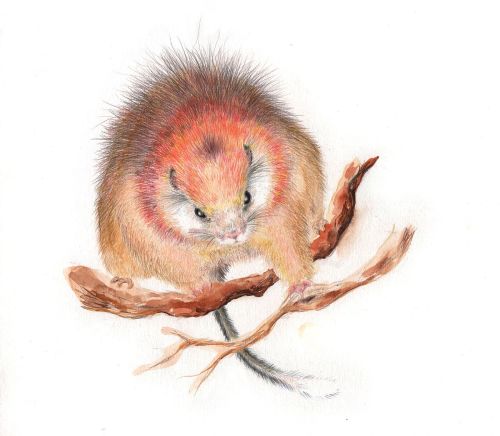
The red-crested tree rat, for one. There have been only three well-documented encounters since 1898, and they just plain disappeared from the zoological record for over a century. The only reason we know they’re not extinct is that one walked right up to a couple of wildlife research interns at a Columbian nature reserve back in 2011, apparently out of pure curiosity, and allowed itself to be photographed and observed for several minutes before disappearing again.
That’s genuinely pretty cool and all, but I absolutely need to talk about how the picture in that Wikipedia article looks like a tiny eldritch horror disguising itself as a peach.
To be fair, based on the actual photos from the 2011 encounter, they really do look like that:
Another example almost everybody has seen but has no idea:
Galls
Galls are weird tumor-like growths on plants (leaves, stems, branches, buds, etc) which are caused by developing arthropods. The mother will lay eggs in the plant tissue however suits her, and enzymes from her? The egg? ?? will reprogram the plant’s tissues to create an incubation chamber for the developing creature. They are SUPER common. Thousands and thousands of species. Galls can be formed by mites (arachnids), or insects, like wasps, midges (flies), or hoppers (homoptera).
Here’s the thing: very few of these can be identified to species because *nobody has named them yet*, which means they haven’t been “discovered” yet. Last year, I found these weird pink ones. When I finally managed to ID them, I learned they had been “discovered” only a couple years earlier.
In my yard, on one tree alone, I have seen and documented no fewer than 10 distinct species. But if I want to know what the adults look like, I’ll have to collect them myself.
For many galls, even if they are a named species, even if the adults have been identified, we know NOTHING about their life cycles. Some have two alternating life cycles: one generation grows in galls, then their babies… grow up… somewhere else???
All links in my post go to my observation pages on iNaturalist. I have many more galls that I didn’t put up here because… there are just so many once you can recognize them that you can’t possibly comprehend it.
Hello, @keepcalmandcarrieunderwood, I’ve been thinking about your question a lot, and this is a really hard one to answer. The obvious first step in getting over a fear of anything is wanting to get over that fear. When you have so many traumatic experiences so close together, especially when you’re young, it will take a lot of work to train your mind to be more comfortable around black and yellow striped things. So first off, congratulations on wanting to be more comfortable about our stripey friends! The good news is, you can do it!
Warning: wall of text precedes bug photos! Also this got Looooooong sorry (not sorry)
Fun fact about me: I have a Bachelor’s degree in Psychology (from way back in 2005). And one of my favorite things about studying psychology was learning about classical and operant conditioning. You are probably already familiar with both of these.
In classical conditioning, two stimuli are paired (they may or may not be at all related), and your reflexive, unconscious response to one gets associated to the other. This phenomenon was popularized with Pavlov and his digestive experiments with dogs (dogs salivate when a bell rings in the absence of food, because the bell has been paired with food many times previously). In your case, the two stimuli are actually very closely related (seeing/hearing things that might be stinging insects, and being stung by stinging insects). Because many organisms rely on learning quickly about danger for survival, it can only take one such pairing to develop a very long-lasting response to something.
In operant conditioning, behaviors are punished or rewarded, which can result in an individual’s behavior changing given the right circumstances. The behavior change is not necessarily conscious. A lot of interesting stuff in our brains happens outside of view from us. Say you look into a cactus flower once and you see a really cool beetle. Neat! You’re going to start looking into cactus flowers a lot more often. And if you keep seeing neat beetles, oh boy those cactus flowers better look out. Even if those flowers start turning up empty, you’ll still keep peeking in them for a while, even if you are in a situation where it’s really not appropriate to keep peeking into cactus flowers (apologies to people on my last guided hike…). I’ll get back to operant conditioning in a minute.
You may have heard about a common treatment for anxiety disorders called Cognitive Behavioral Therapy. I’m a big fan of this method, because it asks you to re-evaluate your thoughts, as you are having them, to restructure your gut reaction to a situation into a less emotionally-charged one. In other words, you have a fear resulting from classical conditioning–it’s totally reflexive and unconscious, and you had no control over the creation of your phobia. The problem is, phobias can become self-sustaining with the help of operant conditioning. Basically: Bee > PANIC! > flee > relief! The act of removing yourself from bee-like insects will give you relief from the fear, and makes you more likely to avoid bee-like insects in the future. But, you don’t want to be afraid anymore!
The trick is: turn your reflexive, unconscious responses into thoughts. This can be really hard–I have a lot of generalized anxiety issues, and I don’t always know what (if any) actual thoughts are making me uneasy. But I think it is easier to translate reflexes into thoughts for phobias, even if they aren’t always logical.
In the case of a fear of stings from bees/wasps, there are several angles you can take:
Learn more about stinging insects and their behaviors, and understand why they sting. Take fear and reshape it into curiosity, use what you learn to avoid getting stung.
Not all that buzzes is a bee. Similarly for yellow/black striped insects. There are lots of mimics out there, who look like a dangerous stinging insect to protect themselves, when they are totally harmless. Learn how to tell them apart, so know which ones couldn’t hurt you even if they wanted to.
Not all bees/wasps can sting! Males cannot sting, and some species are completely stingless.
Desensitization through Education
First off, you need to know a little about stingers. What are they, exactly? Well, they weren’t originally stingers. Before there were stingers, there were ovipositors.
Ovipositors in katydids. Left two: common conehead katydids; Right: lesser meadow katydid
Ovipositors are tubes that some insects use to lay their eggs inside something. Insects who lay their eggs in the ground (but who aren’t burrowing insects, like katydids) will use the ovipositor to make sure the eggs are safely tucked away from predators. Some insects go a step further, and lay their eggs inside another organism (these are called parasites or parasitoids depending on whether or not they kill the host). These insects will lay their eggs either in plant tissues (gall wasps and midges do this, and I wrote a post about galls a little while back [link]), or in animal tissues.
These parasitoid insects tend to be wasps, and they tend to have some pretty fancy ovipositors. The larger ones tend to parasitize caterpillars, and before you gasp and lament the plight of the poor helpless babies, remember that every living creature in nature serves a very important purpose. Caterpillars can absolutely destroy a vegetable garden. These wasps make sure there’s still something left for us.
These wasps do not sting. The painful sting is a result of venom, and these wasps with long ovipositors do not have a venom gland.
But, as insects are wont to do, if there is a niche, they will fill it. The inside of the caterpillar is claimed? Well, you can just lay your egg on the caterpillar instead. This is a lot harder to do. With a long ovipositor, you can just hold on, stick it in, and go. But if you need to lovingly affix your eggs to the outside of a wiggling caterpillar, you’re gonna have a hard time. If only there was a way to temporarily paralyze it!
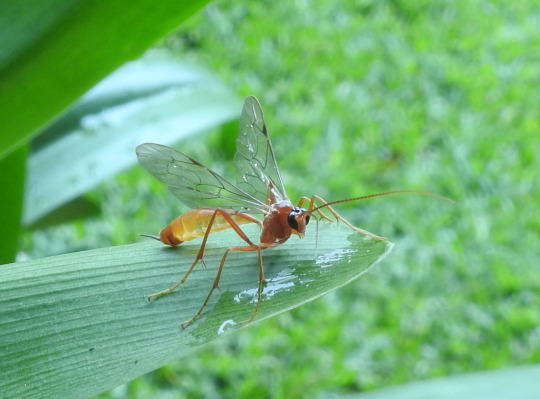
Meet Netelia. This is a genus of Ichneumon wasp. Notice her ovipositor? Kinda short, huh? That’s because it’s a stinger [link]. She stings the caterpillar, which is paralyzed long enough for her to beadazzle it with eggs, and off she goes. I don’t know much about the evolutionary history of ovipositors and stingers, but somehow, some species started living in large colonies full of sterile female workers and a stingless queen who laid all the eggs (think ants and bees). If you didn’t reproduce, you could make some pretty scary and painful stingers to protect your colony! Also: this means that only females can sting.
And this brings us to the issue: some of them DO sting humans and it is not pleasant!
Bees and wasps are similar in that the notorious species tend to live in large colonies, but they sting for very different reasons. Bees are defensive (their stingers are embedded into flesh and detach from their bodies–a nice way of saying they rip their guts out and die), while wasps are offensive (they can sting many, many times, and will do it when they feel threatened even if they are not under attack).
Left: Western Honey Bee; Right: Apache Wasp
Why are they so different? Bees are vegetarians, so they have no need to kill for food. Their stingers are the last line of defense for their colonies, because every bee who stings will die. A colony can’t survive if all the workers die, but it also needs to protect the young and the queen. But these bees tend to make fairly elaborate hives which serve as a good line of defense in addition to the army of stinging workers. Bees will sting if you are actively harming them or the hive, even if you don’t realize it. Remember those ridiculous wide leg raver pants (hey, I said I graduated from college in 2005, stop looking at me like that)? I knew a guy who wore those all the time, and one day his pant leg managed to fall over a single lady bee, and she… uh… Well, she felt threatened. Let’s just say I laughed. Yes, as it happened. I regret nothing. Bees do not want to sting you.
Wasps are also vegetarians (wait, WHAT??)–at least, they are in adulthood. Wasp larvae? Carnivores. Those evil wasps killing other bugs and carrying them off are taking them to their nest. They will lay an egg alongside their prey, which is paralyzed to keep it alive until the egg hatches (terrifying, huh?). What a good mother! Some wasp species are solitary, and their nests can be safe underground. But paper wasps, which you are likely more familiar with, have their babies literally hanging out in the open. Their delicious, nutritious babies. They are so vulnerable! They must be protected!
Paper wasps. Left: Apache wasp nest; Right: Common paper wasp nest
The only thing between a hungry predator and the life of those babies are the valiant wasps sworn to protect the nest. If they sense something which triggers the “hungry predator” switch in their brain, they will attack. Is their nest pretty low to the ground? Are you TOO CLOSE? Look out! Is their nest HIDDEN IN YOUR BALCONY WALL and you bump the side while enjoying a beautiful spring day? Are you throwing rocks at the nest? Do you smell like a bear? I don’t know what triggers wasps, but the only time I’ve been stung was when they secretly lived in my balcony wall. Thing with wasps is, when they’ve had enough, they will come after you. They can sting you to teach you to STAY AWAY and fly back to their nest.
But, if you don’t set off “hungry predator” alarms, and instead exist in their world as “irrelevant scavenger,” you can actually get pretty close to them. I was lucky to find this Common Paper Wasp lady making her nest on the underside of a pokeweed leaf in my backyard two years ago. I took these photos with my phone. I was inches away from her. Sometimes I had a headlamp shining in her face. She never once came after me. I started to recognize her foraging around my yard for paper fiber (ever see a wasp hanging out on your wooden fence, or landing on grass or dried dead plants? they are collecting building materials!), so I could get a really close look at her nest and the eggs inside. Look in the cells in the nest in the top left and bottom right photos. Those little white things are her eggs!
So there’s a bit of a Catch-22 here. If you’re not afraid of wasps, come up to them curiously, SHOVE A CELL PHONE IN THEIR FACE WHILE BLINDING THEM WITH A HEADLAMP, eh, they don’t care. But if you are afraid of getting stung… what are you going to do? Calmly walk away? NO! You’re going to swat at it, flail around, run, scream, etc. All things a predator would do. Same thing with bees. Sometimes, they will land on you for whatever reason. Maybe you’re wearing a fluorescent yellow shirt and you look delicious.
All this baby wanted was some nectar, and from her perspective, I was *clearly* advertising that I had bountiful nectar reserves. If I was not aware that they see UV light, and that this is how they find flowers so quickly, and if I instead thought that bees hate the color yellow and will sting you if you’re wearing it (this is what I was taught growing up… *sigh*), I would have thought I was getting attacked, and would have started with the flailing. This lady, who thought she was coming for lunch, instead now has to start fighting? She’s gonna be mad.
There is a lot to know about bees and wasps. I do not know that much about them, but I think they are very interesting and I love learning more about them.
Mimics Can’t Fool You!
Wow that first section was long. How about some pictures of things that aren’t bees or wasps?
Hover flies! Top: Left – Eupeodes sp.; Right – Copestylum sp. Bottom: Left – Palpada agrorum; Right – Yellow-shouldered Drone Fly
Longhorn beetles! Top: Neoclytus mucronatus (both photos) Bottom: Left – Zebra Longhorn Beetle; Right – Painted Hickory Borer
Moths! Left: Sphinx moths; Right: Clear-wing moths I know, I’m cheating a little here. These are specimens in the Texas A&M University Entomology Collections. They have an open house every January and it’s AMAZING!
Some clear take-aways here: (1) Flies are very into bees (2) Looking like a bee/wasp is a very successful survival strategy! (3) If it looks like a bee… it’s probably a fly (unless it’s actually a bee)
Stingless Fakers
There are two major groups of bees that don’t sting–Tribe Meliponini (Stingless Bees) and Family Andrenidae (Mining Bees).
Admittedly, I have not seen many of these. The two Meliponini species I saw were in Malawi (Africa), and those are the two photos on the left. Far left is a group going to their hive (they can make honey, too!), and center is a different species in their nest (a wax tube on the side of my cottage). These bees are so tiny you’d think they were fruit flies! Right photo is from West Texas, Mining Bees in the Macrotera genus (I love them! Little Valentine butts!)
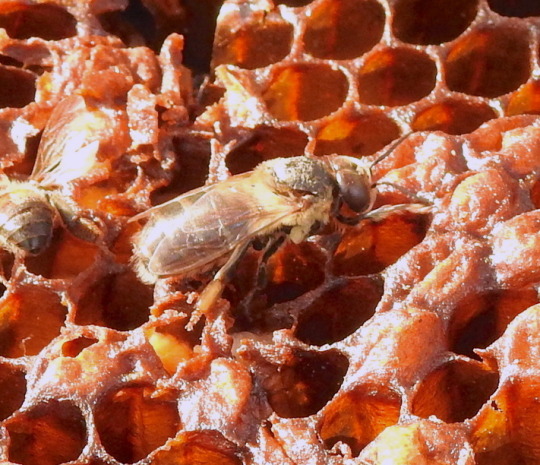
BUT! There is another fairly common group of stingless bees: MALES. No male insect can sting (they can bite if equipped, but remember, stingers are modified ovipositors!). You may never see a male honey bee, but here’s what they look like:
Not the best photo, but you can see he’s shaped… kinda weird? His eyes are HUGE, which is probably the easiest way to tell him apart from the females.
You are more likely to meet a male Carpenter bee, however. How will you know a male carpenter bee?
Male Eastern Carpenter Bee above. I read the males have a white patch on their face (look! his nose!), and there were some other features, but really, WHITE! NOSE!
Another Carpenter Bee I see at home (and NOTICE because … well you’ll see in a minute):
Xylocopa tabaniformis Carpenter Bee. Many apologies for the TERRIBLE PHOTOS. These were from my phone before I had a Real Camera and they only *just came back* this year and I am way behind on photos sorrryyyyyyyy
Anyway, I don’t know how to tell the females/males apart visually (or if you even can). And this photo may very well be of a female, who knows. But the way you know the males: They will get in your business. That’s why I call this section “Stingless Fakers.” It’s because of these. I love them. This pink bush is right outside my front door. I walk around it to get to my car in the morning. And in the summers, there are always a few of these buzzing around. And the males are interested in protecting their (small underground) colonies, so they will COME UP TO YOU to see if you’re a threat. Or maybe to intimidate you because THEY ARE A BEE THEY COULD STING LOOK OUT!
Carpenter bees are distinguished from bumble bees by not being as furry. Carpenter bees will have shiny abdomens. Bumble Bees should be bumbly furry.
ANYWAY IN CONCLUSION Bees/Wasps are interesting, not everything is a bee/wasp even if it looks like one, and they don’t all sting. I wish you the best of luck in facing your fears and buzzing back at bees and hornets in triumph.
Posted (finally–sorry!) May 31, 2018 As always, all photos are mine and most were taken in Texas. Exceptions are Netelia and Meliponini from Malawi.
We’re human and Godzilla is a kaiju, but the common thread we share is our behavior is often misunderstood as meaningless because people want to stop the behavior and don’t look deeper to see why the behavior is happening.
Everything in this post has a point, but I have to explain it all before I can make the point. So prepare for a long Godzilla infodump. 🙂
Godzilla is my oldest special interest. I’ve been a fan since I was a single digit aged kid. He is more than a giant monster to me. He is a creature of intense emotion that is more than “pissed off, kill everything.” The obviousness of those emotions can vary from movie to movie and era to era.
The Heisei era was made between 1984 and 1995. That’s right when I was growing up, so it’s my favorite Godzilla “look” and era. The Heisei era calls back to the original 1954 film, so I’ll include that in what I’m talking about.
Which means he can feel scared. What can scare Godzilla? Falling into a volcano. The lava won’t hurt him, but he didn’t know that at the time. What does scared Godzilla sound like? He screams like a little kid! It’s very sad. (Godzilla 1985, aka The Return of Godzilla)
I’m pretty sure the Heisei era gave us Godzilla laughing once. I couldn’t find a video clip, but he makes a little high pitched growling noise that isn’t his usual roar.
[Animated gif of Godzilla tilting his head side to side and wiggling his tongue around inside his mouth right after he blew up the Futurians’ ship in Godzilla vs King Ghidorah. It’s almost like he’s saying “HAHA! Your ship teleported right in front of me, what did you expect to happen?!”]
And if you think a rubber monster suit can’t be emotive, think again. During the mid-Heisei era, designers built a Godzilla head with complex animatronics in the eyelids, the “eyebrows”, the cheeks and the areas around the mouth to allow facial expressions. They want you to feel for him and with him.
[Animated gif of Godzilla blinking slowly and relaxing mouth over his sharp teeth as he looks down at tiny, out-of-frame Baby. For him, this is a tender, soft expression. He recognizes Baby is a Godzillasaur like he used to be and doesn’t want to scare him. (Godzilla vs Mechagodzilla II) Scene, note the communication taking place between him and Baby.]
Consider these quotes from Godzilla 1985.
“General, Godzilla’s like a hurricane or a tidal wave. We must approach him as we would a force of nature. We must understand him. Deal with him. Perhaps, even, try to communicate with him. And, just for the record, 30 years ago they never found any corpse.”
“He’s looking for something, searching. If only we can find out what it is before it’s too late.”
[Still image: Godzilla clutches a nuclear reactor to his chest to absorb its radiation in Godzilla 1985.]
Godzilla feeds off radioactive material. He has to go where the radiation is to sustain himself. If it’s a ship or a sub, he’ll sink it while breaking it open to get at his sustenance. If it’s a nuclear power plant in the middle of a city, he’ll stomp through the city to get it. Step in his way and he trounces you.
A funny thing about Godzilla is he seems pretty docile until he’s provoked into aggression. (***flashing lights warning) He’ll walk a straight line from point A to B, knocking things out of his way as he goes (as shown in Godzilla vs Biollante) unless something comes along and threatens / annoys him enough to change direction to make it stop bothering him. He knows that if he breaks the thing, it can’t bother him anymore.
It’s not just guns that’ll do it. Flashing bright lights close to his eyes and clock tower bells (Godzilla 1954) piss him off as easily as artillery.
Not feeling well can set him off, too. Consider the first movie, where Godzilla comes out of nowhere. He was once a dinosaur, and the atomic bomb testing around Bikini Atoll awoke and mutated him. I think he was still finishing the mutation process when he first appeared, so he was in pain, confused and enraged that he couldn’t find the familiar world he remembered. He was looking for his HOME. (***flashing lights warning) Then he’s met with power lines, artillery fire and noise. Everything escalates from there.
Sometimes, Godzilla will go bash a city because he’s upset or sad.
In Godzilla vs SpaceGodzilla, (***flashing lights warning) he fails to protect Little Godzilla (older Baby) from being captured, so he slams through a city because he’s pissed off.
In Godzilla vs Destroyah, he’s way more violent in his rampages than usual because he’s undergoing (***flashing lights and animal death warning) a literal nuclear meltdown and he’s in excruciating pain all the way to the bitter end. It’s the saddest thing ever. Godzilla is like a phoenix and Junior (Baby all grown up!) completes his mutation into a new Godzilla in the ashes of his adopted dad.
Now, what happens in pretty much every Godzilla movie when Godzilla shows up? The military goes after him, the weapons get decimated, buildings get flattened and Godzilla walks away more pissed off than before.
He’s like a force of nature, and you can’t nuke a tornado or an earthquake, can you? So what do you do?
Godzilla is a living being. Redirect him.
[Animated gif of Godzilla blinking and jerking his head back in surprise / shock because his out-of-frame opponent is still alive after getting thrashed. (Godzilla vs King Ghidorah) This is Godzilla’s “WTF??” face LOL.]
You think Godzilla’s attention can’t be redirected? (***flashing lights and potato quality warning) Oh, yes it can (Godzilla vs Mothra: Battle for Earth), you just have to make sure the thing that grabs his attention has a better payoff than what he’s already paying attention to, and how well it works will depend on his mood. If the payoff sucks, he’ll turn right around and resume what he was already about to do anyway.
Don’t want Godzilla fighting another monster in your city? Get that monster out of the city and Godzilla will follow because all he cares about is the fight. If the other monster won’t budge, YOU move. Evacuate, GTFO, let them fight and focus your efforts on saving human lives.
There isn’t much you can do if he’s stomping through because he’s mad about something, but evacuating and minimizing the noises and lights that make him angrier will reduce the damage. Cut the power if he comes through at night and he won’t be stepping on things to look at the lights.
Unfortunately, there isn’t an endless supply of psychics like Miki Saegusa who can mentally redirect Godzilla or shut off his anger. Even then, that’s dangerous because his mind is so strong it knocks her unconscious after she settles him down.
[Still image: Miki Saegusa is on a helipad out at sea. She stands with her back to the viewer and looks out at Godzilla, who is waist-deep in the ocean and looming scarily close. She is trying to deescalate his anger and send him back out to sea.]
What about Godzilla’s foraging?
There’s all kinds of radioactive waste sitting buried in various places around the world. It’s sitting there because it’s too dangerous to dump it. Take it to a far off island and leave it there for Godzilla. He’ll render it inert and safer to dispose. Keep all air / watercraft traffic away from the island and let him have at it.
Godzilla will figure out that he doesn’t get shot at or have to deal with flashy annoying lights and noise if he goes to the island, so he likely won’t feel a need to go after boats, submarines or cities as much unless they’re closer to him than the island when he’s hungry. He’s smart enough to figure out free food is better than city food. Before long he’ll connect the island with food and go there when he’s hungry probably 90% of the time. Just try not to be late with a delivery, because he might sink your drop off vessel out of hangry spite. 😉
Now apply similar concepts to autistic people. Think about it. Difficult behaviors are an expression of emotions or discomfort, even if the emotion is a simple “I don’t want to go there!” or “My stomach hurts!” or “I got interrupted so much today that I am done cooperating with interruptions!” and as complex as “My parents are always fighting and it scares me!”
Physical discomforts that seem tiny to a neurotypical can be intolerable to an autistic person. Stuff like a blister on a toe, a cold sore, a stuffy nose, rattling keys or the electronic whine from a TV cable box’s hard drive. Check everything.
Have they eaten, drank, gone to the bathroom and slept? Is it too hot or too cold? Are they dressed properly for the temperature? Do any parts of their clothes, underwear (or diaper), socks, shoes or anything they wear feel rough in places that touch skin? Is their hair in need of a trim and falling in their eyes? Has their day been a string of broken routines or interruptions? Do their eyes roll or dilate (possible seizure) when their behavior takes a turn? Do they go on a rampage after eating (acid reflux / intestinal problems / gallstones) or when they go to the bathroom (constipation / diarrhea / hemorrhoids / urinary tract infection)? Did someone in their home die or move away? Is there a new baby or new pet? Has something in their new environment changed drastically, such as a different table or strong paint fumes? Is somebody wearing perfume? Was a smoker in the area recently? Is the cat’s litterbox being cleaned out regularly? Check those things. Check anything and everything.
Make the environment feel better for the person if a stim they’re doing is interfering with learning, and they won’t need to do the stim as much or at all to tolerate the room they’re in. Lower the lights, take down that bright colored poster, move their desk away from a window or let them sit away from other people if that feels better. Let them wear ear defenders or wrap up in a weighted blanket. Let them take a short break to stand up and step outside the room if they can’t sit still despite trying to.
Focus on redirecting harmful / self-injurious stims to safer ones that meet the same sensory needs. Do they bang on things a lot? Give them an exercise mat or a punching bag to hit. Give them a beanbag chair to use as a crash mat if they like to throw themselves on the floor. Give them something safe to chew, like a chew necklace from stimtastic.co if they tear up their knuckles or fingernails from chewing on them or are prone to biting other people. Give them a pool noodle to whack things with or throw. Give them handheld beanbags to throw. Give them piles of pillows to kick and throw. If their screaming only bothers you because of proximity, plug your ears or protect them with earplugs and let person scream it out. Trying to contain aggression without giving it another outlet makes it worse. (Personal experience as someone constantly stifled…it’s like containing an explosion, painful!)
Don’t drag them out of a space unless there’s no way to keep them safe there. Instead, focus on getting dangerous things out of their sight or reach, bring in the safer stuff I mentioned above and let the meltdown blow itself out. Minimize noise and light. They may be an emotional sponge and pick up your tension, which adds to theirs, so try to fake calmness as much as you can. Only intervene if they’re seriously injuring themselves to the point of dribbling blood or you know they’ll break a bone if you don’t step in to help them not hurt themselves. Take care of minor injuries after they’re calm.
If a person prone to explosive meltdowns or outbursts is content to watch fish swim in a fish tank, don’t drag them off to another activity unless it’s necessary for *them* to do it, such as a doctor’s appointment, or they are in a spot where somebody else might disrupt them (such as standing by a door that will hit them if it’s opened suddenly). Don’t turn off their music without warning if they are calm or happy stimming. Don’t turn off their TV, shut off a game console or take a book out of their hands without warning. Don’t act like nothing they do is too important to interrupt with your stuff and then get mad at them when they interrupt you later.
How would you feel if you were dragged off to a noisy construction site just as you’re dropping off to sleep after being awake for 24 hours? You’re trying so hard to relax and people won’t let you. Not fun, is it?
So do the equivalent of putting nuclear waste on an island, cutting power to the city, evacuating the citizens and relocating an opponent, and you’ll reduce or even prevent many of the “problem behaviors” a lot of parents complain about. There’s always a reason for those behaviors, no matter how big or small, and treating them as meaningless because you don’t see the meaning behind them is dismissive.
I’m well aware Godzilla symbolizes the atomic bomb and all its destructive power. I’ve heard it said that he also represents an emotion, one that perhaps varies from movie to movie and era to era. My point is if one can find emotion in Godzilla, it shouldn’t be that hard to see it in another human being. Even if you can’t identify the emotion they’re feeling, it’s important to recognize that an emotion is being felt, and that emotion is driving everything else.
Godzilla is a good teacher if you know how to listen to him, and the same goes for autistic people whose communications are difficult to understand.
[Animated gif of Godzilla relaxing out of a frown after beating up Mechagodzilla. (Godzilla vs Mechagodzilla II)]
Bringing this monster of a post back because I feel like it.
@botanyshitposts so what exactly is a quillwort, and what’s the big deal on this particular one?
imagine if there was a single remaining mammoth species on earth, and it only was able to get by into the modern era by sacrificing it’s status as a huge landscape-changing roaming herbivore to evolve into a small animal the size of a dog. it looks a lot like a dog, actually. people often mistake the tiny mammoth species as a dog, and will just casually say it’s a dog.
small-mammoth enthusiasts, however, will avidly remind people that they are not in fact a dog, and their organs, although shrunken to the size of a dog’s organs, are still wooly mammoth organs. you actually have to seek out special vets for the small wooly mammoths because even though it looks remarkably like a dog to the untrained eye, when you’re faced with the internal anatomy it’s so far deviated from anything living today that it’s difficult to understand and work with.
this is because there is, quite literally, no animal anatomy quite like the small woolly mammoth’s left alive on earth. this means that there’s no living approximation of how their organs work, or what the fuck is going on in there, even though they look like a dog from the outside. the closest living relative of the small woolly mammoth is so far deviated from it’s anatomy that’s literally of no help to anyone to compare the two, because the only thing they have in common is how they reproduce. scientists studying the wooly mammoth’s anatomy are forced to debate with each other constantly about what a certain organ might do, or what it at least used to do based on the fossils of the giant wooly mammoths that once dominated the landscape, but they just…have no idea.
so the small woolly mammoth is not at all like a dog, even though it looks like one. how it works, how it reproduces, how it functions on a basic anatomic level are so utterly and completely prehistoric that they’re not at all like any other living animals. this makes them the subject of infinite fascination to paleontologists trying to approximate the biology and ecology of the giant woolly mammoths that once lived…but it’s incredibly challenging. it’s also incredibly challenging to explain why they’re different to people who just don’t care, or just see them as dogs because they look like them, because the significance of something like it is so easily lost when something looks ‘normal’.
isoetes –Quillworts– are that tiny wooly mammoth. their ancestors lived 400 million years ago and included the giant prehistoric spore-reproducing trees lepidodendron, which made up the bulk of massive prehistoric forests that were eventually compressed into the coal we’re still using today. they’re so old that the roots aren’t roots, they’re leaves, and it took botanists 100 years of bickering to finally confirm this. they’re so old that the change that weeded out all the giant 100+ foot tall members of the lineage was literally the original shifting of the continents, as in, like, when pangea split. they’re so old that it reproduces through ENORMOUS spores contained in spore packets on it’s leaves. they’re so old that we just have no fucking idea how to process it.
quillwort anatomy is, quite literally, that of a comically small 400 million year old spore tree with the trunk squished into a woody structure so small that you could miss it if you didn’t know what you were looking for on a dissection. the anatomy of this genus doesn’t function like any other modern plant genus on earth. quillworts have organs and cell structures that we still don’t understand in the year 2019.
quillworts are incredibly valuable finds to paleobotanists because they’re so easily passed over in botanical surveys, and their habitats are constantly being threatened, making a great deal of species endangered. although they’re still around on almost every continent– see the earlier point on them evolving before the continents split– there are a lot fewer of them out there now; like anything, they can be more common in some areas than others, but my state has only found one recorded colony in the past 50 years to give an idea of what we’re dealing with here.
Prairies are some of the most endangered ecosystems in the world, with the tallgrass prairie being the most endangered. Only 1-4% of tallgrass prairie still exists.
Prairies are critically important, not only for the unique biodiversity they possess, but for their effect on climate.
The ability to store carbon is a valuable ecological service in today’s changing climate. Carbon, which is emitted both naturally and by human activities such as burning coal to create electricity, is a greenhouse gas that is increasing in the Earth’s atmosphere. Reports from the International Panel on Climate Change, a group of more than 2,000 climate scientists from around the world, agree that increased greenhouse gases are causing climate change, which is leading to sea level rise, higher temperatures, and altered rain patterns. Most of the prairie’s carbon sequestration happens below ground, where prairie roots can dig into the soil to depths up to 15 feet and more. Prairies can store much more carbon below ground than a forest can store above ground. In fact, the prairie was once the largest carbon sink in the world-much bigger than the Amazon rainforest-and its destruction has had devastating effects.
I just have to add–that extensive root system? It’s not just how the plant eats, and how it keeps itself from getting pulled out of the ground during storms, or dying when its aboveground portion is eaten… it’s how it talks to its friends and family, how it shares food with its friends and family, and more than likely, how it thinks.That’s a whole plant brain we’ve domesticated away, leaving a helpless organism that has trouble figuring out when it’s under attack by pests, what to do about it, has very little in the way of chemical defense so it can do something about it, and can’t even warn its neighbors. Even apart from the ecological concerns, what we’ve done is honestly pretty cruel.
Whether or not you think this should qualify as a form of “intelligence” as we know it (which in itself as a pretty nebulous and poorly defined thing), plants exhibit complicated interactive behaviors that help them grow and thrive, and the way we harvest a lot of them for our produce just doesn’t even give them a chance to reach their maturity and begin trading nutrients the way they’re supposed to.
this is why I get so defensive about grass on Tumblr, and yes, I recognize how ridiculous that sentence is. The anti-lawn-culture movement – which is great in many ways! – is very anti-grass, because they think of grass as this plastic green stuff that American dads spray on everything, at the cost of Perfect Beautiful Nature. But grass is incredible. The reason that people commonly like to surround themselves with grass is because it is a fantastic plant. And yet it’s associated with the boring and mundane! People think of it as, like, background noise. They think of it as the floor. It’s like some kind of carpet to them, to be complained about occasionally because it isn’t a forest or vegetable garden. They don’t even care about it, and then they complain about it. But let me tell you: the Grass Fandom is extremely rewarding.
Obviously, it isn’t a good idea to terraform landscapes into lawns. Golf courses can fuck right off. Nobody needs to water lawns (if lawn grass turns yellow in the heat, it is almost always because it has simply gone dormant; it’ll turn green as soon as it gets some water. You don’t need to water it, it will resurrect itself.) But neither is it a universally good idea to rip up established lawns and yards and greens in order to replace them with vegetable gardens or whatever (unless you need to, or if the grass can only live there with extensive life support in place.) Grass is an excellent plant to have around the home or town; it allows pets, poultry and children to play and piss and shit and walk, and it kindly breaks all of it down; you can walk on it, and it forgives you; it prevents erosion, saving our vanishing topsoil with a ferocious stubbornness; it locks the moisture into the ground, produces a renewable harvest of grass clippings that can be composted for rich green manure, and respires nearly year-round in some areas.
I mean, grass resists being stomped on all day! It keeps high-traffic outdoor areas from becoming mudpits or dusty swathes! That’s seriously impressive in a plant. To replace that durability in public and private spaces, you’d often have to lay down gravel or chippings for people to walk on, which isn’t green and doesn’t grow and has to be acquired from somewhere. Isn’t grass impressive? Name another type of plant that will carry you like that.
Like, the OP mentions grasslands and climate change. You almost never hear about this, because the eco-public prefers the concept of trees as the Most Eco Plants Ever. Everyone loves trees sooooo much, that there is this constant background insistence that planting loads of trees will fix environmental damage forever, and that the world would be better if it all looked like some Eurocentric fantasy of a mossy fairy forest.
Now, trees are great! I am also in the tree fandom. But trees aren’t hugely efficient at fixing carbon – and across most geographical swathes of the planet, they only work part-time. They only grab carbon dioxide and produce oxygen during the stages of their life cycles when they are “awake” and actively growing – so not during winter, not in their old age, etc. And contrast with wild native grass, which apparently considers carbon capture and sequestration to be its favorite hobby. But you almost never hear people going on about “preserving grassland” or being “grass-huggers” – and that is incredibly important! Let’s talk more about grass!
And vast tracts of the world – magnificent biomes on every part of the planet – are not native forests, but native grassland. Steppes, tundras, prairies, savannahs and scrublands are places that trees don’t dominate, but they are bursting with important and diverse life – often centered around the rhythms of native grasses. Trees don’t live in Antarctica, but grasses do! Grasses are GREAT. They harbor life! They support life!
Grass forms the basis of the human food supply – we eat grains more than anything else. Grains are grasses, and we also use and eat the animals that eat grass. The great domesticated cereal grains of the world – maize, rice, millet, wheat – allowed for food storage, which allowed towns and civilizations to form. And the domesticated animals which have carried our societies on their backs for so long – cows, sheep, horses – all eat grass. Grass is so incredibly important to our daily lives. And it’s beautiful! And complicated! And clever! It’s so much more than a floor covering.
Resist the insistence that grass = lawn. (and in some climates and geographies, embrace that ‘lawns’ are a natural environment.) Encourage and celebrate the native grasses of your area! Whether they’re tallgrass or bamboo, they are very exciting and important. Perhaps you’d like to meet the nearest patch of grass – a lawn, a park, or a strip of green in a city. Is it delicate bentgrass? Tough and resilient ryegrass? Is it invasive? indigenous? Formerly invasive but now naturalized? What is it used for? Who loves it?
Just. Grass is so great! Join the Grass Fandom today!


















 ifesbob