My therapist only recently understood that when I said, “I don’t know how to make this phone call or make this appointment.” I very literally meant I didn’t know what to do. I can dial the phone, but what do I say EXACTLY? What questions are going to be asked? What do I need to have on hand? What if they ask me something I don’t know the answer to?
I’m one of those people that needs very specific and detailed instructions if I’m doing something for the first time.
Be patient with people. We all have our struggles. Sometimes it can make all the difference in the world knowing someone can spare a few minutes to care about you and walk you through something that’s hard for you.
I don’t think welfare fraud is a problem period I genuinely don’t. I don’t care when it happens and it means nothing to me. I’m glad. As if the government doesn’t steal from you every day lmao… I don’t give a damn
It’s also literally not a problem because there isn’t enough welfare fraud happening to even be a problem to any reasonable human being. It’s practically nonexistent, in fact.
My first “real job” out of college was working for the welfare fraud and collection line.
My God.
If ever there was a job that made you despair for humanity.
I learned two things there:
1. People are petty-ass bitches who can’t stand to see their “neighbor on welfare” doing “better” than they are.
2. 99.9999% of the time there was no actual fraud, just a GROSS lack of knowledge as to how the welfare system actually works on the part of both non-recipients.
Example: Had some guy report his neighbor for owning an “expensive antique car”. Said car was a 1978 Buick with no remaining paint, no hubcaps, and was at least fifth-hand. At the time, the year was 2002. I politely explained that a) that’s not a classic car and b) he should pity his neighbor the gas mileage and insurance costs. The caller said he had not thought of that and hung up.
My other favorite was someone calling to report that their “neighbor on welfare” who was a single mother with no income or support had her children in a “private school”. I asked what the name of the school was. Said private school is actually a charity-run orphanage and school for children who have no parents, or whose family situation is less than stable. I informed the caller of this and they hung up without a word.
Someone else called and felt that their “neighbor on welfare” should have to sell all their jewelry, antiques, family heirlooms, and collection of vintage sports memorabilia before they could be eligible to be “given free money” by the state.
The system is old, overtaxed, convoluted, and being forced to function in a way that was never intended. Like the workhouses of the 19th c, welfare was originally for out of work men. But the people who wound up using it were women, children, the disabled, and the elderly. This continues to this day.
If there’s fraud, it’s minimal to the point of barely existing. Ya’ll are just greedy, nosy, entitled assholes who can’t mind your own damn business. If you REALLY want to do something about “all these people on welfare” try, I don’t know, ACTUALLY HELPING THEM. Offer to watch their kids. Make them a casserole. Drive them to the store. Don’t make their lives harder than they already are. I guarantee, their lives are a LOT harder than yours.
Even if you don’t think/know that you have [disorder] (or even if you know you don’t!) you’re allowed to use coping strategies meant for or associated with that disorder. You can use ADHD tips for your poor memory. You can stim even if you’re not autistic (stimming has a lot of overlap between disorders honestly). You can use chronic fatigue tips if you have depression. You’re not stealing resources. If it helps you, it helps you, whether you were the target audience or not
Not the concept, the notion, the Platonic ideal of a low-cost low-impact high-efficiency dwelling. That’s great. That’s awesome.
What really imagines my dragons is that in practice about 9 times out of 10 tiny house communities are just a way for rich hipsters to finally fulfil their greatest fantasy:
They found a way to fucking gentrify the trailer park
listen i know you’re making a point here but i cant stop thinking about ‘imagines my dragons’
Unpopular opinion, maybe, but the narrative of “Here’s what you can do as an individual to fight climate change” isn’t useless.
It has its place, and that’s mainly in the mental health realm. I’m a super anxious person. I get depressed easily. Articles talking about little steps I can take to reduce my carbon footprint give me tangible ways I can contribute to the solution, and help give me a sense of control over the whole mess, however illusionary it may be.
The framing of the narrative is the problem, not the narrative itself; guilt-tripping people never works. Pointing out “if you’re feeling scared, here’s some steps you can take to be part of the process” is way, WAY better. And the more steps you include, the more myriad ways you can take some ownership of the process and go “I am NOT powerless you motherfuck,” the better. Not everyone can take all of the listed steps and that’s COMPLETELY understandable. You gotta take care of you, first. But the more we list, the more accessible ways we come up with to give climate change the finger in our everyday lives, and to refuse to let the fear win.
By all means, go after the corporations. They’re the big fuckers here and I am totally on board with that. But if you’re feeling helpless and hopeless? Maybe take a look at one of those “how can I help” articles and pick a few little things to implement.
It’s all about taking care of your mental health!
Also, if you’re creative, you can make a big impact.
Here are some things I’ve done:
I periodically drop by home depot and other box stores, and if I see a big sale on LED lights I buy a ton of them. I have installed LED’s at dozens of people’s homes, probably saving collectively thousands of dollars. I also approached my apartment complex and replaced incandescent bulbs both in their office and their laundry room with LED’s…the laundry room lights are on nearly 24/7 and it’s a big space, and this has probably saved them around $300 annually for something that cost me around $20. And now the apartment complex really appreciates this so they’ve been very accomodating when I ask for things like doing non-essential improvements or upgrades in my apartment.
There is a wild area behind my apartment complex and it’s part owned by the complex and part owned by the city. A large area of it was completely overgrown with invasive plants. I pulled a lot of them out and added a lot of seeds of locally native plants, and the plant growth now is MUCH more lush…there is much more biomass and also much more biodiversity. Some trees have sprung up that are now 9 feet tall and growing raipdly during the growing season. This stuff is all gonna sequester a lot of carbon. I also have planted previously barren areas of mulch flower beds densely with native flowers. These also sequester carbon and also contribute to biodiversity. The habitat created by all this work will also help insects and other species that are having their ranges altered by climate change, to adapt, by giving them more habitat.
I chose to live in a place where I don’t need to use my car very much. I went from driving my car around 10,000 miles a year to driving it under 5,000 miles a year. This has saved me a ton of money (not just gas, but also maintenance, tolls, parking, and much lower insurance) and also improved my quality of life.
I make periodic posts and videos about the things I’m doing, and I talk to friends. I also talk to businesses and mention energy-efficient things in reviews of businesses I write on Yelp. For example, if I notice a restaurant uses LED lighting I note that in the review and say I appreciate it, or the same for supermarkets like ALDI that make greater use of enclosed refridgerator cases.
I and my brother continually pressed my parents until they did an energy audit of their home. We got them to buy a new furnace, add some insulation, fix some areas where air was leaking out, and get heat-insulating shades on some rooms with drafty windows, and we also tweaked the baseboard system. The house is now much more pleasant and even in temperature, and we’ve saved them thousands of dollars in heating costs that were associated with unnecessary fossil fuel use.
You may have different things you can do, but the point is, you can do big, substantial things. It’s not just personal choices, you can offer to help other people. You can research things, get good at doing certain things, and then share that knowledge with others.
You can save people money, hundreds or thousands of dollars. And people will appreciate that, like my apartment complex really likes me as a tenant and I see it in how they treat me, they’ve let me do A LOT of things that I asked like having a garden and planting things in vacant flower beds and upgrading things in my unit. And my parents really appreciate the work my brother and I did in the house and the things we convinced them to do cause they’re saving a ton of money already and the house is more comfy.
You might think up completely different things from these that I haven’t even thought of!
I think what’s especially helpful to keep in mind, which the second comment sorta implies, is that it’s not just solely about fixing the big underlying causes of climate change. Climate change harms people and the environment, and you can probably do more to fix that harm than you can to stop it.
So even if planting more wildflowers doesn’t stop climate change, it means that the individual animals in your area have more places to eat and hide. You might be able to help people stay warm or stay cool as seasons change. That tangible change is so reassuring, so healing, and might help you feel empowered to do harder, scarier things. Even if you cannot stop climate change, it is a wondrous feeling to know that there are lizards in your garden where last year there were none. That’s an entire lizard living in the world that might not have been without you.
Anything you can do as an individual to mitigate the damage from climate change and environmental abuse good and worthwhile, and you should do it because you are making a tangible impact.
It’s a tiny tangible impact.
But “tiny” is still a quantifiable amount. It’s not zero.
No doubt you’ve heard the parable of the starfish:
A young child was walking along the seashore, when she noticed hundreds of starfish that had washed up along the beach with the incoming tide.
Knowing they would soon dry out in the hot sun and die, she quickly started picking them up and throwing them back into the sea. One by one, the starfish were returned to safety.
“What are you doing?” asked a nearby fisherman.
“I’m saving the starfish,” the girl replied proudly. “If they don’t make it back into the water, they will die.”
The fisherman, shaking his head, looked at the girl and said, “You can’t possibly save all these starfish … there are so many you can’t even count them! What difference can you possibly make?”
The girl looked down at the sand, picked up another starfish, and tossed it into the ocean. “It made a difference to that one!”
Go on. Make a difference to that one. Do what you can.
It’s both/and, not either/or. Yes, we absolutely do need to hold governments, corporations and other huge systems accountable for their environmental devastations. But we also can make differences as individuals, especially locally. I am working with a wildlife refuge to remove invasive plant species so we can make more room for native ones, which helps create an oasis of habitat in an increasingly human-dominated world. Those little patches of habitat, even gardens and yards that are planted with natives, can be the difference between a species surviving or going locally extinct. And the more individual populations there are, the more genetic diversity survives.
Of course, we also have to have to preserve wildlife corridors and migration routes on a larger scale, and we’re working on that, too. But the micro and macro are both needed. Everything is needed right now. It’s too crucial a time.
When I was three my parents introduced me to a little game called “Stay or Go?”
It’s a simple game with a simple concept and simple rules:
You make a small pile of items. You pick one up and ask, “Stay or go?” If it’s “stay,” you put it in a pile and leave it in the room you’re in. If it’s “go,” you put it in a different pile. When you’re done with the large pile, move “go” to your designated area for the items you’re getting rid of.
You can play this by yourself or with a partner. But whoever owns the items needs to be the one deciding “stay” or “go.”
Now, you might be thinking that said game would be a nightmare to play with a three-year-old and that the “stay” pile will always have the most items. And yeah, “stay” was the biggest one for many years.
However, it was a game that I loved playing.
I would play it for hours with my parents and even now they’re some fond memories.
And we stopped playing together and I stopped asking the question out loud, but I still will play it when I want to clean out my room. And we actually still say, “I’m going to clean my room and play Stay or Go, so we should plan on donating Goodwill soon.”
A few weeks ago, I decided to watch the Marie Kondo show on Netflix because people were talking about it and I was interested in what she had to say about tidying and if she had any tips and what exactly “spark joy” meant.
About twenty minutes in, I thought, “Oh! She’s playing Stay or Go but like, with philosophy!”
The KonMari method of tidying encourages putting a set group of items, picking each one up individually, and asking yourself, “What value does this bring to my life? What purpose does it have? Does this improve my life? Does this item and the purpose it serves make me happy by staying? Or will it serve a better purpose by going?” And if you choose “go,” you thank it for being in your life and put it in the “go” pile.
Maybe this is because I’ve done a similar thing for most of my life, but I honestly don’t understand why people are throwing such a hissyfit over the whole process she encourages. She wants you to live your best life and she wants you to have the best living space to achieve that.
“But she thinks books are-”
Good, if they serve a purpose in your life and have a positive impact by being in your house. That’s what she thinks about books. I’m not through the entire season, but there was one episode where one of the people was crying and having a hard time even beginning to go through the books because he had such a strong attachment to them and had a hard time thinking about letting them go. Marie noticed this and asked him what he was thinking. He said that he loved books and that he’s always loved them and he’s never seriously thought about getting rid of any of them before.
And Marie nodded in understanding and held up one of his books and asked, “Do you love this?” and he nodded and talked about how it was one of the first books he truly loved and he reads it again every two or three years.
She nodded, set the book down, and said, “Okay. Then keep it.”
And as he slowly went through the pile you could see him realize that he didn’t need to get rid of any books if he didn’t want to and he fell into a groove and tidied up his bookshelf quickly.
He kept most of his books.
When Marie saw the bookshelf, she talked about how neat it looked and how nice it was and didn’t mention about how he barely got rid of anything because his books made him happy and he organized the space so it reflected that.
“She ignores the fact that some people are mentally ill and can’t-”
No.
She doesn’t.
There was a woman who lost her husband and couldn’t bring herself to touch his things. She brought this up to Marie.
Marie told her that she didn’t need to touch his things if it distressed her. That she didn’t need to try powering through it and could leave it alone and not touch it. That they would not focus on it at all if it distressed her. Because she wanted the house to be neat and tidy and be comfortable and happy, and attempting to reach that goal with emotional distress wouldn’t work.
She constantly makes sure that the people she’s helping are comfortable and not distressed and are focusing on being as comfortable and happy as possible.
“Well the people with severe hoarding disorders or OCD or depression-”
Listen.
Listen.
I am mentally ill. I am ADHD and have depression with a large helping of severe anxiety.
Even when my room is clean, it’s not clean.
The cleanest my room has ever been has been when we were moving and all my things were in boxes in another room. I am disorganized and my room is a mess on good days. When I’m in a bad place, you can barely walk. As in, you have to tiptoe to move around. There are times when doing laundry is basically impossible for me and I have so much dust to the point I’m avoiding an entire wall because I will start coughing. If something means something to me, I will keep it and not let go of it and the longer I own something the more likely it is I will keep it well past its life expectancy and usefulness because I’ve held on to it this long, might as well keep it longer.
After watching her help other people, I’ve realized that some of my most favorite possessions, the things that I refuse to get rid of, the things I cannot imagine giving up, are not worth keeping. And I have actually thought about how the next time I cleaned they would be the first things I got rid of because they were actually reminding me of times in my life that were painful but also had some happiness so I kept them even though thinking about those things hurt.
After watching a show about helping people organize their homes and the many uses of tiny boxes hoisted by a short Japanese woman who wants people to be happy and fulfilled in life.
I have been playing Stay or Go with those objects for 10 and 11 years now and always picked Stay because I couldn’t bear to let go of them and only now have I realized that I will be happier and will heal much more if I don’t have them.
She doesn’t say “If you have X mental illness, do Y” but she doesn’t have to. Because that’s not what she is set out to do. She says that it’s not for everyone and if it doesn’t work then don’t feel bad.
At the end of the day she wants you to be mindful about your living space and organize it to your comfort levels and gives hints and tips.
And if you don’t like it, that’s okay.
But don’t be mad at people for liking it.
And don’t tell us that we can’t play “Stay or Go.”
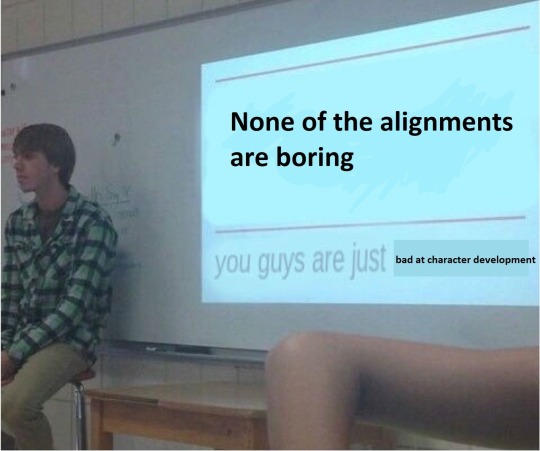
The fact that some people think you can’t play around with the character alignments shows how people limit their imagination too much to archetypes.
One example: making a Lawful Good character question whether it’s more important to be lawful or to be good.
Lawful Good is fun exactly for that reason. They can easily be at odds with themselves and have trouble deciding which is the right choice without breaking their own moral code.
(Plus “lawful” alignments don’t necessarily mean a character follows someone else’s laws. The “lawful” part could come from their own ethics that they follow and a Lawful-aligned character could easily commit murder if murder isn’t against their conscience. Hell you could have a lot of fun just deciding exactly what “laws” a Lawful character adheres to.)
In my opinion, the difference between a “fake fan” and a real one comes mostly down to how much *respect* they show the work in question, its other fans, and its creators. Fake fans will often nitpick a work’s flaws – no matter how minor – and demand very specific changes be made to it. Imagine, if you will, someone coming into your house and complaining about every aspect of the interior (or worse, mocking you for living in a house at all), then screaming obscenities and horrible accusations at you for daring to evict them. This is the Fake Fan, a cancerous tumor in a fandom who disguises itself as a “real” fan despite having no love for the work or its creators, nitpicking every minor thing, making up issues to complain about, and most annoyingly, demanding that changes be made to the work.
Naturally, this doesn’t mean a True Fan is supposed to ignore genuine problems with the work – for example, a game with tight controls having a sequel with floatier, less-responsive controls is a legitimate problem – but “true fans” will often critique objectively major problems, such as continuity errors or poor controls as stated above, and not minor or subjective issues such as representation – which is important, but not nearly as much as some make it out to be. Not all “real fans” are this wholesomely-minded, but as a general rule, fake fans will tend more towards “complaining” whilst real fans tend more towards “critiquing”; the difference being that one side genuinely wants to see the work improve for everyone, while the other wants to see the work improve only for themselves – or in some cases, doesn’t want the work to exist at all, seeing it as a blight on the world for merely existing – and the worst part of it all is: the fake fan will often call the real fan’s critiques the real complaining.
In short, the issue of real verses fake fan (in my humble opinion) comes down to how much respect they show the work, its fans, and its creators, or if they tend more towards complaining about the work’s minor flaws rather than its bigger, more subjective issues.
Also, fake fans tend to lean towards demanding that a certain thing be a certain way (I.e specifically how they want it) while ignoring if something similar already exists even within the same work.
For example, RWBY fans who constantly want Yang to be a lesbian and say that they “need” the representation while ignoring Ilia (who canonly had romantic feelings for Blake) and are viciously opposed to even acknowledging that or outright say that she doesn’t count because she’s a “psycho lesbian”.
Even though she’s not. At all.
You know what OP you addressed this topic far more accurately than i did so major props to you.
 ifesbob