today i looked up lost words and these are my favorites:
airgonaut n 1784 -1784 one who journeys through the air Balloonists, skydivers and other airgonauts are all a little mad, if you ask me.
alabandical adj 1656 -1775 barbarous; stupefied from drink His behaviour after the party was positively alabandical.
amarulence n 1731 -1755 bitterness; spite After losing her job to a less qualified man, she was full of amarulence.
amorevolous adj 1670 -1670 affectionate; loving Our father, though amorevolous, could be a strict taskmaster at times.
apanthropinization n 1880 -1880 withdrawal from human concerns or the human world His life as a hermit in the woods was characterized by apanthropinization.
aquabib n 1731 -1883 water-drinker I was never much of an aquabib, and always preferred harder libations.
artigrapher n 1753 -1753 writer or composer of a grammar; a grammarian Today’s prescriptivists are no better than the artigraphers of the Renaissance.
boscaresque adj 1734 -1734 picturesque; scenically wooded Despite northern England’s industrial pollution, parts of it remain boscaresque.
crocitation n 1623 -1656 croaking; cawing The crocitation of the gulls meant that I got no sleep last night.
dodrantal adj 1656 -1883 of nine inches in length The male stripper’s dodrantal instrument impressed the ladies greatly.
ephydriad n 1823 -1823 water-nymph The synchronized swimmers were like ephydriads, full of natural grace.
essomenic adj 1771 -1771 showing things as they will be in the future The essomenic properties of crystal balls are very much in dispute.
fabrefaction n 1652 -1678 act of fashioning or making a work of art The sculptor felt that fabrefaction was more important than the end result.
latibule n 1623 -1691 hiding place The girl emerged triumphantly from her latibule, only to find her friends had already left.
lignatile adj 1855 -1855 living or growing on wood She collected lignatile mushrooms on her hike, confident in her identifications.
magastromancy n 1652 -1652 magical astrology Her reliance on magastromancy to decide the students’ grades got her in trouble.
murklins adv 1568 -1674 in the dark She stumbled murklins about the house until she found the light switch.
nepheliad n 1818 -1821 cloud-nymph Like a nepheliad, the skydiver dove gracefully through the clouds.
nerterology n 1800 -1800 learning relating to the dead or the underworld Her inquiries into nerterology were inspired by a youthful visit to a medieval crypt.
quaeritate v 1657 -1657 to question; to inquire If I might quaeritate, why are we headed in the wrong direction on the trail?
scaevity n 1623 -1658 unluckiness; left-handedness She attributed her failure to evil forces, but her family felt it was a matter of scaevity.
scelidate adj 1877 -1877 having legs; legged The legless dragon of Eastern myth contrasts with its scelidate Western counterpart.
senticous adj 1657 -1657 prickly; thorny He pricked himself on a senticous bush as he searched about for his golf ball.
siagonology n 1895 -1895 study of jaw-bones Reliance on siagonology alone led to the proliferation of the Piltdown Man hoax.
sparsile adj 1891 -1891 of a star, not included in any constellation The prevalence of sparsile stars today reflects technical advances in telescopy.
stagma n 1681 -1820 any distilled liquor I will touch neither wine nor stagma, though I do occasionally partake of ale.
supellectile adj 1615 -1843 of the nature of furniture Our apartment is full of knick-knacks, but is lacking in supellectile necessities.
thural adj 1624 -1714 of or pertaining to incense The mysteries of the ancient order involved the burning of thural herbs.
vampirarchy n 1823 -1823 set of rulers comparable to vampires Some believe that we are secretly ruled by the Illuminati or a similar vampirarchy.
venialia n 1654 -1654 minor sins or offences Though he had done nothing heinous, all of his friends had been victims of his venialia.
English being your native language (in a place where English is basically the only language) is a double-edged sword or whatever because on the one hand you don’t actually have to work to learn one of the most useful/used languages on the planet but on the other hand it’s a lot less likely that you’ll learn a language in school or otherwise.
There’s a theory that early Europeans started saying “brown one” or “honey-eater” instead of “bear” to avoid summoning them, and similarly my friend has started calling Alexa “the faceless woman” because saying her true name awakens her from her slumber
English has an avoidance register used in the presence of certain respected animals, which sounds fancy until you realize it’s spelling out w-a-l-k and t-r-e-a-t in front of the dog.
‘ard’ is a real suffix in the english language just like ‘ly’ or ‘ify’, it just isnt common enough for us to notice its usage. ‘ard’ means ‘too much’ or ‘too easily’
so ‘mustard’ is something that is ‘too pungent’, just as ‘wizard’ is someone who is too wise, ‘coward’ is someone too easily cowed, and ‘drunkard’ is someone too often drunk
this implies that ‘bastard’ is someone who is too ‘bast’ and this needs experimentation and research
Are you fucking serious omg
This is pretty much correct. According to the OED bastard is from Old French and the bast- part means “pack saddle” which was used as a bed by mule drivers, giving the phrase fils de bast, a child conceived on the pack saddle instead of the marriage bed. In English it becomes bastard, the -ard being a pejorative. It is the same one as wizard and coward and drunkard.
if anyone ever tells you that english isn’t ridiculous remember that the reason why we have a silent b in debt is because a group of guys got together to standardise english spelling and got to the word debt, which at the time was primarily spelled either ‘dett’ or ‘det’. so they basically went:
‘everyone speaks latin, right? so let’s put a silent b in debt. like debitum, which is latin for debt. problem solved.’
also the reason why there is a h in ghost is because when the printing press first came to england the only people trained to operate it were flemmish speaking, and they put a h after g because that’s what you do in flemmish. they put shit like ghirl and ghoose, but the only reason why ghost stuck is because people saw ‘the holy ghost’ in the bible and were like ‘well, that MUST be right’.
so yeah english is a really stupid language with some of the most ridiculous spelling
Anyone telling you that English isn’t a bullshit Frankenstein language is lying.
We say “English doesn’t make any sense” because saying “English is unusual in that, when it borrows vocabulary from other languages, it tends to partially retain the morphology of the originating language group rather than adapting the word in question to English morphology, which is why we have twelve different ways to construct a plural” takes too long.
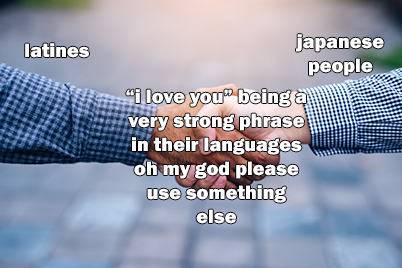
YEA. i had a relationship with someone and she dropped the “te amo” super quicky and i was like…………”thats ok, thank you, but im gonna be honest w you….i’m not saying te amo until i really feel it” thats how serious it is.
te amo IS very serious, very deep, very intimate. when you want to tell someone that you love them without it being massive, the term you want is te quiero
cant believe no one had contributed this
Accuarte AF.
“Te quiero” is the best alternative so we all do not succumb into a “te amo” anxiety.
Since we’re including other languages, any tips for Japanese learners?
Your friendly neighborhood bilingual here to help you out @just-fic-me-up
So idk if you can read hiragana so I’ll just use English letters. There are 4 ways to say you care about somebody in Japanese with increasing degrees of intimacy. Suki is like “I like sushi” type loose feeling. Also used for crushes or “I’d like to ask that person out.” Daisuki is literally “like a lot” and is used for “I love sushi” or “I really like this person” but tends to get translated as “I love you” which is pretty correct. Couples use it for each other
Next up is aishiteru and that’s. Hoo. Boy howdy. That’s te amo levels of intimate. You say that like before you propose, when you’re married, etc. It’s more like “I’m in love with you” and it’s very special. You won’t ever hear this used outside of very private moments between irl couples. I haven’t even seen it used in fiction honestly. And then there’s the big dog
The K word as my wife and I call it. He’s half Japanese and he has never said this to me despite us being literally married and we started dating my senior year of hs which was six and a half years ago. I’ve used this with him MAYBE thrice IF that often. I’ve never seen or heard it used literally ever is how special and intimate this phrase is. Not to totally and completely undersell this but it’s like a “once in a lifetime, the only person who could ever hold my heart” kind of intimate expression of love. It’s whispered on your deathbed to your lover of 65 years special. It’s koishiteru and you DO NOT use that word lightly if ever. It ties your soul directly to someone else’s with just a few sounds
But those are the tiers in Japanese. Go forth my friend and wield your newfound knowledge wisely
Im realizing how limited english is with only one word to cover all of that. No wonder its such an awkward language for translations!
“Let’s face it – English is a crazy language. There is no egg in eggplant nor ham in hamburger; neither apple nor pine in pineapple. English muffins weren’t invented in England or French fries in France. Sweetmeats are candies while sweetbreads, which aren’t sweet, are meat. We take English for granted. But if we explore its paradoxes, we find that quicksand can work slowly, boxing rings are square and a guinea pig is neither from Guinea nor is it a pig. And why is it that writers write but fingers don’t fing, grocers don’t groce and hammers don’t ham? If the plural of tooth is teeth, why isn’t the plural of booth beeth? One goose, 2 geese. So one moose, 2 meese? One index, 2 indices? Doesn’t it seem crazy that you can make amends but not one amend? If you have a bunch of odds and ends and get rid of all but one of them, what do you call it? If teachers taught, why didn’t preachers praught? If a vegetarian eats vegetables, what does a humanitarian eat? In what language do people recite at a play and play at a recital? Ship by truck and send cargo by ship? Have noses that run and feet that smell? How can a slim chance and a fat chance be the same, while a wise man and a wise guy are opposites? You have to marvel at the unique lunacy of a language in which your house can burn up as it burns down, in which you fill in a form by filling it out and in which an alarm goes off by going on. English was invented by people, not computers, and it reflects the creativity of the human race (which, of course, isn’t a race at all). That is why, when the stars are out, they are visible, but when the lights are out, they are invisible.”
But, no, because there are reasons for all of those seemingly weird English bits.
Like “eggplant” is called “eggplant” because the white-skinned variety (to which the name originally applied) looks very egg-like.
The “hamburger” is named after the city of Hamburg.
The name “pineapple” originally (in Middle English) applied to pine cones (ie. the fruit of pines – the word “apple” at the time often being used more generically than it is now), and because the tropical pineapple bears a strong resemblance to pine cones, the name transferred.
The “English” muffin was not invented in England, no, but it was invented by an Englishman, Samuel Bath Thomas, in New York in 1894. The name differentiates the “English-style” savoury muffin from “American” muffins which are commonly sweet.
“French fries” are not named for their country of origin (also the United States), but for their preparation. They are French-cut fried potatoes – ie. French fries.
“Sweetmeats” originally referred to candied fruits or nuts, and given that we still use the term “nutmeat” to describe the edible part of a nut and “flesh” to describe the edible part of a fruit, that makes sense.
“Sweetbread” has nothing whatsoever to do with bread, but comes from the Middle English “brede”, meaning “roasted meat”. “Sweet” refers not to being sugary, but to being rich in flavour.
Similarly, “quicksand” means not “fast sand”, but “living sand” (from the Old English “cwicu” – “alive”).
The term boxing “ring” is a holdover from the time when the “ring” would have been just that – a circle marked on the ground. The first square boxing ring did not appear until 1838. In the rules of the sport itself, there is also a ring – real or imagined – drawn within the now square arena in which the boxers meet at the beginning of each round.
The etymology of “guinea pig” is disputed, but one suggestion has been that the sounds the animals makes are similar to the grunting of a pig. Also, as with the “apple” that caused confusion in “pineapple”, “Guinea” used to be the catch-all name for any unspecified far away place. Another suggestion is that the animal was named after the sailors – the “Guinea-men” – who first brought it to England from its native South America.
As for the discrepancies between verb and noun forms, between plurals, and conjugations, these are always the result of differing word derivation.
Writers write because the meaning of the word “writer” is “one who writes”, but fingers never fing because “finger” is not a noun derived from a verb. Hammers don’t ham because the noun “hammer”, derived from the Old Norse “hamarr”, meaning “stone” and/or “tool with a stone head”, is how we derive the verb “to hammer” – ie. to use such a tool. But grocers, in a certain sense, DO “groce”, given that the word “grocer” means “one who buys and sells in gross” (from the Latin “grossarius”, meaning “wholesaler”).
“Tooth” and “teeth” is the legacy of the Old English “toð” and “teð”, whereas “booth” comes from the Old Danish “boþ”. “Goose” and “geese”, from the Old English “gōs” and “gēs”, follow the same pattern, but “moose” is an Algonquian word (Abenaki: “moz”, Ojibwe: “mooz”, Delaware: “mo:s”). “Index” is a Latin loanword, and forms its plural quite predictably by the Latin model (ex: matrix -> matrices, vertex -> vertices, helix -> helices).
One can “make amends” – which is to say, to amend what needs amending – and, case by case, can “amend” or “make an amendment”. No conflict there.
“Odds and ends” is not word, but a phrase. It is, necessarily, by its very meaning, plural, given that it refers to a collection of miscellany. A single object can’t be described in the same terms as a group.
“Teach” and “taught” go back to Old English “tæcan” and “tæhte”, but “preach” comes from Latin “predician” (“præ” + “dicare” – “to proclaim”).
“Vegetarian” comes of “vegetable” and “agrarian” – put into common use in 1847 by the Vegetarian Society in Britain.
“Humanitarian”, on the other hand, is a portmanteau of “humanity” and “Unitarian”, coined in 1794 to described a Christian philosophical position – “One who affirms the humanity of Christ but denies his pre-existence and divinity”. It didn’t take on its current meaning of “ethical benevolence” until 1838. The meaning of “philanthropist” or “one who advocates or practices human action to solve social problems” didn’t come into use until 1842.
We recite a play because the word comes from the Latin “recitare” – “to read aloud, to repeat from memory”. “Recital” is “the act of reciting”. Even this usage makes sense if you consider that the Latin “cite” comes from the Greek “cieo” – “to move, to stir, to rouse , to excite, to call upon, to summon”. Music “rouses” an emotional response. One plays at a recital for an audience one has “called upon” to listen.
The verb “to ship” is obviously a holdover from when the primary means of moving goods was by ship, but “cargo” comes from the Spanish “cargar”, meaning “to load, to burden, to impose taxes”, via the Latin “carricare” – “to load on a cart”.
“Run” (moving fast) and “run” (flowing) are homonyms with different roots in Old English: “ærnan” – “to ride, to reach, to run to, to gain by running”, and “rinnan” – “to flow, to run together”. Noses flow in the second sense, while feet run in the first. Simillarly, “to smell” has both the meaning “to emit” or “to perceive” odor. Feet, naturally, may do the former, but not the latter.
“Fat chance” is an intentionally sarcastic expression of the sentiment “slim chance” in the same way that “Yeah, right” expresses doubt – by saying the opposite.
“Wise guy” vs. “wise man” is a result of two different uses of the word “wise”. Originally, from Old English “wis”, it meant “to know, to see”. It is closely related to Old English “wit” – “knowledge, understanding, intelligence, mind”. From German, we get “Witz”, meaning “joke, witticism”. So, a wise man knows, sees, and understands. A wise guy cracks jokes.
The seemingly contradictory “burn up” and “burn down” aren’t really contradictory at all, but relative. A thing which burns up is consumed by fire. A house burns down because, as it burns, it collapses.
“Fill in” and “fill out” are phrasal verbs with a difference of meaning so slight as to be largely interchangeable, but there is a difference of meaning. To use the example in the post, you fill OUT a form by filling it IN, not the other way around. That is because “fill in” means “to supply what is missing” – in the example, that would be information, but by the same token, one can “fill in” an outline to make a solid shape, and one can “fill in” for a missing person by taking his/her place. “Fill out”, on the other hand, means “to complete by supplying what is missing”, so that form we mentioned will not be filled OUT into we fill IN all the missing information.
An alarm may “go off” and it may be turned on (ie. armed), but it does not “go on”. That is because the verb “to go off” means “to become active suddenly, to trigger” (which is why bombs and guns also go off, but do not go on).



 ifesbob