It’s basically a big bug that you can scoop up out of the water on the coastline if you live on the coast and you’re so hungry you want to eat a big bug. Then some genius realized that since only people combing through the muck saw these things, rich folks (especially inland rich folks) would have no idea what it is, so you could play it off as some exotic delicacy and they’d pay through the nose.
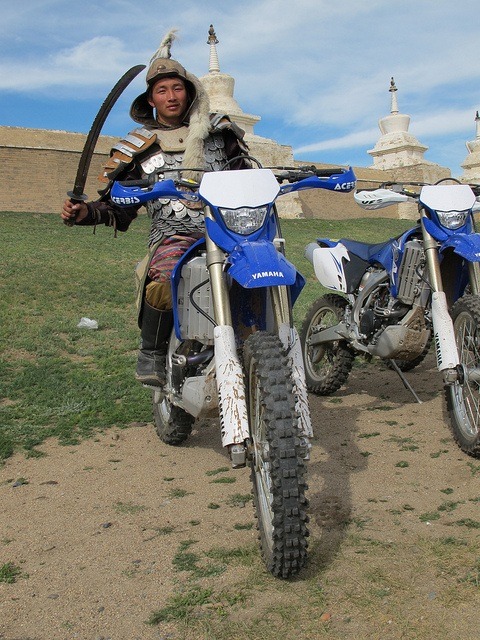
Mongolians are cool because they’ve merged their traditional and modern ways of life so rather than having poverty due to losing all their important skills they just live in their yurts with their cows and 827474874mbs internet
sure their GDP in dollars is low but when you can survive like your anscestors did it doesn’t mean anything, nothing wrong with adding a motorcycle and wifi into the mix
Everyone should live like their ancestors did 1000 years ago but with the addition of wifi tbh
Adapt. Survive.
this is the single most inspiring piece of information I have yet to come across in all my moments in this world
hey I don’t think I’ve ever talked here about corn wolves. here let me find a gas station real quick
okay so I’m in the middle of nowhere stopped for gas in a small town in Iowa rn and my Internet is REALLY spotty so I hope this posts but
as people who have followed this blog for longer might know, sometimes I go hang out with this corn genetics lab at school, as in we meet up on friday nights to talk about corn science and stuff. once the corn genetics subject of the week is covered sometimes we go off track and start talking about other stuff. as u may imagine from a corn genetics lab, most of the members grew up on farms here in the midwest, and one night we were talking and a couple of the people started discussing an urban legend that they were taught as kids to keep them from running into their family’s cornfields and getting lost. one of those people was from Nebraska, and the other from rural minnisoda- these were isolated incidents of this urban legend happening, and all of us were deeply engrossed in this. i cannot make this shit up, this is the story:
there are wolves that live inside the corn when it’s full grown. they’re huge, and are camouflaged to hide in the fields. their breathing sounds like the misting of the irrigation systems set up over the corn in these areas for water. if they see small children in the fields, they kill and eat them.
now I’ve lived my whole life in suburban Iowa, and I can vouch that we don’t have irrigation systems like that here; our group came to the conclusion that this must be the reason that from our 7 or 8 person sample size, the corn wolves did not exist in Iowa, the largest producer of corn. I’ve never seen the corn wolves mentioned anywhere else outside that one night with the genetics lab, and it really fascinates me because as a horror/creepypasta person myself, I think it’s a great example of those strange little urban legends that never get written down on paper. the fact that it’s never appeared anywhere else in my life kind of confounds me, because it’s a really cool story. i like to go driving around rural Iowa when I’m home from college, and i always end up thinking about the corn wolves.
neither of the people believed it as kids btw lol
This is a FANTASTIC piece of Americana and cryptic lore. I propose making them a thing immediately.
Fun geography time.
This isn’t an unprecedented or unusual piece of folklore, and I think
there’s a notable demographic reason that this lore shows-up in the
long-grass prairies of the northern Corn Belt of the U.S. This appears
to be a classic telling of “Roggenwolf” folklore, a variation on the
“feldgeister” concept.
Roggenwolf – or sometimes, Kornwolf – specifically refers to the German folk belief in a phantom wolf spirit which hides in tall corn fields and stalks children. Roggenwolf is one of the more popular and widely-known of the feldgeister spirits.
In German folk culture, Feldgeisters, as is probably obvious from the name, are malevolent spirits which dwell in crops and rural agricultural fields. Feldgeisters
are almost always specifically associated with children; that is, they
are said to target children for torment and death. They are not really
associated with naturally-occurring grasslands or woodlands, but instead
are distinctly related to domesticated crops. Sometimes, some rural
residents will make small ritualistic offerings during harvest season as
a gesture to appease the spirit. The spirit is said to be most active
when crops are at their tallest.
Other variations of the crop-dwelling feldgeister include an evil pig (Roggensau); a dog that tickles children to death (Kiddelhunde); a witch-like corn-woman who kidnaps children (Roggenmuhme); and a chicken that pecks-out children’s eyes (Getreidehahn).
I
would say that there are two (2!) very good reasons why feldgeister lore shows-up in some micro-regions of the Midwest, while being absent
in others. Specifically, both the ethnic heritage and the ecology of a
certain part of the Plains/Midwest create good conditions for
replicating this European lore in North America
People familiar with the cultural
geography of the American Midwest are probably well-aware of the strong
ethnic Norwegian presence among rural agricultural cultures in the
glaciated plains of the Red River Valley of western Minnesota, the
northern half of North Dakota, and northeastern Montana. Ecologically,
this landscape is glaciated prairies with pothole lakes, and often hosts
much more barley than corn. Meanwhile, the Heartland region of rural
Illinois and Indiana, though hosting quite a bit of heavy corn industry,
isn’t too much more ethnically German than other parts of America, and
much of the landscape is a mixture of Rust Belt industrial areas
in-between the cornfields (so it’s not exactly desolate and creepy).
However,
there is very strong ethnic German presence in the long-grass prairies
southern Minnesota, South Dakota, south-central North Dakota, parts of
western Wisconsin, and central Nebraska and Kansas away from the urban
areas of Omaha and Kansas City. In most of this land, over 50% of the
population has German ancestry. Aside from this cultural composition,
this region also lends itself better to creepy, eerie stories because it
is more empty and ecologically homogenous than the rest of the Great
Lakes and Heartlands; this is the region where crops run uninterrupted
for miles and rural dirt-roads run in empty grid networks in every
direction. Though the feldgeister concept has a closer association with
cornfields in Europe, the long-grass prairies (roughly centered neared
Sioux Falls) host 1) heavy German influence, and 2) the most expansive
crops in the country. Therefore, the region is probably ripe for a
replication of spooky German lore about haunted cornfields.
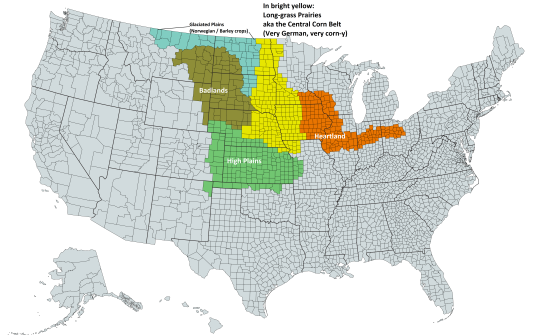
Source: Me Map 1 – Cultural Micro-Regions of the Heartland and Great Plains:
I think that this map might help to visualize where both cornfields and
rural lifestyle predominate, opening the door to rural folklore. The two
regions here where corn agriculture is predominant are the orange and
yellow regions. The orange region, the classic “Heartland”, hosts
Indiana Hoosier culture and the cornfields of Illinois and Ohio.
However, the region is marked by smaller farms and a higher population
density, and is not that rural compared to the plains further west; much
of this region also hosts larger cities and a lot of Rust Belt
industrial zones and dairy farms. The yellow region, however, is both
covered in corn and quite rural, where crops can span from horizon to
horizon. That’s where we would look for German folk culture.
Source: An anonymous hero cartographer who’s had their work stolen by Pinterest users Map 2 – German Ancestry in the U.S.
This might help to visualize the places where predominant corn agriculture overlaps with German ancestry. Note that in much of central Wisconsin and central North Dakota, over 50% of people have German ancestry. But this land isn’t really dominated by corn. However, the region roughly from Fargo (on the Minnesota-North Dakota border) to Kansas City is both heavily German and dominated by corn. —
Anyway, feldgeister lore is scary. I’d love to hear more American versions, since a lot of the scholarship on these spooky corn-wolves is based on folk culture in Germany itself, rather than the diaspora in the U.S.
Saw this post about feldgeister’s going around again, so thought I’d make a low-effort re-post for anyone interested in “Midwestern gothic” or how local ecology influences regional folklore.
this an awesome hot take thank you!!
and just in time for halloween and the corn harvest, too 👀
I fell down a rabbit hole of research about inventions circa the 40s and was surprised by a bunch of things that have been around way longer than I thought and some that are strangely reccent, and compiled them into a list. Aka, a resource for fic writers.
Bananas (or rather, the ones we have today. The ones he’d be accustomed to, the Gros Michel, a sweeter, creamier species, went extinct in the 50s and was replaced with the bland Cavendish banana.)
High-fives (the low-five was actually invented first, around WW2, and he may have been familiar with that)
Buffalo Wings (invented in the 60s)
CPR (not really used until the late 40s, not widely known until the 50s)
Tiramisu (invented in the 80s)
Big Macs & McNuggets (while McDonald’s was founded in 1940, the former wasn’t introduced until the 60s, and the latter, the 80s)
Seat belts (the first car to have one was in the late 40s, and only became mandatory to wear them in the 80s. holy shit.)
Walmart (invented in 1962. Or really, the large-scale supermarkets as we know them today really)
Yellow tennis balls (prior to the 70s they were usually black or white)
Panadol (first sold in the US in the 50s)
The smiley face aka 🙂 (popularised in the 60s)
Now alternatively, here’s a list of things Steve WOULD (or possibly would) be familiar with:
I’m not sure why some of these surprised me.
Modern Sunglasses (have been around a lot longer than I thought, and were mass produced in the 20s)
Nokia (was first founded in 1865. I’m not kidding. They began as a pulp mill and moved into making rubber respirators for military from the 30s onwards)
Nintendo (been around since 1889 as a toy company, during the 40s they made playing cards. Wouldn’t be implausible that he knew about Nintendo, perhaps from Morita)
Krispy Kreme (opened in 1937, didn’t spread widely until the 50s however)
Kool-Aid (introduced in the 30s)
Oreos (introduced in 1912)
Printed/graphic tees (didn’t become a trend until the 60s-70s, but they certainly existed in the 40s)
Hoodies (originated in the 30s, worn by workers in cold New York warehouses. Meaning, it’s entirely plausible Bucky could’ve been wearing hoodies in the 40s)
Malls (they weren’t called that back then, but they certainly had shopping centres or plazas since the 1800s)
Converse sneakers (invented in 1908 and have barely changed since!)
I didn’t expect anyone to really reblog this wow! Here’s a couple more things to add to the list:
Would not have known about:
Velcro (patented in 1951)
Modern Sunscreen (in 1944 they had ‘Red Vet Pet’, used by soldiers it was described as a “disagreeable red, sticky substance similar to petroleum jelly”)
Bubble Wrap (1957)
Slinkies (Not sold until 1947)
Microwave oven (invented just a year after he went under)
Frisbees (invented in 1948)
Acrylic paint (not sold commercially until the 50s)
Roller blades (1979)
Would have likely known about:
Reeses’s Peanut Butter Cups (introduced in 1928)
Mountain Dew (introduced in 1940)
Twinkies (1930)
M&M’s (1941)
Lay’s Potato Chips (1932)
Tootsie Pops (1931)
Levi’s Jeans (been around since the 1850s!)
Duct Tape (been around since the early 1900′s, at this time it was called duck tape)
3-D movies (the first 3-D movie with the red/blue glasses was in 1922!)
Monopoly (1935)
Nescafe coffee (1938)
Coming back to this because I found out a few more!
More things he would likely not be familiar with:
Butter chicken (1950s)
Wireless TV remote (invented 1955)
Superglue (not sold until 1958)
Saran wrap (1949. ok and cool fact, the name Saran comes from the combined names of the creators cat and dog, Sarah and Ann!)
Colour TV (invented in his time, but not broadcasted until the 50s)
Things he would possibly/likely be familiar with:
Electric guitars (invented 1931)
Electric washing machines (as early as 1904. They look nothing like they do now though and I doubt he owned one.)
Laundromats (since the 30s or earlier)
Electric razors (produced in 1937)
Air conditioner (invented in 1902)
Pop up toaster (1919)
Robots (in 1928 the humanoid robot Eric was created. Funnily enough during Steve’s time the word ‘robot’ was pronounced as ‘row-boat’)





 ifesbob